Cars
Comparing Two Garage Quotes? The Parts Supplier Neither Shop Mentioned Is Setting the Gap
Most of a repair estimate is assembled from numbers the shop did not invent, and knowing who set them changes what you should ask and when you have leverage.
Rafael Quintanilla|
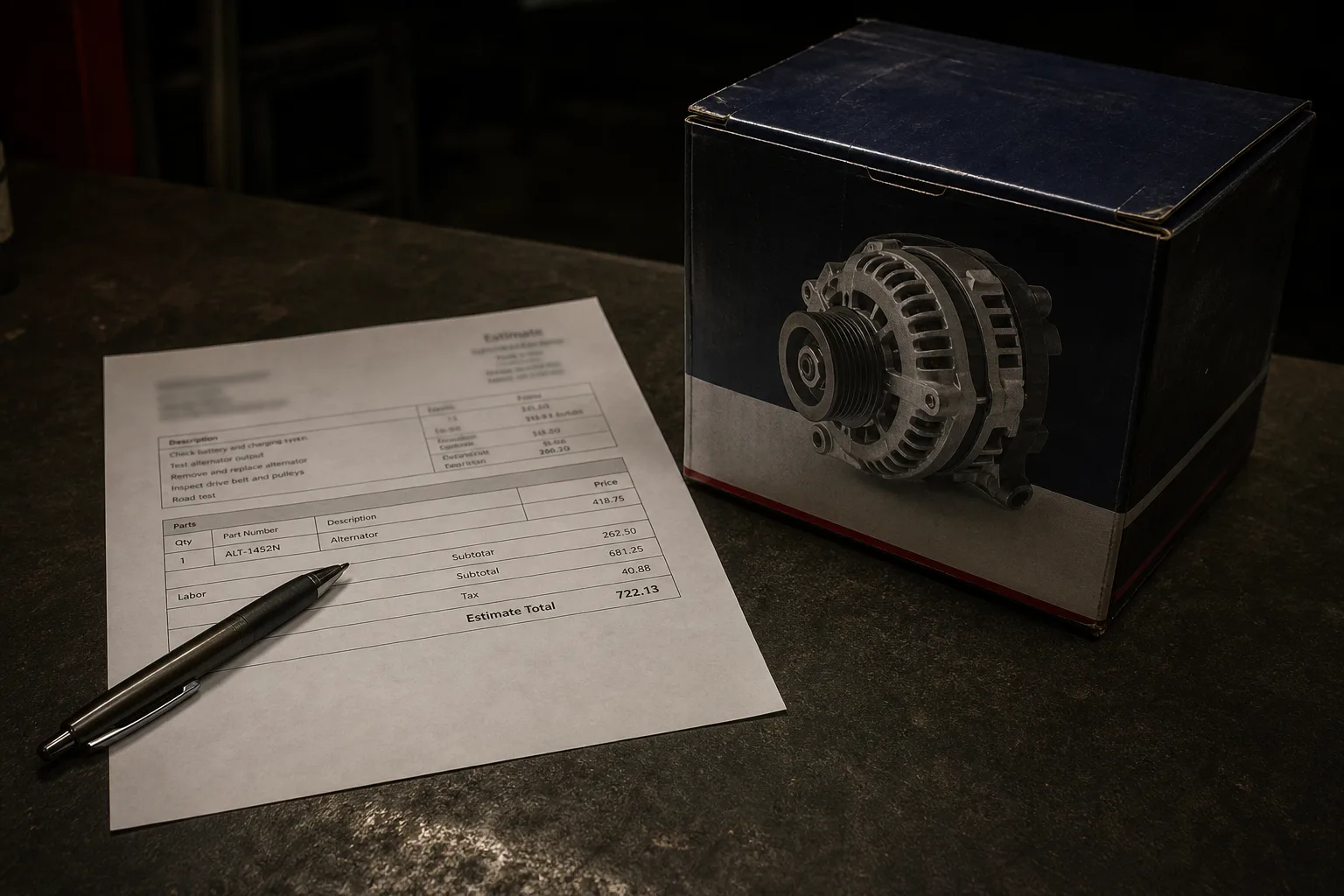
Two estimates for the same water pump arrive two hundred dollars apart, and the usual conclusion is that one shop is honest and the other is not. That reading survives about ten minutes of scrutiny. A repair estimate is not a single judgment made by a service writer at a counter; it is an assembly of at least three numbers, drawn from three different sources, only one of which the shop fully controls. Once you can see the seams, the gap between two quotes stops being a character test and starts being a question with an answer.
What the number is actually made of
Open any printed estimate and you will find labor stated in hours rather than in dollars of effort. Those hours usually come from a published labor time guide, a commercial reference the shop subscribes to, which assigns a book time to a given operation on a given vehicle. The shop multiplies that figure by its posted hourly rate. Parts sit on a separate line, priced from whatever the shop paid plus a markup, and shop supplies, hazardous waste disposal and diagnostic time occupy a third category that varies more between businesses than either of the first two.
The consequence matters. If both shops are quoting the same book time on the same job, their labor lines will land close together, and a wide spread almost always traces to parts, to a difference in what each shop assumed was failing, or to one estimate including a step the other left for later. Asking a shop to justify a two hundred dollar gap invites a defensive answer. Asking which line the gap sits on invites a factual one, and the factual one is usually available in under a minute at the counter.
The party nobody in the conversation represents
Standing behind both shops, invisible on both estimates, is the parts distributor. Independent garages buy through warehouse distributors and local jobbers who price by account tier, and those tiers reflect monthly volume, payment history and how long the relationship has run. A shop turning high volume on a given line buys that alternator meaningfully cheaper than a two-bay operation buying it once a quarter, and that difference arrives on your estimate without ever being named. The distributor is the party with real influence over your bill who has no seat at your conversation.
There is a second layer. Most distributors offer several grades for the same part: an original equipment unit, a premium aftermarket equivalent, an economy line, and sometimes a remanufactured option with its own core charge. Each carries a different warranty, and the warranty is often administered by the parts maker rather than the shop, which means the person honoring it in two years may not be the person selling it to you today. When a quote says only brake caliper, it has told you almost nothing about which of those four things you are buying.
So the question that opens the estimate is not what a shop charges but which grade it quoted and what the warranty term and administrator are. A shop that has priced an economy unit will say so plainly, and will often price the better part on request within the same phone call. A shop that quoted original equipment will tell you that too, and the two hundred dollar spread resolves into a decision you can actually make, rather than a suspicion you cannot test.
The sequence that gets you a comparable answer
Start by getting both estimates onto the same operation. Ask each shop to state the labor hours separately from the rate, and to name the specific repair rather than the symptom, because one shop replacing an assembly and another replacing a component inside it are not competing on price at all. Then ask for the part grade and the warranty term in months and miles. Then ask what the estimate assumes will not be needed, which is where a timing component, a gasket set or a flush quietly turns a firm number into a provisional one.
Authorization is the last piece and the one most often skipped. Many states require a written estimate above a dollar threshold and your approval before the total rises past a set percentage, and the Federal Trade Commission is responsible for unfair and deceptive practices in how repair work is advertised and billed. Put a dollar ceiling in writing, ask to be called before anything crosses it, and ask that replaced parts be set aside for you. None of that is adversarial. It is the same paperwork discipline a fleet manager applies by default.
Where the answer changes with the number of vehicles
For one car, the leverage is almost entirely on the parts side and on authorization, because a single owner has no standing to negotiate an hourly rate and no credible reason to ask. The honest move is to choose the grade, get the warranty in writing, and compare like against like. At that scale, the shop's posted rate is a fixed feature of the market you are shopping within, and the time you spend trying to move it is better spent confirming that both estimates describe the same job.
The arithmetic turns somewhere between five and ten vehicles. That is roughly where a business generates enough predictable monthly labor hours that a shop will quote a commercial rate, open a net-thirty account, and treat scheduling as a relationship rather than a transaction. Below that threshold you are a retail customer with good habits. Above it you can ask for a fleet rate, specify a standing parts grade across all your vehicles, and require that any job over a stated figure come back for written approval before the technician starts.
By twenty vehicles the overlooked party becomes visible and negotiable. At that volume it is worth asking your shop which distributor it buys through and whether a standing order on filters, pads, belts and batteries would improve the tier, because the saving flows back to you as a lower parts line. Some operators go further and supply their own parts, which solves the markup and creates a warranty question the shop will want settled in advance. Both arrangements work. The useful part is that at scale, you finally get to choose between them.
A quote read this way stops being a verdict on a shop and becomes a document with identifiable authors: a time guide for the hours, a distributor for the parts, and the business in front of you for the rate and the judgment. Each of those three can be asked about separately, and each gives a different kind of answer. The owner of one car gets a better part and a firm ceiling. The owner of twenty gets a tier, a rate and a supply chain worth managing.