Family
Granite Is Priced by the Cubic Foot. Here Is What the Rest of the Bill Buys
A monument quote is four or five separate purchases stacked into one number, and only some of them are required by anyone other than the seller.
Lucinda Fairbairn|
A monument quote arrives as a single number, and families read it the way they read a car price: one object, one cost, take it or leave it. It is not one object. It is a piece of quarried stone, a set of cuts and polishes, a quantity of lettering, a concrete foundation poured by somebody with cemetery authorization, a permit, and a delivery. Those six things are priced by different people under different rules, and at least two of them are negotiable in ways the paperwork does not advertise. Knowing which is which changes what you spend, and more usefully, changes what you owe later.
The stone, the cutting and the lettering are three separate prices
Raw granite is sold by volume and by color, and the color is the part that moves the number most. The common grays quarried in large volume sit at the bottom of the range, while reds, blacks and the deep blues sit well above them, not because they wear better but because less of the material exists and it travels farther to reach the shop. A larger stone in a common color frequently costs less than a modest stone in a scarce one. Then comes fabrication: how many faces are polished, whether the edges are rock-pitched or sawn, whether the shape is a plain rectangle or a contour that has to be cut on a profiling machine. Lettering is the third price, usually charged by character or by panel, and it is where a short inscription and a long one genuinely diverge.
What shifted over the last several years is the cutting itself. Sandblasting through a rubber stencil is still the standard for names and dates, but laser etching on polished black granite has moved from a specialty into routine work at most fabricators, which brought portrait and scene work down from a commissioned extra to a line item. That is good for families who want it and irrelevant for families who do not, and the distinction matters because an etched panel is priced separately from the inscription and is one of the easiest things to decline without the stone looking unfinished.
The cemetery's charges are not the dealer's charges
Most of the surprise in a monument bill comes from the part the monument dealer does not keep. Cemeteries charge a foundation fee, often by the linear inch or square foot of base, to pour the concrete the stone sits on, because they will not let an outside crew dig in their ground. Many add a separate setting or installation fee, and a permit or inspection fee on top of that. Some charge for the privilege of allowing a monument purchased elsewhere, which is a practice worth asking about in writing before you sign anything with anyone. None of these are optional if you are burying in that cemetery, and all of them are published, which means you can get the numbers before you shop for stone rather than after.
Perpetual care is the item families most often misunderstand. The fund maintained by the cemetery typically covers mowing, roads, fences and general grounds, and in most places it does not cover your individual monument. The stone is personal property sitting on cemetery land, and keeping it upright, legible and clean is the family's job indefinitely. Dealers who specialize in cemetery headstones will usually say this plainly if asked, and the better ones put the maintenance expectation in the purchase agreement rather than leaving it to be discovered by a grandchild twenty years out.
Which line items are genuinely optional
Granite vases, whether set into the base or sold as a companion piece, are optional and are also the single most common source of later damage, because they catch mower strikes and freeze water in winter. Ceramic photo medallions are optional, as are second-side inscriptions, decorative borders, scrolls, and the small flush markers some families add at the foot of a grave. Rush fabrication is optional, and it is priced like it: ordering in a season when the shop is not busy, and accepting a delivery window measured in months rather than weeks, reliably costs less than the same stone wanted by an anniversary date.
The newer optional items are digital. QR plaques and scannable memorial tags now show up in catalogs, linking to a hosted page of photographs and obituary text. They are cheap to add and they carry a subscription or a hosting dependency, which is a maintenance obligation rather than a purchase, and should be evaluated as one. A granite inscription will outlive everyone reading this. A hosted page will last exactly as long as someone keeps paying for it and the company keeps operating, so the sensible approach is to treat the digital layer as a nice extra and put anything that must survive into the stone.
What changed in how you are supposed to care for it
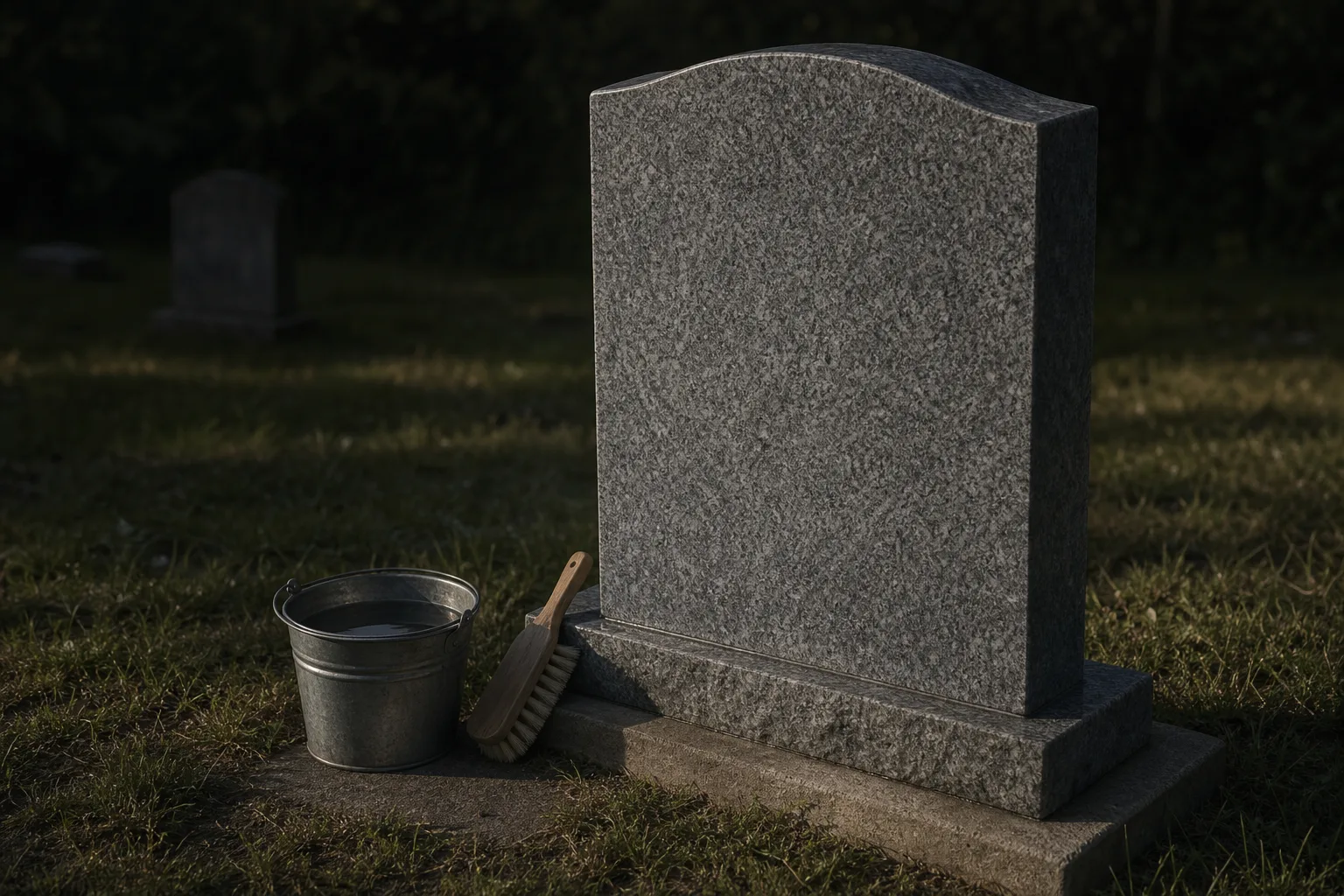
Cleaning advice has genuinely reversed within living memory, and that reversal is now written into cemetery rules in many places. Household bleach, wire brushes and pressure washers were once routine and are now prohibited on a great many grounds, because bleach leaves salts that keep working inside the stone, metal brushes score the polish, and pressure strips the finish off marble and older limestone outright. The current standard practice is water, a soft natural-bristle brush, and a non-ionic biological cleaner formulated for stone, applied patiently and rinsed thoroughly. On polished granite, a wash once or twice a year handles almost everything. On marble and sandstone, the work is slower, and the staining returns over months rather than disappearing on the day.
The structural upkeep matters more than the cosmetic kind. Foundations settle, frost heaves them, and a monument that leans two degrees this year leans four in a decade until a tall die separates from its base and goes over. Resetting is far cheaper than replacing, and a cemetery office will usually give you a list of monument companies that do it. A reasonable rhythm is a visual check each spring: look at whether the stone is plumb, whether the joint between die and base is still tight, whether the ground has sunk on one side, and whether tree roots have arrived. Caught early, the fix is a crew for part of a morning.
Price information is more available than it used to be
The Federal Trade Commission is responsible for the rule requiring funeral providers to disclose prices item by item and to let families buy only what they want, and the habit of itemized disclosure has spread outward from funeral homes into how monument work is quoted and how cemeteries publish their fee schedules. That makes a comparison possible that was awkward a generation ago. Ask the cemetery for its full charge list and its monument regulations, then ask two dealers to quote the same stone in the same color with the same character count, and the gap between the quotes stops being mysterious.
The stone is the part of a funeral that is still answering to someone thirty years later, which is a different kind of purchase from a casket or a hearse. Spend where the spending lasts: good foundation work, a color you can get matched again, lettering deep enough to read after weathering, and a quiet understanding of who in the family will be doing the spring walk.