Health
Told to Keep Everything for Seven Years? The Clocks That Actually Decide
The seven year rule is a tax rule and nothing more. Here is what starts each retention clock, and which papers never expire while you still own the thing.
Lucinda Fairbairn|
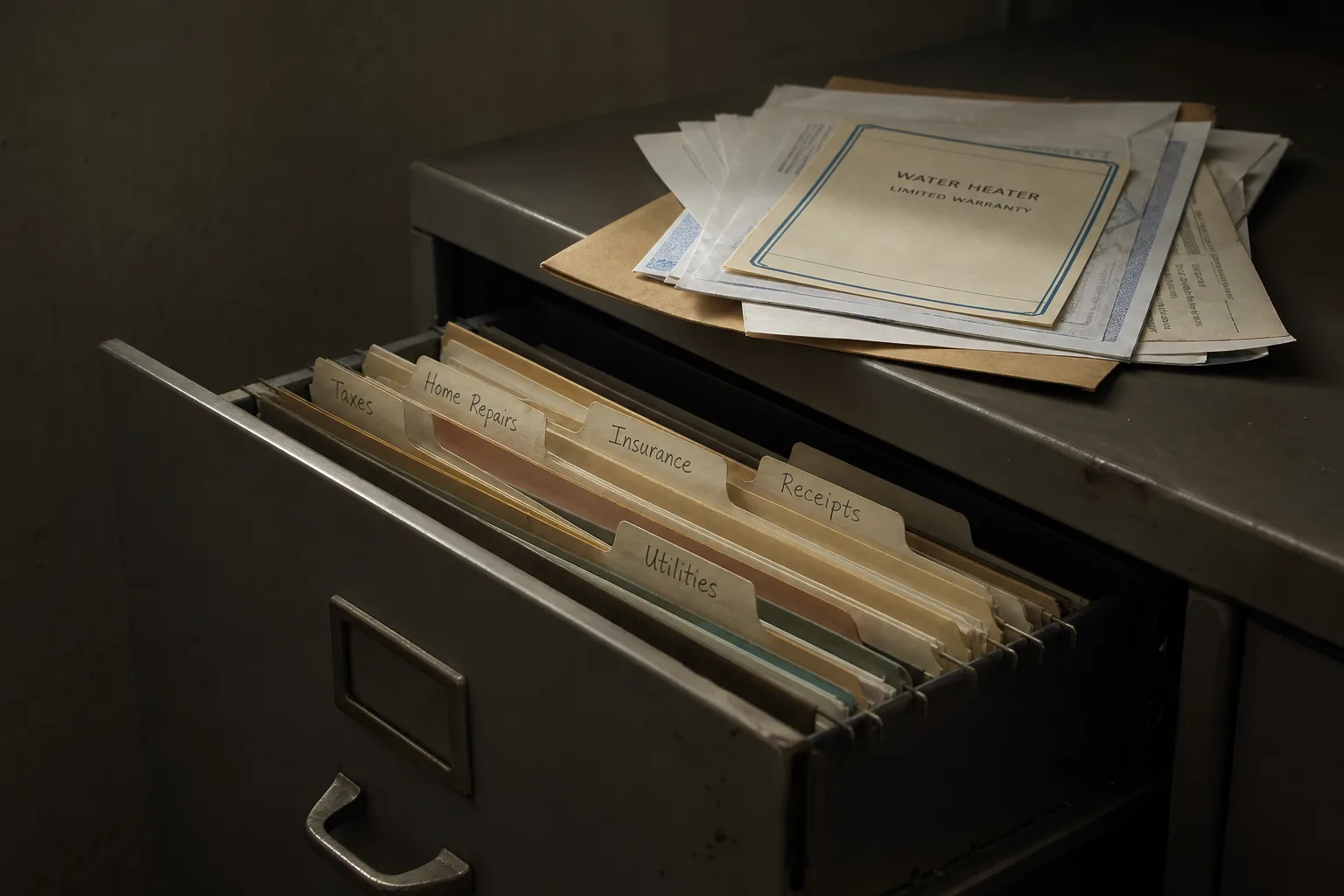
Almost everyone starting a household filing system has been handed the same number: keep it seven years, then shred. It is repeated by relatives, by coworkers, by the person who sold you the filing cabinet, and it is not wrong so much as it is answering one narrow question that was never the question you had. Seven years is a tax answer. It says nothing about the roof warranty, the closing packet, the pay stub that proves your contribution history, or the photograph of a kitchen taken the week before a pipe let go. Those records run on entirely different clocks, and a few of them never stop.
The practical cost of believing the folklore shows up years later, when someone asks for a document you destroyed on schedule. By then the only remedy is paying a third party to reconstruct it, assuming the third party still exists.
What the seven years actually refers to
The Internal Revenue Service administers federal tax record keeping, and its retention guidance is built around how long a return can still be examined or amended. That window is not fixed at a single span. It stretches or contracts depending on what the return did: a straightforward return with income fully reported sits under a shorter period than one claiming a loss from worthless securities or bad debt, which is where the longer figure most people repeat comes from. A return never filed at all has no closing window whatsoever. So the honest version of the rule is that different lines on the same return age at different rates, and the folklore has collapsed all of it into one number that happens to be the long end of the range.
What follows from this is a sorting instruction rather than a calendar instruction. Keep the return itself, which is a thin document, indefinitely, because it is the index to everything else and takes almost no room. Keep the supporting paper, the W-2s and 1099s and receipts and mileage logs, for the period that applies to the most aggressive position on that particular return. Someone filing a simple return with one employer and the standard deduction has a far lighter obligation than a first year freelancer deducting a home office, and treating both the same way means one person is drowning and the other is exposed.
The clock starts at an event, not on January first
This is the part first timers most often get backwards. Retention periods do not run from the tax year, and they do not run from the date you filed if you filed late. They run from a triggering event, and identifying the event is the whole skill. For a tax return, the clock generally starts at the filing deadline or the date you actually filed, whichever is later. For a property, it starts when you sell, not when you buy, which is why improvement receipts collected across twenty years of ownership all stay live until the year after the sale is reported. For a loan, it starts at payoff and the release of lien, not at the last payment.
Get in the habit of writing the trigger on the folder rather than a date. A folder marked "improvements, keep until three years after we sell" survives a move, a software change, and your own forgetting, in a way that a folder marked 2019 does not. It also stops the annual purge from eating something that looks old and is not. Most of the records people regret destroying were destroyed because they looked stale, not because anyone checked what the clock was tied to.
The documents with no expiry while you still own the thing
A separate category runs on ownership rather than time, and it is the category a first time filer rarely sets up because nobody mentions it. The deed, the title insurance policy, the survey, the recorded easements, the closing disclosure, and the certificate of occupancy stay useful for as long as the house is yours and are frequently wanted by the buyer's attorney at the far end. Vehicle titles behave the same way. So do permits and inspection sign-offs, which are the only proof that a finished basement or a replaced panel was done legally, and which a future appraiser or insurer will ask about in exactly the moment you cannot produce them.
Warranties and manufacturer documentation belong here too, filed by the asset rather than by the year. A water heater installed in 2021 with a six year tank warranty is a 2027 problem, and the invoice proving the installation date is what converts a warranty into a replacement. Keep the proof of payment with the warranty, not in the tax drawer, because the two will be needed together and never separately. Photographs of each room, taken once a year and dated, sit in the same group: they cost an hour and they are the single most useful thing a household can hand an insurance adjuster.
Sorting a first pile in one afternoon
Start with four physical piles and resist adding a fifth. The first is permanent identity and ownership: Social Security cards, birth and marriage certificates, deeds, titles, estate documents. The second is active obligations: the current mortgage or lease, insurance policies in force, loans not yet paid off, anything with a live account number. The third is tax support, divided by year with the return stapled on top. The fourth is everything tied to an asset you still own, filed by asset. Anything that fits none of these four is almost certainly disposable, and the test is simple: name the person who could plausibly ask you for it, and if no one comes to mind, it goes.
Then decide the storage question once rather than per document. Scanning is fine for tax support and asset records, and a dated scan with a legible signature is accepted far more widely than people assume, but originals matter for anything with a raised seal, a notarization, or a recording stamp. Those belong in a fireproof box at home or a safe deposit box, with a plain typed index of what is in it kept somewhere else entirely. The index is what makes the system survive you, and it is the piece first timers skip.
What the habit buys back
The reward for building this correctly is not tidiness. It is that the three or four moments in a decade when a document decides real money, a claim, a sale, an audit letter, a dispute with a contractor, all resolve in an afternoon instead of a month of calls to institutions that have purged their own copies. Set it up once with the triggers written on the folders, add to it as paper arrives, and purge annually against the trigger rather than the date. A first attempt done roughly in this shape outperforms an elaborate one built on the seven year rule, because it is sorting by the question each paper will eventually have to answer.