Money
One Ring or a Tray of Twenty Two, and the Questions That Change With the Count
A repeat buyer works a single ring and an estate tray on the same afternoon, and the diligence that protects one purchase turns out to be the wrong tool for twenty.
Rafael Quintanilla|
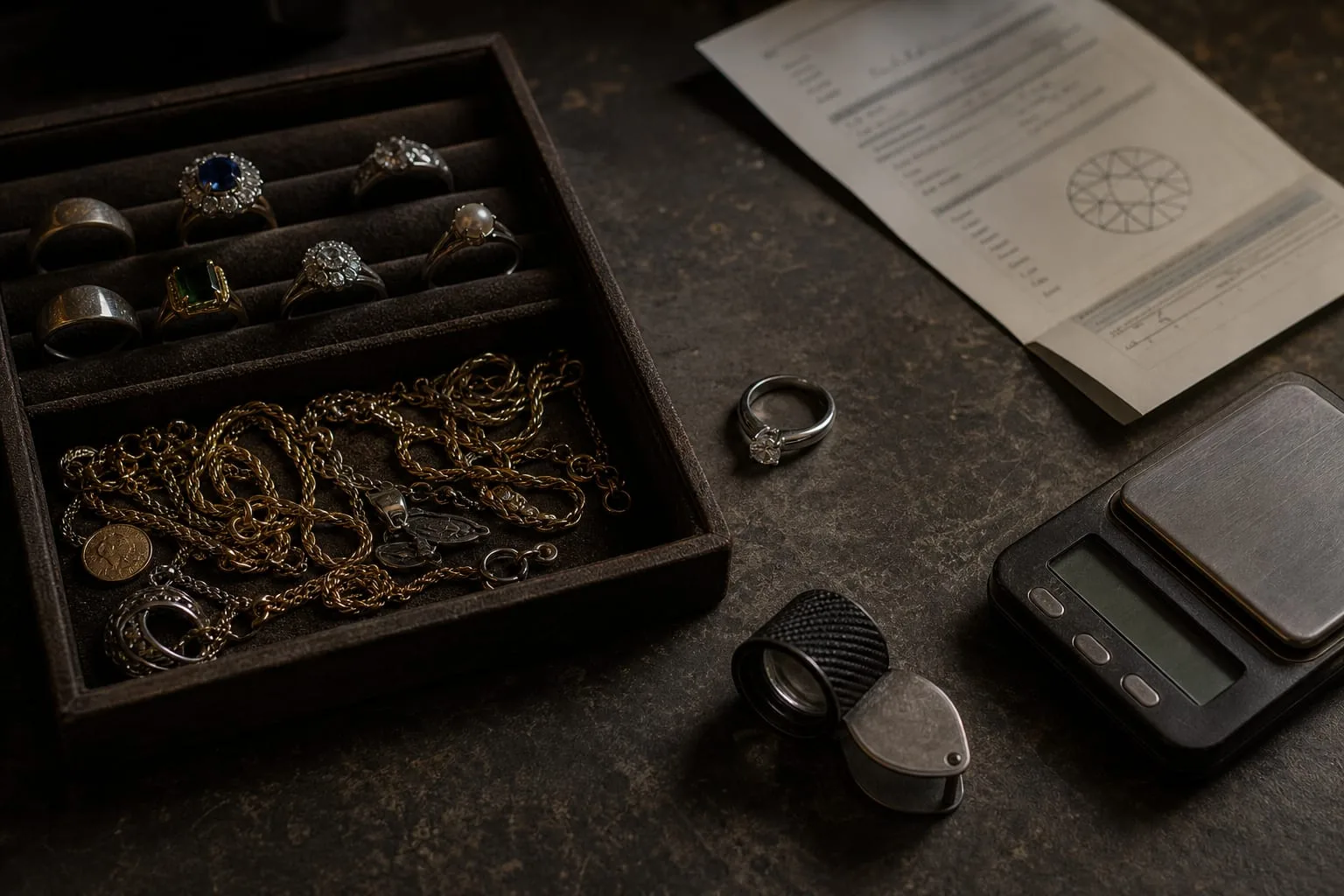
A buyer I have watched work estate goods for years does two very different things in the same afternoon, and the difference is not taste or budget. In the morning she looks at one ring for a client, a single stone in a worn platinum mount, and she asks perhaps nine questions before she will name a number. In the afternoon she bids on a tray of twenty two mixed pieces from the same estate, and she asks two. Both decisions are sound. The reason they look nothing alike is that the protections available to a buyer scale badly, and knowing where they stop scaling is most of the skill.
The same estate, two completely different problems
The ring is a known quantity in the sense that everything about it can be checked before money moves. There is one stone, one mount, one mark inside the shank, one seller willing to answer questions, and enough value in the piece to justify a lab report and an hour of a bench jeweler's time. The tray is the opposite: two dozen items, most of them modest, a few possibly not, sold under conditions of sale that a bidder accepts by raising a paddle. Verifying each piece would cost more than the tray is worth. So the buyer stops verifying pieces and starts verifying the lot, which is a different exercise with a different failure mode.
That shift is the whole subject. Everything a careful person is told about buying jewelry, get it in writing, get the report, get the return window, is written for the single-item purchase. It is good advice there. Applied to a tray, it produces either paralysis or a bidder who has paid twenty times for diligence and still cannot tell you what he owns. The threshold sits lower than most people expect, and it is set by the value of the individual piece rather than by the size of the check.
What the stamp inside the shank actually commits someone to
Her first question on the single ring is about the marks, and she asks it in a specific way: not what does it say, but who put it there and what were they claiming. A karat or fineness mark on a piece sold in the United States is not decoration. Precious metal quality marking is governed by federal stamping law and by the Federal Trade Commission, which oversees how the jewelry trade describes metals, gemstones and treatments to buyers. A stamp reading 14K carries a representation about fineness, within recognized tolerance, and a piece described as gold-filled or plated is describing something structurally different from a piece described as solid.
The practical consequence is that the mark tells you what a manufacturer or importer asserted, at some point, in some country, about a piece that may since have been sized, re-shanked, soldered or partly replaced. On one ring, that gap closes cheaply: a jeweler tests the metal at the shank and at the head, because those are frequently not the same alloy, and the answer arrives in minutes. On a tray, she does not test twenty two pieces. She tests the four heaviest, treats the marks on the rest as a claim rather than a fact, and prices the lot accordingly. The discount she takes for not knowing is smaller than the cost of knowing.
Her question to a private seller is blunter than most buyers manage: has anything on this piece been replaced or repaired, and do you know who did it. Sellers with records produce them. Sellers without records usually say so, and that answer is itself useful, because it tells her which assumptions she is buying.
A grading report describes a stone, not a purchase
The second cluster of questions is about the paper, and here the repeat buyers diverge sharply from the occasional ones. A laboratory grading report from a recognized lab is a description of a stone examined loose, on a date, by that lab. It is not a guarantee of value, not a statement about the mount, and not a promise that the stone in front of you is the stone in the document. So she reads the report number against the girdle inscription where one exists, checks the measurements and weight against the piece, and asks when the stone was last out of the setting. Reports for colored stones carry the additional question of treatment disclosure, which the FTC's guidance to the trade treats as material information a buyer is entitled to.
An appraisal is a separate document with a separate purpose, and confusing the two is the most expensive routine mistake in this category. An insurance replacement appraisal is written to establish what it would cost to replace the item, which is deliberately not what the item would fetch if you sold it tomorrow. Buyers who treat a replacement figure as evidence of a bargain are comparing two unlike numbers. On a single significant purchase she wants the lab report from the lab and the appraisal from someone with no interest in the sale. On a tray, she wants neither, because the pieces will be sorted, and the two or three worth documenting will be documented after they are hers.
Where the protection lives, and how quickly it thins out
The third question is about terms, and it is the one that changes most with scale. A retail purchase from a dealer usually comes with a stated return period, a written description that the seller is answerable for, and, if the card was used, the dispute rights that ride along with card payment. That combination is strong. It is also almost entirely absent from the way volume goods move. Auction lots are typically sold as is, with conditions of sale that limit or exclude warranties of description, and with a narrow window for a specific kind of claim, usually counterfeiting rather than disappointment. Estate and private sales frequently have no stated terms at all.
So the questions she asks before an auction are about the document, not the goods: what does the counterfeit remedy actually cover, how many days do I have, and who decides. Wire payment removes the card dispute route entirely, which is worth pricing into the bid. Her rule of thumb is that when a single item is worth more than she is willing to lose outright, it must be bought under terms that let her unwind the deal, even if that means paying a dealer's margin instead of chasing a lot. Below that line she buys as is, in quantity, and accepts that a certain fraction of any tray will be wrong.
The number that sets the threshold
She does not think about it as one purchase or twenty. She thinks about the value of the largest single piece, because that is what determines whether the loss on one mistake can be absorbed by the winners in the same lot. When one item carries most of the value, the lot is really a single-item purchase with clutter attached, and it gets the full treatment: metal test, report verification, independent appraisal, written terms, card payment. When value is spread thinly across many pieces, the lot is an averaging exercise, and the correct diligence is a fast sort, a weight check on the heaviest items, and a bid that leaves room to be wrong twice.
The buyers who lose money in this category are almost never the ones who asked too few questions of a tray. They are the ones who bought a single serious piece the way you buy a tray.