Law & Legal
Two Attorneys, Two Different Answers? The Scope Line Is Usually Where the Money Sits
When two lawyers quote wildly different fees for the same problem, the disagreement is usually about scope and about whose hours get billed alongside theirs.
Theodore Kranz|
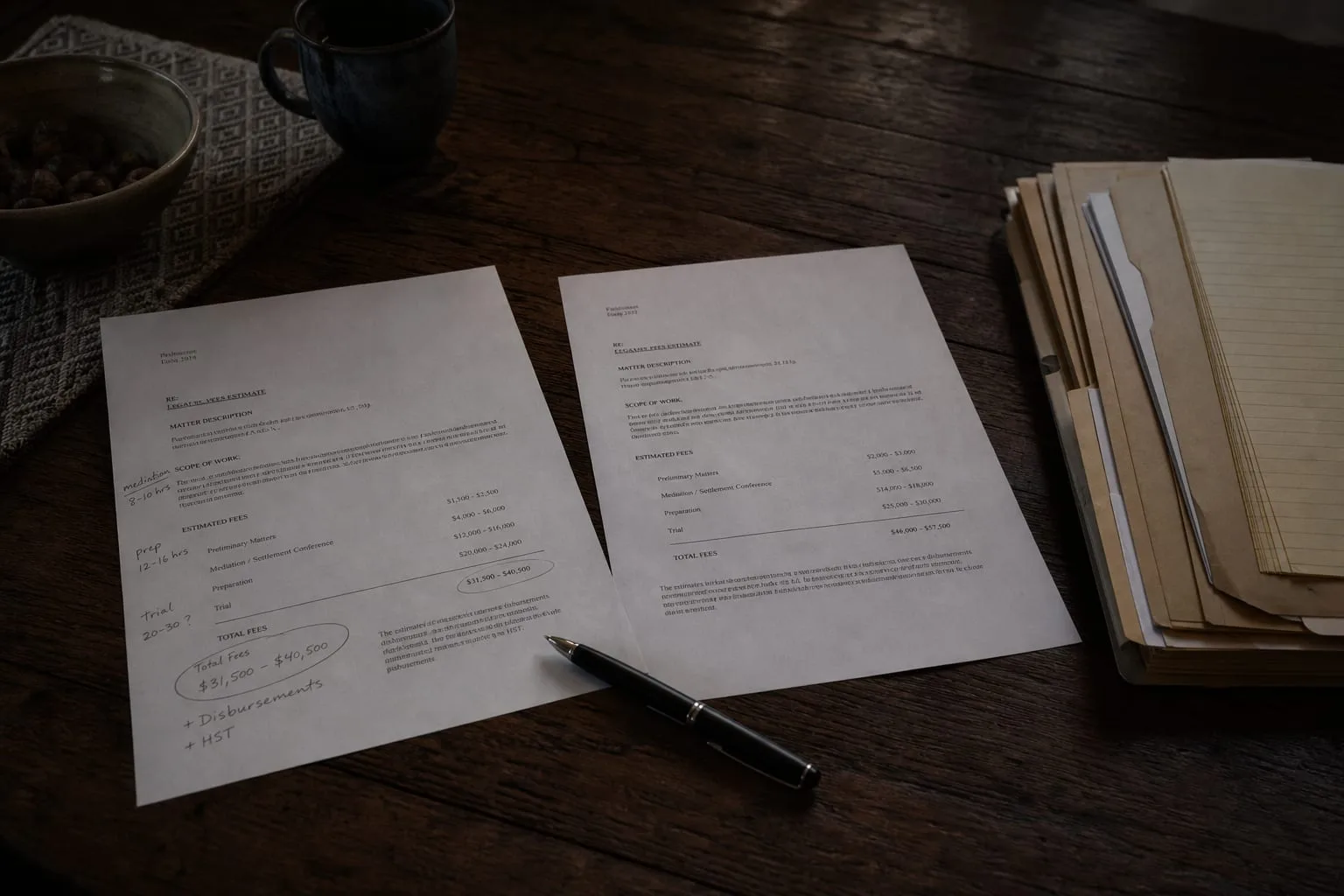
You describe the same facts twice, to two attorneys, in the same week, and you get back two numbers that are not in the same neighborhood. One says four thousand and sounds relaxed about it. The other says eleven, maybe more, and wants a retainer before anything happens. The temptation is to read this as one honest quote and one padded one. Usually it is neither. The two lawyers have quoted against two different assumed routes through the problem, and the route, not the hourly rate, is where almost all of the money lives.
The quote is priced against an assumed path, not a legal question
A fee estimate is built backward from a picture in the lawyer's head of how the matter ends. One attorney is picturing a demand letter, a phone call with opposing counsel, and a signed release in six weeks. The other is picturing a filed complaint, a discovery schedule, and a deposition. Both may be reasonable readings of the same facts, because the facts genuinely support both. So when the advice conflicts, the first thing to establish is not who is right about the law but which ending each one priced. Ask each to describe the last three things that happen before the file closes.
That single question does more than any rate comparison. If one answer ends with a letter and the other ends with a hearing, you are not choosing between two prices. You are choosing between two strategies that happen to carry prices, and the cheaper strategy is only cheaper if it works. Get each attorney to say plainly what happens if it does not: whether the first four thousand is a down payment on the eleven, or money spent on a path you then abandon. Some scopes fold neatly into the larger one. Others do not, and that distinction is worth asking about in the first meeting.
The hours that show up on your bill and belong to someone else
Very little of a legal matter is performed by the person whose name is on the door. A paralegal assembles the exhibits, drafts the routine correspondence, and does the calendar math on deadlines, usually at a fraction of the attorney's rate and sometimes at a rate the engagement letter never names. A title examiner runs the chain of ownership. A process server locates a party who does not want to be located. A court reporter transcribes the deposition and bills by the page. A records custodian at a hospital or a municipal office charges for copies, and charges again for certification. None of these people are your lawyer, and all of them end up on your invoice.
The customer-side confusion here is the line between fees and costs. Fees are the firm's time. Costs are money advanced on your behalf to third parties, and in most engagement letters they are billed through at whatever the third party charged, with no discount and no cap. A quote of four thousand may mean four thousand in fees plus filing fees, service fees, transcript fees, and expert fees that arrive later and separately. A quote of eleven may be all in. The two numbers are not comparable until you have made both of them mean the same thing, which takes one direct question about what the figure does and does not include.
The adjacent professionals who each quote against a narrower slice
Legal advice rarely arrives alone. A real estate agent tells you a boundary problem is a survey issue. A title company tells you it is an exception on the commitment that can be insured over. A CPA tells you the settlement structure changes what you report. An insurance adjuster tells you the carrier will appoint counsel and the cost is not yours at all. Each of these people is competent inside their own remit and each is quoting against a slice of the problem, which is why their answers conflict without anyone being wrong. The conflict is a scope conflict wearing the costume of a factual disagreement.
This matters most where the adjacent professional's work substitutes for billed legal time. A survey ordered before the consultation can cut hours off a boundary matter. Statements, closing documents, and correspondence gathered and dated in advance shorten the intake. In residential real estate the closing cost disclosures that the Consumer Financial Protection Bureau oversees will separate out title and settlement charges from anything you are paying an attorney directly, and reading those two columns side by side is often the fastest way to see which professional is already covering which task. Duplication is the expensive part, and it is avoidable once you can see it.
Making two quotes comparable before you pick one
The practical work is short. Ask each attorney what ending they priced, what happens to the money if that ending does not arrive, whose hours besides their own are billable and at what rates, and which third-party costs are excluded from the figure they just gave you. Ask what documents you can supply that would reduce the estimate, and ask for the estimate to be restated once you supply them. Then ask what would make them revise upward. An attorney who can answer all six without hedging has actually thought about your matter, and the number they gave you means something.
The lawyer whose quote is higher is often the one who priced the harder ending honestly, and the lawyer whose quote is lower may simply be describing a first step. Once you know which you are being offered, the conflict stops being a conflict and becomes a choice you can make on purpose.