Health
Cleaning Out the Filing Drawer in January, and Which Records Have Stopped Earning Their Space
The January purge used to be a paper decision made once a year; now it is a weekly one, and the threshold where a simple system breaks sits lower than most people expect.
Rafael Quintanilla|
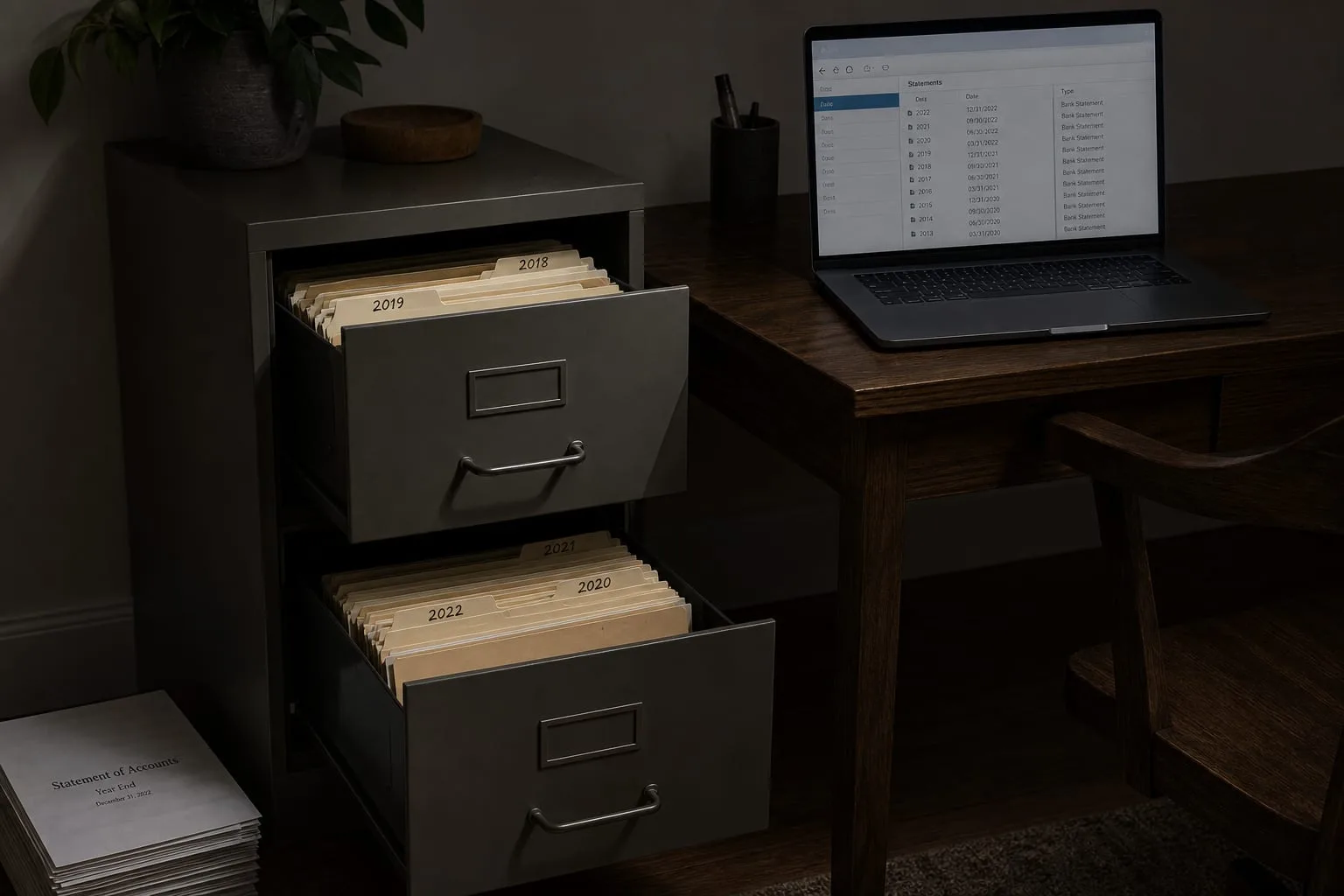
January is when the drawer gets opened, because the tax packet arrives and something has to move to make room. That is the whole reason most households sort records at all: not a policy, but a physical shortage of space in a two-drawer cabinet, resolved once a year with a recycling bin and a rough guess about what still matters. The guess is where the money leaks. Ten years ago the guess was mostly harmless, because the paper itself told you what you had. Now the drawer is half empty and the records live in eleven places, and the same January hour buys much less certainty than it used to.
The same hour of work, ten years apart
A decade ago, the annual sort was a physical task with physical limits. Bank statements came in the mail, the mortgage servicer sent a year-end summary, the insurance renewal arrived as a booklet, and the contractor left a carbon-copy invoice on the counter. You could hold a year in two hands and feel whether anything was missing. The failure mode was loss: a fire, a move, a well-meaning purge of the wrong folder. The recovery was a phone call and a small fee, and the institution on the other end usually had a longer memory than you did.
Now the same hour is spent logging into portals, and the failure mode has inverted. Almost nothing is lost, but a great deal is unreachable on the day you need it, because the account closed, the servicer sold the loan, the app was retired, or the statement archive only reaches back a limited number of years and quietly drops the rest. The paper you do get is often a summary of something more detailed that exists only behind a login. That changes what the January decision is. It is no longer which paper to throw away. It is which records you have actually taken possession of, in a form that survives the company that produced them.
What still runs on a clock, and what runs on an asset
Two different retention rules are at work in the same drawer, and mixing them is why people keep everything or keep nothing. The first kind of record has a clock: the supporting documents behind a filed return, the receipts and statements that prove a deduction, the mileage log, the 1099s. The Internal Revenue Service is responsible for the recordkeeping periods that govern these, and the general look-back window is measured in a small number of years from filing, with specific circumstances extending it well beyond that. Those records genuinely stop earning their space. Once the window closes, the folder is dead weight and January is the right time to retire it.
The second kind has no clock at all, because its usefulness is tied to an asset you still own. Closing documents, the survey, permits and inspection sign-offs, the invoices for a new roof or a finished basement, the schedule of insured jewelry, the appliance warranty and the model numbers. These establish basis, prove work was permitted, or settle a claim years from now, and they stay useful until the asset is sold or replaced, plus the tax window that follows the sale. A homeowner who purges by year rather than by asset will eventually pay a capital gains bill on improvements they cannot document. That is the expensive half of the drawer, and it is usually the thinner half.
The point where a shoebox stops working
For one bank account, one W-2, one house and one car, almost any system works, including no system. The volume is low enough that memory covers the gaps, and reconstructing a year takes an afternoon. The answer for one of something is not the answer for twenty, and the interesting question is where in between the break happens. In practice it is not twenty. It shows up somewhere around four or five separate income or asset streams: a salary plus a side business plus a rental plus a brokerage account, or a small operation with three vendors, a payroll service and a business card that occasionally buys groceries.
At that point two things change at once. The number of monthly documents crosses what anyone will file by hand without falling behind, and the records start needing to be matched against each other rather than merely stored. A rental deposit has to reconcile to a lease, a repair invoice to a unit, a card charge to a job. Storage is easy; correspondence between records is the work. The households that struggle are almost never disorganized people. They are people running a five-stream life on a one-stream system, which held up fine for years and then stopped, usually in the month a second property or a first employee arrived.
The week-to-week version, which is the only version that lasts
An annual sort is a poor instrument for a monthly problem, and the seasonal push in January works best when its job is narrowed to two things: retiring what has aged out, and confirming that the asset file is complete. Everything else belongs to the week. The practical shape is a single intake point, whether that is one email folder, one scanning app or one physical tray, cleared on a fixed day, with file names that carry a date, a source and a purpose, so that finding a record does not depend on remembering where you put it. Ten minutes on a Friday, at four or five streams, is roughly the whole cost.
What that weekly habit buys is not tidiness. It is the ability to answer a question from outside on someone else's timeline: an insurance adjuster asking when the roof was replaced, a lender asking for two years of a business's deposits, a tenant disputing a charge from eighteen months back, a preparer asking what a large March transfer was for. Those requests arrive with a deadline attached, and the difference between a twenty-minute answer and a two-week reconstruction is entirely a matter of whether the record was captured when it was cheap to capture. January is when you notice the difference. The week is where it gets decided.
Making the purge safe enough to actually do
The reason drawers grow rather than shrink is that people cannot tell a dead record from a load-bearing one, so they keep both, and the cabinet becomes a place things go rather than a place things are found. Sorting by clock and by asset fixes that in one pass. Statements and receipts supporting a closed tax year go, once you have checked that nothing in them touches property basis or a carryforward. Everything tied to something you still own moves into a file per asset and stays. Statements from institutions you have left get downloaded before the login stops working, which is the one step that ten years ago did not exist and now matters most.
Done that way, the January hour is smaller every year rather than larger, and it stops being an act of nerve. The drawer holds the closing file, the improvement file per property, the current year in progress, and very little else, which is what a well-kept record set actually looks like at any scale.