Money
Have to Bind a Policy by Friday? The Exclusion Reading That Fits in Ninety Minutes
A first-timer's method for reading the exclusions in a homeowners policy under deadline, and the difference between skimming the list and actually working it.
Theodore Kranz|
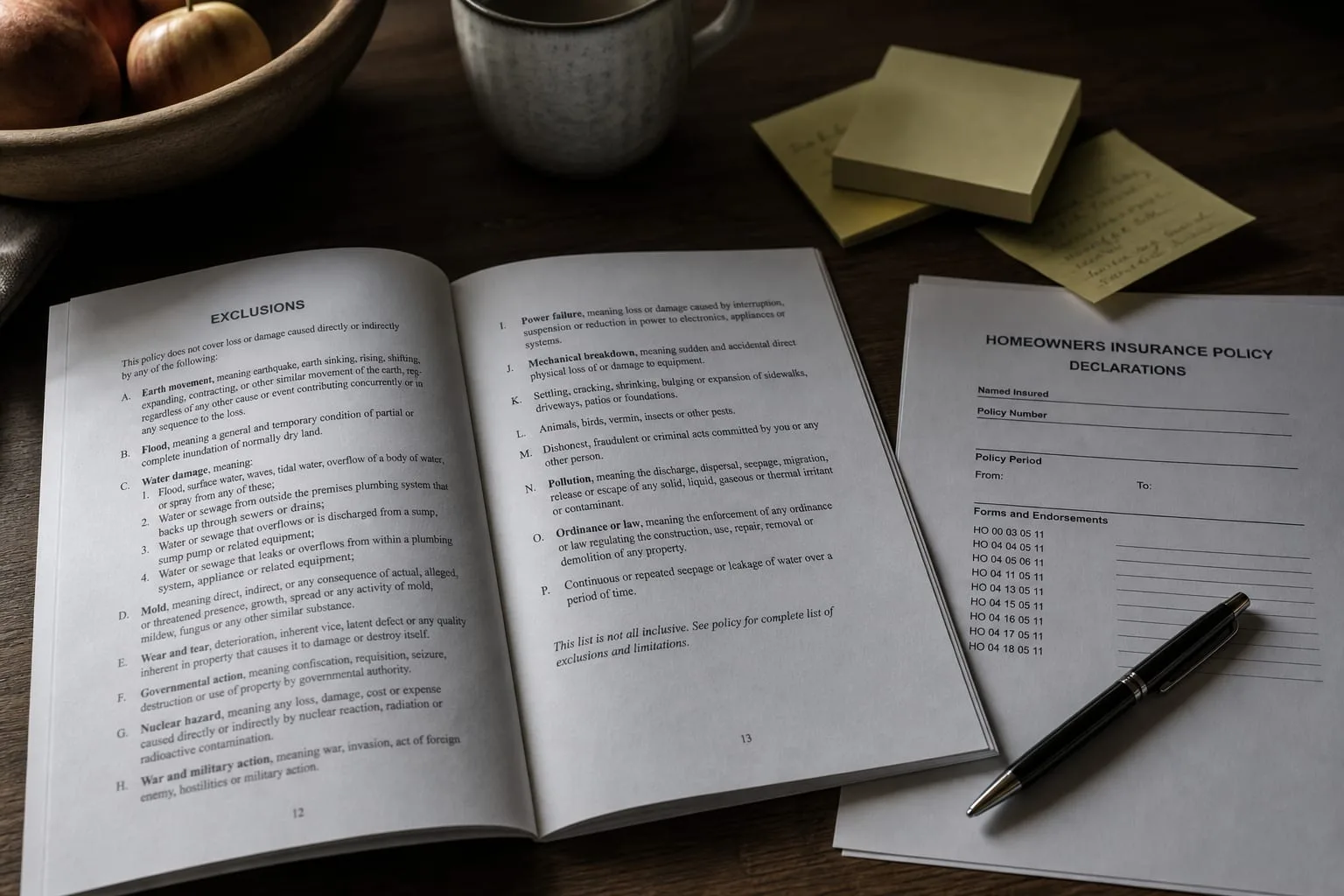
The exclusions section is the only part of a policy that was drafted with a courtroom in mind, which is why it reads badly and why it repays attention out of all proportion to its length. Someone buying coverage for the first time, with a closing date already set and a lender asking for a binder, usually gets about an hour of real reading time. That is enough. What separates a competent job from a barely adequate one is not hours spent; it is the order in which the pages are opened, and knowing that an exclusion almost never travels alone.
A barely adequate reading looks like this: open the policy, find the heading marked exclusions, skim the fourteen or so items, note that flood and earth movement appear, and stop. A good reading treats each exclusion as the middle of a sentence that begins in the definitions and ends in an endorsement. The three parts contradict each other often enough that reading only one of them tells you very little about what you actually bought.
Open the definitions before the exclusions
Every exclusion is built out of defined terms, and the definitions are where the money moves. A policy that excludes damage from surface water has told you nothing until you find out whether the form defines water to include water that backs up through a sewer, water that seeps through a foundation wall, and water that arrives as wind-driven rain through an opening the wind itself made. Those are four different events with four different answers, and the exclusion sentence collapses them into one word. Read the defined terms first, in the order they appear, and mark the three or four that carry the weight: occurrence, water, collapse, residence premises. Then the exclusions read at normal speed.
Residence premises deserves a first-timer's particular attention, because it is the term that decides whether the policy covers the house at all in an edge case. A form that defines it as the dwelling where you reside, shown in the declarations, will behave differently during a six-month renovation you are living elsewhere for than a form that says the dwelling shown in the declarations and nothing more. If you plan to be out of the house while work is done, that single definition is the one to check before Friday.
Read each exclusion looking for the word that gives coverage back
Exclusions are drafted as a broad denial followed by narrow restorations, and the restorations are what you are buying. Look for unless, except, but we do cover, and ensuing loss. Earth movement is typically excluded, and then fire or explosion resulting from earth movement is typically covered again, which means the same earthquake produces two different claims outcomes depending on what happened next. Freezing of plumbing is commonly excluded while the dwelling is vacant or unoccupied, and then restored if you used reasonable care to maintain heat or shut off the supply and drained the system. That is not fine print about probability. It is a maintenance instruction with a dollar figure attached.
The habit worth building on your first policy is to write the condition next to each exclusion in your own words, as an if-then. If the water came from outside the foundation, no. If it came from a pipe inside a wall, yes, unless the leak was gradual and continuous over weeks. If nobody was home in January and the heat was off, no. Six or seven lines of that is a more useful document than the policy, and it takes fifteen minutes.
Check the forms list on the declarations page last, because it overrides
The declarations page carries a list of form numbers and edition dates, and each of those is a document that amends the base policy. Endorsements both give and take: one adds water backup coverage with its own sublimit, another removes coverage for a detached structure rented to others, a third replaces the entire mold provision with a stricter one. A first-time buyer who reads the base form carefully and never opens the endorsements has read a draft. Count the form numbers, count the documents you actually received, and if the counts differ, ask for the missing ones before you sign rather than after a loss, when they will arrive attached to a denial letter.
Flood is the exclusion that no endorsement in a standard homeowners policy repairs, and it is the one where a first-timer most often assumes otherwise. Flood coverage is written separately, and the National Flood Insurance Program that stands behind much of it is administered by the Federal Emergency Management Agency, which also maintains the mapping that lenders consult. If the property sits anywhere near a mapped flood area, treat that as a second purchase on a second timeline, not a line item in this one.
Send one written question, and keep the answer
Set two quotes beside each other and you will find the same peril excluded in two lengths, one clause of nine words and one of forty. The longer clause is usually the narrower exclusion, because the extra words are carve-backs. That comparison is the strongest argument you will have for paying more for the policy that looks worse on the summary sheet. Then take your single most likely loss, the finished basement, the flat roof, the tree over the driveway, and email the agent asking plainly whether it is covered and under which form. A written answer, dated and saved, is worth more than an hour on the phone.
Do the definitions, the carve-backs, and the forms list in that order and the ninety minutes holds. What you end up with is not a legal opinion. It is a short list of the specific conditions under which your policy behaves differently than you assumed, which is exactly the list you want in hand on the day something happens.