At Home
Burned by a Bathroom Tear-Out? The Ten Minute Pass That Keeps the Next One Small
Modern showers put the waterproofing where you can see it, which is why a quarterly look at one joint decides whether the next repair is caulk or carpentry.
Lucinda Fairbairn|
The people who have done this many times over do not check a shower because they are diligic about housekeeping. They check it because they have already paid for the alternative once, watched a two-day repair turn into a nine-day one, and decided never to be surprised in that particular way again. What follows is the method that survives that experience: not a deep clean, not a renovation, a short recurring look at the two or three places where a modern bathroom is designed to fail first. It takes about ten minutes. The reason it works has more to do with how showers came to be built than with any product you can buy.
How the shower stopped forgiving you
A tile shower built in the middle of the last century was a thick, wet assembly: a sloped mortar bed over a pan liner, tile set into cement, grout that was itself essentially a mineral. Water got in constantly, and the assembly was built on the assumption that it would. The liner caught it, the weep holes let it out, and the mass of mortar dried between showers. Maintenance in that world was mostly cosmetic, because the part doing the waterproofing sat several inches behind anything you could reach with a sponge.
What replaced it is faster, lighter, and much thinner. Cement board or a foam panel, a liquid or sheet membrane, thinset, tile, and a flexible sealant at every joint where one plane meets another. Done properly it is at least as watertight as the mortar bed, and it goes in a fraction of the time, which is why nearly every shower built in the last thirty years looks like this. The trade is one you inherit as an owner. The waterproofing plane now sits close to the surface, and its most vulnerable inch is the one you can see, touch, and neglect.
That inch is the change joint: the line where the tile field meets the tub deck or the shower pan, and the vertical corners where two walls meet. Those seams move, because the tub flexes when it fills, the framing moves with the seasons, and the tile does not. Grout is rigid and cracks there by design. Sealant is what belongs in a joint that moves. Once the sealant lets go, water no longer runs down the tile and out the drain. It runs behind the tile, into the panel edge, and onto the subfloor, and nothing about the room looks wrong for months.
What a bad experience actually does to the schedule
The households that come to this after a bad tear-out split into two groups, and both groups are reacting to the same shock. One group overcorrects: new caulk twice a year whether it needs it or not, three products in the cabinet, a running suspicion about every stain. The other group freezes, because the last time they mentioned a small thing to a contractor the estimate came back with framing in it, and they would rather not know. Neither posture is a schedule. A schedule is short, dull, and unattached to how you feel about the last repair.
The people who do this routinely also learn what the earlier repair failed to teach them. A handyman running fresh sealant over a stained joint is not fixing anything, because the failure was underneath, and burying it costs you the only warning signal you had. The Environmental Protection Agency is the federal body responsible for guidance on indoor moisture and mold, and its framing is the useful one for a homeowner: the fix is the water, not the surface. Everything in the ten minute pass is arranged around finding water early enough that the answer is still a tube of sealant.
The pass itself, in order
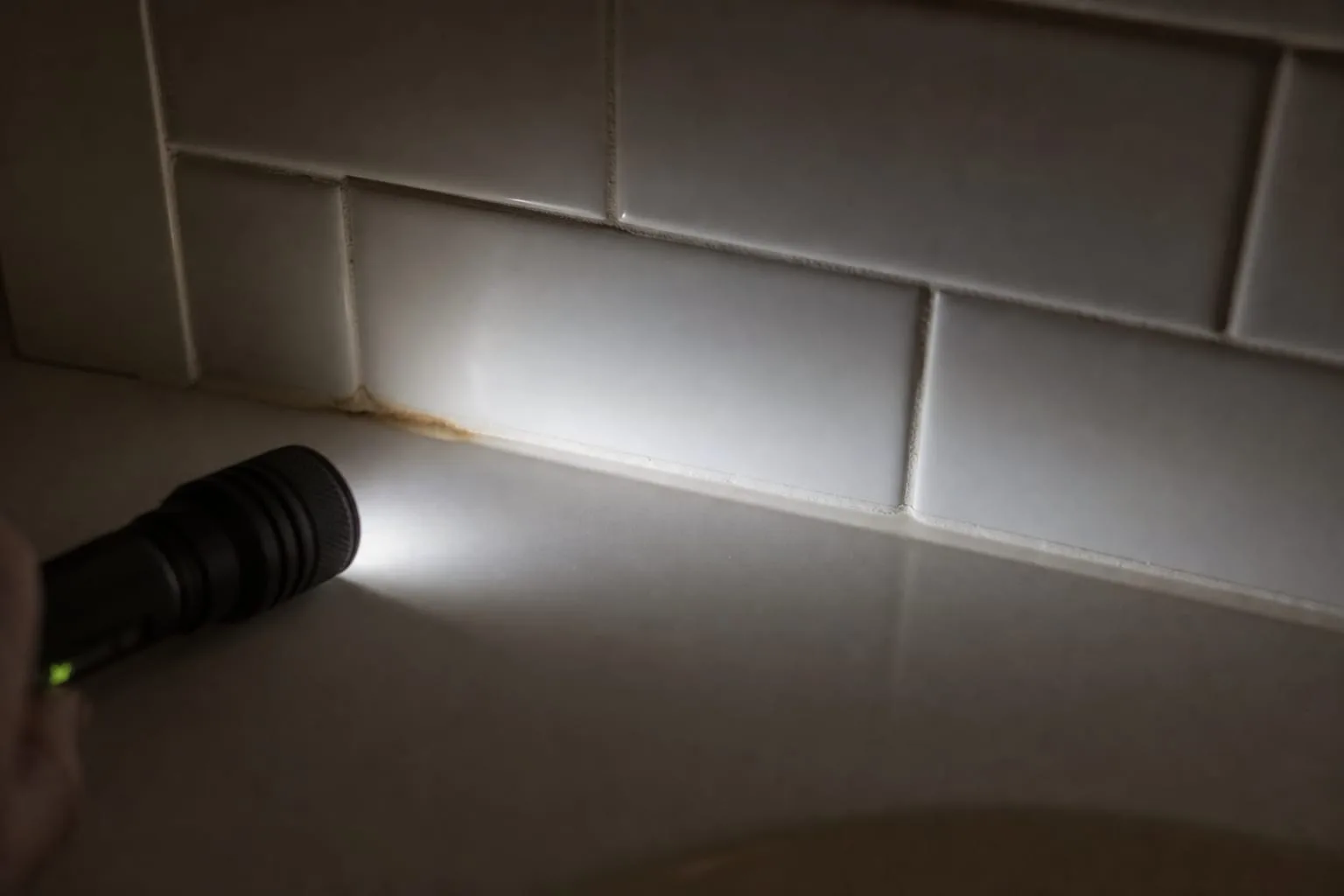
Do it dry, hours after anyone has showered, with a flashlight held nearly flat against the wall so the light rakes across the tile. Start at the tub or pan joint and run a fingernail along it end to end. You are feeling for a soft spot, a lifted edge, a section that has pulled away from the tile even slightly, and any place where the sealant has gone from a bead to a smear. Then press the tile field just above the joint with your thumb. Sound tile is silent and immovable. A hollow click or the faintest give means the setting bed behind it is already wet.
Second, the vertical corners, top to bottom, same test. Third, the grout in the field, looking only for cracks that run in a straight line rather than the random hairlines that mean nothing. Fourth, the escutcheon at the shower valve and the flange where the head enters the wall, both of which are ordinary sealant joints that nobody thinks of as joints. Fifth, walk out of the bathroom and look at the ceiling below, if there is one, and the flooring immediately outside the door, where a subfloor problem shows itself as a cupped board or a nail head that has begun to lift.
Write the date somewhere you will find it again. Quarterly is enough for a family bathroom and twice a year for a guest one, and the log matters more than it sounds, because the value of the pass is comparison. A joint that looked the same in March and June is fine. A joint that has changed in three months is telling you the movement is ongoing, and that is the one to cut out and redo now rather than in the fall.
Deciding between sealant and a conversation
Removing and replacing a failed sealant joint is a Saturday morning and the cost of a utility blade, a tube, and a bottle of denatured alcohol, and it is genuinely within reach of someone who has never done it. Cut both edges, pull the old bead out whole, clean the substrate until it is bare and dry, and tool a single continuous bead. What disqualifies you from doing it yourself is not the skill. It is the hollow tile, the soft floor, the stain on the ceiling below: findings that mean water has already been behind the assembly long enough to matter, and where a proper estimate wants to open a small area rather than reseal a large one.
That distinction is the whole return on the exercise. A homeowner who arrives at a contractor holding a dated log and a specific finding gets a scoped repair, because there is nothing left to guess about. The same homeowner arriving after a ceiling gives way gets the estimate with framing in it, and deserves it. Ten minutes, four times a year, is what stands between those two conversations.