At Home
Dry It in Place or Cut It Out? The Choice That Gets Made on Day Two
Restoration used to mean demolition. Better moisture measurement changed that, and the decision now turns on readings taken two days after the water stops.
Lucinda Fairbairn|
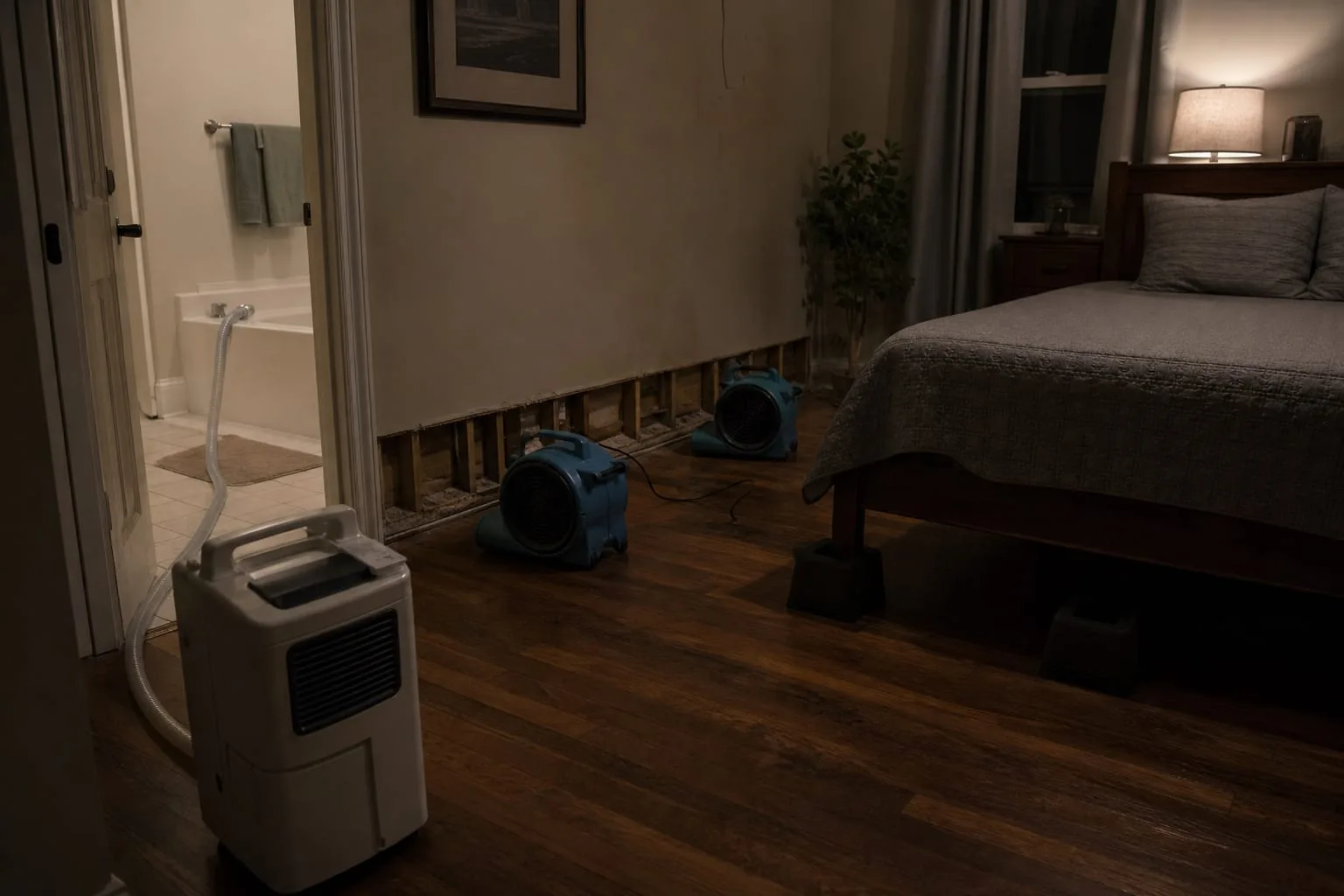
The water stops, the shop vac comes out, and within a few hours somebody is going to ask you a question that decides most of the cost: do we dry what is already there, or do we cut it out and put new material back. That question used to have one answer, and it did not involve drying. Understanding why it now has two, and how the two diverge in the ordinary week that follows, is worth more than any argument you will have with an adjuster later. The choice gets made on day two. The consequences run for a month.
Why demolition was the default, and what displaced it
For a long stretch, the trade had no reliable way to know whether a wall cavity was dry, so the safe assumption was that it was not. Wet drywall got cut to a line, wet carpet and pad went to the curb, wet baseboard came off, and the job became a small remodel. That was not carelessness; it was the only defensible response to a question nobody could answer from the outside. Demolition was a substitute for measurement. Where you cannot read the moisture, you remove the material that might be holding it, and you bill for the replacement.
What changed the default was instrumentation, and then a written method built around it. Pin meters and non-invasive meters let a technician compare a wet area against an unaffected reference point in the same house, hygrometers made the air itself readable, and infrared cameras narrowed where to look before anything was opened. Once the moisture content of a stud or a slab could be recorded on Monday and compared on Wednesday, drying became a documented process with an endpoint rather than a hope. Standards work followed the tools, and the industry's language shifted from tear-out toward controlled drying with daily readings.
The public health side pushed the same direction on timing. The Environmental Protection Agency is responsible for federal guidance on indoor mold and moisture, and its framing put the emphasis on getting wet materials dry quickly rather than on how much of the house got demolished. That reframing matters for a homeowner, because it locates the risk in elapsed time. A wall dried thoroughly inside two days is in a different category from a wall left damp for a week, whatever the invoice says about square footage removed.
What each option actually looks like on your floor
Drying in place means the assembly stays and the moisture leaves through it. Expect air movers pointed along the baseline of the walls, one or more dehumidifiers plumbed to a drain or emptied by hand, small holes drilled behind the shoe molding or a strip of baseboard pulled to vent the cavity, and a technician returning daily to write readings on a log. The room is loud, warm and unusable for as long as it runs, typically three to five days for clean water caught early. Nothing is thrown away except the carpet pad, which almost never survives.
Tear-out means the wet material becomes debris. Drywall is cut to a level line, usually two feet or four feet up, insulation comes out in bags, carpet and pad are rolled and hauled, and the framing gets dried in the open. The drying itself is faster and easier to verify because the cavity is exposed, but you have now bought a second project: hanging, taping, texturing, priming, painting, and reinstalling trim. That work happens after the drying certificate, often weeks later, with a different crew and its own scheduling gaps.
The cases that genuinely require removal are not close calls. Water that has passed through sewage or a toilet trap, water that sat long enough to soften the gypsum, laminate flooring that has already swelled at the seams, and cavities packed with wet cellulose all point one way. Where the water was clean, the extraction happened within hours, and the readings are trending down by the second visit, the drying route holds up well and keeps your walls intact.
Rented equipment against a crew, priced honestly
Two fans from the hardware store and a household dehumidifier will dry a small, contained spill: a supply line under a bathroom sink caught in twenty minutes, a dishwasher that overflowed onto tile. What rented gear does not give you is the record. A restoration crew arrives with calibrated meters, sizes the dehumidification to the volume of the space, and produces a moisture log with dates, locations and readings that an adjuster will accept as proof the structure reached a dry standard. That documentation is often the difference between a covered repair and an argument about whether mold that appears in March came from the January leak.
Run the comparison on the water's path rather than on your confidence. Water that stayed on hard surface in one room is a homeowner's job. Water that crossed a threshold, went under cabinets, reached a shared wall, or dropped through a ceiling into the floor below has entered assemblies you cannot read. Calling a crew in the first day, before anything has been thrown away, keeps both routes open. Calling on day four usually closes the cheaper one, because by then the readings that would have justified drying in place have been overtaken.
The week you are actually going to have
Whichever route you take, the maintenance falls on you between visits. The equipment must stay on overnight, which means resisting the urge to silence it at eleven o'clock, and it means checking that a breaker has not tripped under the combined load of three air movers and a dehumidifier on one circuit. Interior doors stay closed to hold the drying chamber. Somebody empties a collection tank or watches a drain hose. Somebody photographs the log sheet each day, because the paper copy leaves with the crew and the readings are the evidence.
The electricity is a real line item and nobody warns you about it. Dehumidifiers and air movers running continuously for four or five days show up on the next bill, and that increase is a documented part of a mitigation claim if you keep the statement. The rest of the week is displacement: a bedroom you cannot sleep in, furniture on foam blocks, an appointment window every afternoon. It is dull, and dullness is the sign it is going correctly. The alternative week, the one where nobody measured anything, is quieter at first and considerably more expensive by spring.
The useful habit is to treat the first two days as a measurement exercise rather than a cleanup, because the readings taken then determine which of the two routes remains available to you. Extract the standing water, get the meters in the house, and let the numbers say whether the wall stays. That sequence is what forty years of better instruments bought homeowners, and it holds up.