Cars
First Garage Quote? The Total Is the Least Useful Number on the Page
Most first-time comparisons stop at the bottom line, but the labor rate, the book hours, the parts grade and the authorization clause decide what you actually pay.
Theodore Kranz|
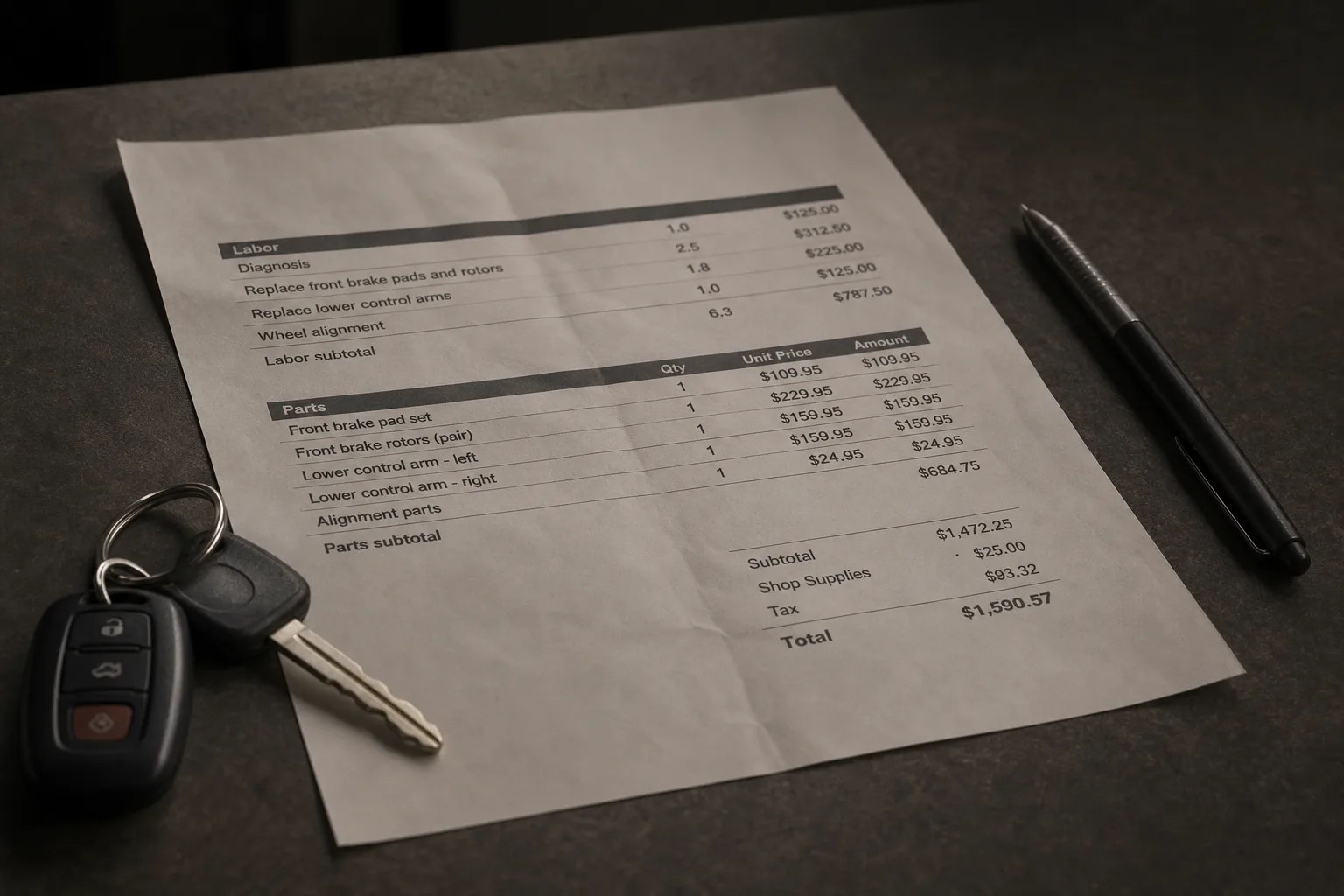
The first repair quote most people receive arrives as a single number at the bottom of a printed page, and the instinct is to treat that number as the thing being compared. It is not. The total is a product of four or five separate decisions the shop already made on your behalf, each of which can be changed, and two quotes that differ by four hundred dollars usually differ because of one of those decisions rather than because one shop is honest and the other is not. Reading the page in the right order makes the gap legible.
The labor line is two numbers pretending to be one
Every labor charge on a quote is an hourly rate multiplied by an hour count, and the two move independently. The rate is posted, usually on a wall near the counter, and a dealership rate running well above an independent shop's is no scandal: it reflects building costs, factory training, and diagnostic equipment the independent may not own. The hour count is the part newcomers miss. Shops bill most jobs from a published labor guide that assigns a standard time to each operation, so a brake job is billed at the guide figure whether the technician takes ninety minutes or three hours.
That matters because a faster shop with a higher rate can land below a slower shop with a lower one, and because the hour count is where two quotes for the same repair quietly diverge. One shop may quote the guide time for replacing an alternator alone; another may quote the same job with an overlapping operation, a belt or a tensioner, bundled in at a combined time rather than two full times stacked. Ask both shops how many hours they are billing and at what rate. The arithmetic either reconciles or it exposes something worth a question.
Parts are not one category, and the warranty follows the part
A line reading "water pump" tells you almost nothing. The part could be an original equipment component bought through the dealer network, an aftermarket equivalent from an independent manufacturer, a remanufactured unit rebuilt from a used core, or a used assembly pulled from a salvage vehicle. Those four options can span a wide price range on a single repair, and a shop quoting the cheapest of them against a shop quoting the most expensive will look dramatically better on the total while describing identical work. The grade belongs on the page. If it is absent, ask for it in writing.
The clause that becomes expensive under one specific condition is the warranty attached to the part, because it is rarely the shop's warranty at all. Many parts carry a manufacturer's coverage that replaces the component and nothing else, which means the second water pump arrives free and you pay the labor to install it again. Other shops cover parts and labor together for a stated period or mileage, whichever comes first. On a job where the labor is three hours and the part is sixty dollars, that distinction is worth more than the entire parts line, and it is the first thing to compare once the two totals are close.
The difference between an estimate and an authorization
The word at the top of the page carries legal weight that varies by state. An estimate is a projection; a quote, in some jurisdictions and in most shops' own paperwork, is a figure the shop has committed to within a stated tolerance. Many states require a written estimate before work begins above a dollar threshold, and require the shop to obtain your approval before exceeding it by more than a set percentage. The Federal Trade Commission oversees unfair and deceptive practices in consumer auto repair, and state attorney general offices typically publish the specific thresholds that apply where you live.
What this means practically is that the authorization line, often a signature box with four lines of small type above it, decides whether you can be billed for discovery. A broadly worded authorization lets the shop proceed with "necessary additional repairs," which is how a six hundred dollar job becomes an eleven hundred dollar job without a phone call. The fix is simple and costs nothing: write a dollar ceiling next to your signature, state that any work above it requires your verbal approval, and give the shop a phone number that will actually be answered during the day.
Diagnostic time, shop supplies, and the lines that look like rounding
A diagnostic fee covering an hour of a technician's time is legitimate work and should be priced as such, but whether it is credited against the repair if you proceed is a separate question with real money in it. Many shops waive or apply the fee when they perform the work; some do not, and some apply it only to repairs above a certain value. On a job where you are collecting a second opinion, the fee is the cost of information, and knowing in advance whether you are paying it twice or once changes which shop you visit first.
Below that sit the small lines: shop supplies, hazardous waste disposal, environmental fees, sometimes a flat percentage of labor rather than an itemized cost. These are standard and generally modest. What is worth checking is whether the shop supplies line is capped, because an uncapped percentage on a long job grows in a way an itemized charge for rags, lubricants and fluid disposal does not. On a two hour repair it is noise. On a transmission job running fifteen hours of labor, it is a line item that deserves a sentence of explanation.
How to set two quotes beside each other and get a real answer
Comparing totals on two sheets of paper written in different formats is not a comparison, it is a guess. The useful exercise is to rewrite both onto one page in the same order: labor rate, labor hours, parts grade, parts warranty term and whether it includes labor, diagnostic fee and its credit status, fees, and tax. Four of those six lines usually match. The one or two that do not are the entire gap, and once you can name them you can ask each shop to requote with the other's assumption, which is a conversation shops have every week and do not find unreasonable.
Do this once and the second quote you ever read takes about ten minutes. A shop that will put the parts grade in writing, state the hour count, cap the overage at a number you chose, and tell you plainly whether the warranty covers the labor to install the replacement has given you everything the decision requires. That shop is also, in the ordinary course of things, the one that calls before it spends your money. The paperwork and the habit tend to travel together, which is most of what a first-timer is really trying to find out.
Keep the approved estimate, the final invoice and the parts receipts in one place, because a warranty claim eighteen months out is decided by the paper you kept rather than the conversation you remember. If the two documents differ, the time to resolve it is at the counter, before payment, while the technician who did the work is still twenty feet away and the car is still on the lot.