Cars
Handed a Menu of Recommended Services? Which Lines the Manufacturer Actually Asked For
The service schedule in your glovebox and the menu at the counter are two different documents, and knowing which line came from where changes the bill.
Theodore Kranz|
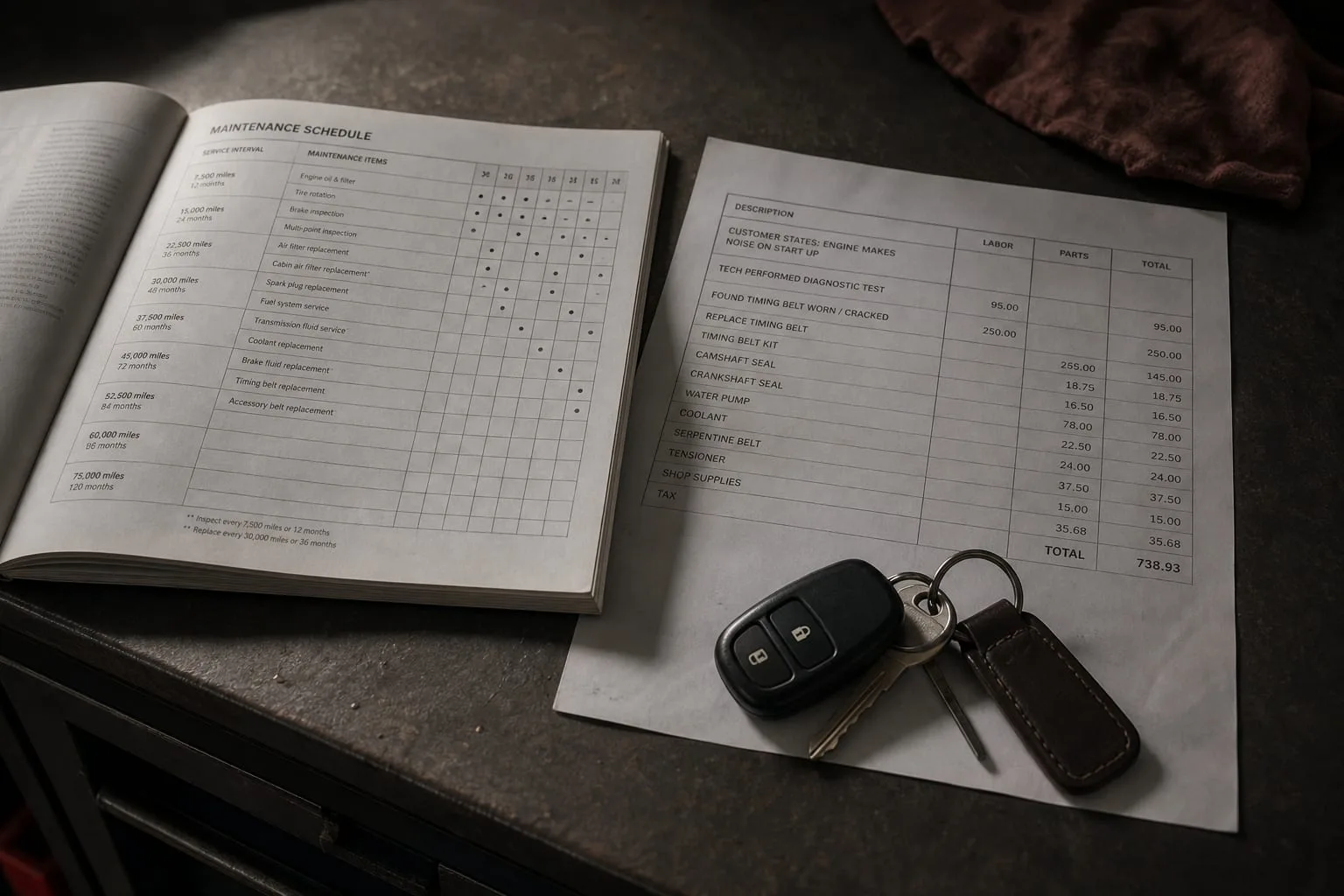
The assumption almost everyone arrives with is that a servicing schedule is a single fixed list, issued by the manufacturer, and that a shop reading from a tablet at the counter is reading that list back to you. It rarely works that way. What you are usually shown is a menu built by the service department, drawn partly from the manufacturer's schedule, partly from a supplier's recommendation, and partly from what the shop has decided is prudent for vehicles of that age in that climate. All three can be defensible. Only one of them affects your warranty.
Two documents, and only one of them binds anything
Open the glovebox and you have the manufacturer's maintenance schedule, printed by mileage or months, with a small number of items marked as required and a larger number marked as inspections. Then there is the shop's menu, which is a commercial document: a package at 30,000 miles, a package at 60,000, priced as a bundle. The menu is not wrong for existing, but it is not the thing a dealer can point to if a transmission fails and someone wants to argue you did not maintain the car. The Federal Trade Commission oversees how warranties are written and what a manufacturer may require of you, and the practical consequence for a customer is narrow: keep records of the items the printed schedule actually calls for, and you have met the obligation.
The gap between the two documents is where the money sits. A shop may recommend a fuel system cleaning, a throttle body service, or a coolant flush at an interval the manufacturer never published, and none of those is fraudulent; they are judgments. But when a customer asks which items are required and which are recommended, and the answer comes back as a single undifferentiated total, that is the moment to slow down. Ask for the schedule page. Most service advisors will print it without complaint, because it exists and they have it.
Inspect and replace are not the same word
The single most expensive misreading in servicing is treating an inspection line as a replacement line. Schedules are full of instructions to inspect brake pads, inspect the drive belt, inspect the cabin filter, inspect suspension components. An inspection costs labor time and produces a finding. A replacement costs parts and labor whether the part needed it or not. When a menu converts every inspection into a replacement at a fixed interval, the customer pays for a decision that the manufacturer deliberately left open, and the reason it was left open is that wear depends on how the thing was used.
The customer-side test is simple and it works across trades. Ask what the finding was, not what the interval says. Brake pads have a measurable thickness and a shop can tell you the number in millimeters and the number at which replacement is called for. A drive belt has visible cracking, or it does not. A cabin air filter can be held up. The same logic runs through home systems: an HVAC technician on a maintenance visit is contracted to inspect and clean, and a recommendation to replace a blower motor should come with a reading, an amp draw, a temperature split, something you could write down. Findings travel. Intervals alone do not.
The severe service column, and who put you in it
Nearly every manufacturer schedule has two columns, normal and severe, and the severe column shortens intervals substantially. What counts as severe is defined in the small print: short trips in cold weather, extended idling, towing, dusty roads, stop-and-go driving in heavy traffic. A shop that quotes you against the severe column has usually made an assumption about your driving without asking, and the assumption may well be right. City commuters who drive four miles each way in winter genuinely are in the severe category, and the schedule says so plainly.
The problem is that the classification is never announced. It arrives silently, as a shorter interval on a reminder sticker or a text message suggesting service two months earlier than you expected. So ask which column you are being quoted from, and then read the definition and decide honestly whether you fit it. Highway drivers who cover long distances at steady speed frequently do not, and moving from the severe column to the normal one on a vehicle kept eight years removes a meaningful number of visits without touching the warranty position at all. Customers who make this determination once, in writing, tend to stop relitigating it every spring.
Reading a service invoice as a record, not a receipt
The invoice matters more than the visit, because in any later dispute it is the only thing that exists. A useful invoice names the part, gives the mileage, dates the work, and describes findings in terms someone else could check. A weak invoice says multi-point inspection completed and lists a package code. Two customers can pay the same amount at the same shop and walk out with documents of very different value, and the difference only shows up years later when a component fails inside a powertrain warranty and a claims adjuster wants proof the fluid was changed on time.
Ask for the fluid specification to be printed, not just the word transmission service. Ask for the oil grade rather than the word oil. If a shop performs work using a fluid equivalent to the manufacturer's specification rather than the branded one, that is normally fine, and the specification number on the invoice is what makes it fine. Keep the invoices in one folder, physical or scanned, in mileage order. This is a fifteen minute habit that quietly settles arguments you may never have.
What to do at the counter, in order
Before approving anything, ask for the manufacturer's schedule page for your mileage, ask which column it is drawn from, and ask which lines on the quote appear on that page and which are shop recommendations. Then take the recommendations one at a time and ask what was observed. Some will hold up immediately: a coolant that tests acidic, a serpentine belt with visible cracks, a filter that is visibly loaded. Others will turn out to be interval-driven and can wait for the next visit, when there may be an actual finding to act on. Nothing about this conversation is adversarial, and service advisors who work with informed customers generally prefer them, because the approvals that follow are firm and the callbacks are fewer.
The schedule is a floor, the menu is an opinion, and the invoice is the record. Once a customer can tell which document is speaking, the annual maintenance conversation stops being a negotiation about trust and becomes a short exchange about facts, which is what it was designed to be.