At Home
Your Maintenance List Keeps Failing? Local Rules Already Set Half the Dates
Most household maintenance schedules collapse because they were invented. The ones that hold borrow their dates from ordinances, utilities, warranties and weather that are already fixed.
Theodore Kranz|
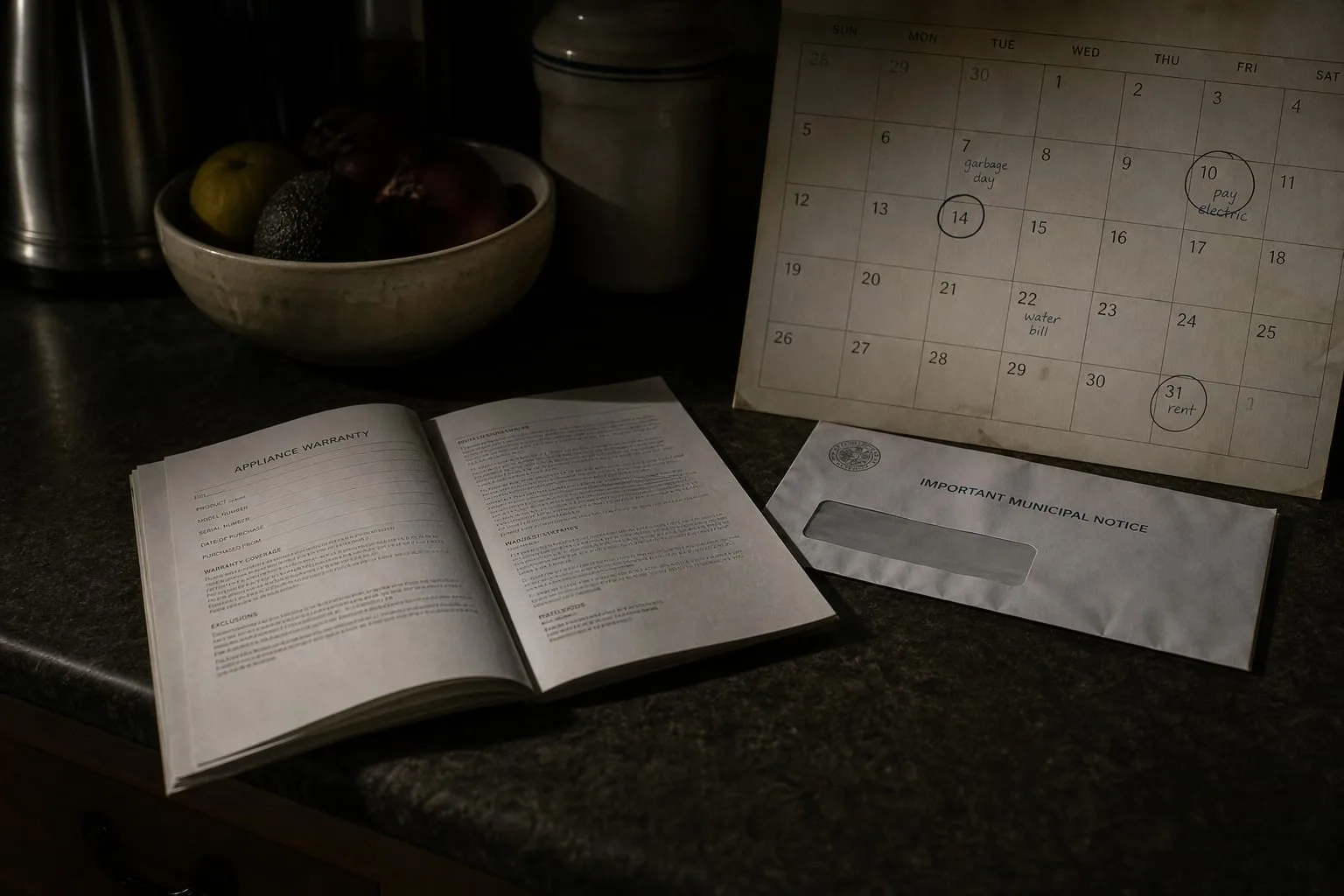
A maintenance schedule built in January from a magazine checklist has a predictable life expectancy: about eleven weeks. It fails not because the household is lazbut because the dates were invented, and an invented date has nothing behind it when a Saturday gets busy. The schedules that survive borrow their dates from somewhere else, from a town ordinance, a utility's testing cycle, a warranty condition, a first frost that arrives within the same ten days every year. That borrowing is the whole skill. It is also the part almost nobody does before writing the list.
Compare an invented date with a borrowed one
Consider two versions of the same task. The first reads "clean gutters twice a year," which sounds responsible and means nothing, because twice a year in a neighborhood of red oaks is not twice a year in a neighborhood of pines, and the second cleaning either happens after the last leaf drops or it happens too early and buys you nothing. The second version reads "clean gutters when the oak out front is bare, and again in March before the spring rain." One is a rule you have to remember. The other is a rule the tree reminds you about. Every durable line on a maintenance schedule works the second way, tied to an observable event rather than a month.
The same comparison holds for the tasks that carry money. Draining an outdoor spigot is worthless in September and urgent the week before the first hard freeze, and the first hard freeze in a given zip code is not a mystery: it lands inside a fairly narrow window that your neighbors, your irrigation contractor and the local extension office all already know. Anchor the task there and it gets done. Anchor it to "fall" and you will be doing it in the dark with a flashlight after a burst line, which is the version that costs four figures.
The dates your town has already chosen for you
Before deciding anything, it is worth finding out how much of your calendar is not yours. Snow ordinances in much of the Northeast and Midwest require a homeowner or a commercial occupant to clear an abutting public sidewalk within a set number of hours after snowfall stops, and that clock, not your preference, determines whether you need a shovel by the door or a service on retainer. Wildfire jurisdictions in California and across the interior West impose defensible space clearance around structures, sometimes with an inspection season attached, which turns brush cutting from a chore into a dated obligation. Coastal counties tie shutter checks and tree limb work to the start of hurricane season. Water utilities in many systems require an annual backflow preventer test by a certified tester and will send a notice, then a shutoff warning.
Septic maintenance is the clearest example of the same task carrying different dates in different places. The Environmental Protection Agency is responsible for the federal framework covering decentralized wastewater systems, and county health departments build on it locally, which is why one jurisdiction expects a pumping interval documented every three to five years while a neighboring one requires an inspection at the point of sale and little in between. If you own a system, the interval that matters is your county's, not the generic one, and finding it takes a single phone call that pays for itself the first time a lender or a buyer asks for records.
The clause that only becomes expensive under one condition
Maintenance intervals also show up in documents people sign and never reread. Manufacturer warranties on tankless water heaters and high-efficiency furnaces frequently condition coverage on annual professional service, and in hard water regions the descaling requirement is the one that gets skipped and the one the manufacturer asks about when the heat exchanger fails in year six. Homeowners policies rarely demand a service schedule outright, but they do exclude damage that develops gradually, which means a failure traced to years of neglect and a failure traced to a sudden event are treated as two different claims. A chimney is the sharpest case: many jurisdictions and most insurers expect an annual inspection of a wood-burning appliance, and the absence of any record becomes a problem exactly once, after a flue fire.
None of this argues for doing more. It argues for knowing which three or four items on your list have a document behind them, because those are the ones where skipping a year is not a cosmetic decision. The rest of the list, the window washing and the closet turnover, can slide without consequence, and treating everything as equally binding is the fastest way to abandon the whole thing.
How to build the judgement in one sitting
Spend an hour, once, gathering the dates that already exist. Your municipal website will state the snow clearance window, the bulk pickup calendar and any burn restrictions. Your water utility will state whether a backflow test or a meter access inspection applies. The county health department will state the septic interval. The manuals for your two or three most expensive appliances will state the service condition, usually in the warranty section rather than the operating instructions. Write each item with its trigger attached, not its month, and note who enforces it, because an obligation with an enforcer behind it belongs at the top and an obligation with only your conscience behind it belongs lower down.
Then compare that sheet against whatever list you were working from, and delete the overlap. What remains is usually shorter than expected and considerably more specific, tied to leaf drop and frost dates and inspection seasons rather than to an even distribution across four quarters. A schedule shaped that way survives a bad month, because the reminders come from the weather, the mail and the town rather than from your own memory.
The household that keeps a maintenance schedule is rarely the more disciplined one. It is the one that spent an hour finding out which dates were already fixed, and then stopped arguing with them.