At Home
Missed the Fall Cleanup Window? What Separates a Good Catch-Up From a Barely Adequate One
Once a maintenance window closes, the difference between a real catch-up and a cosmetic one is where the work stops, and local rules often decide that for you.
Lucinda Fairbairn|
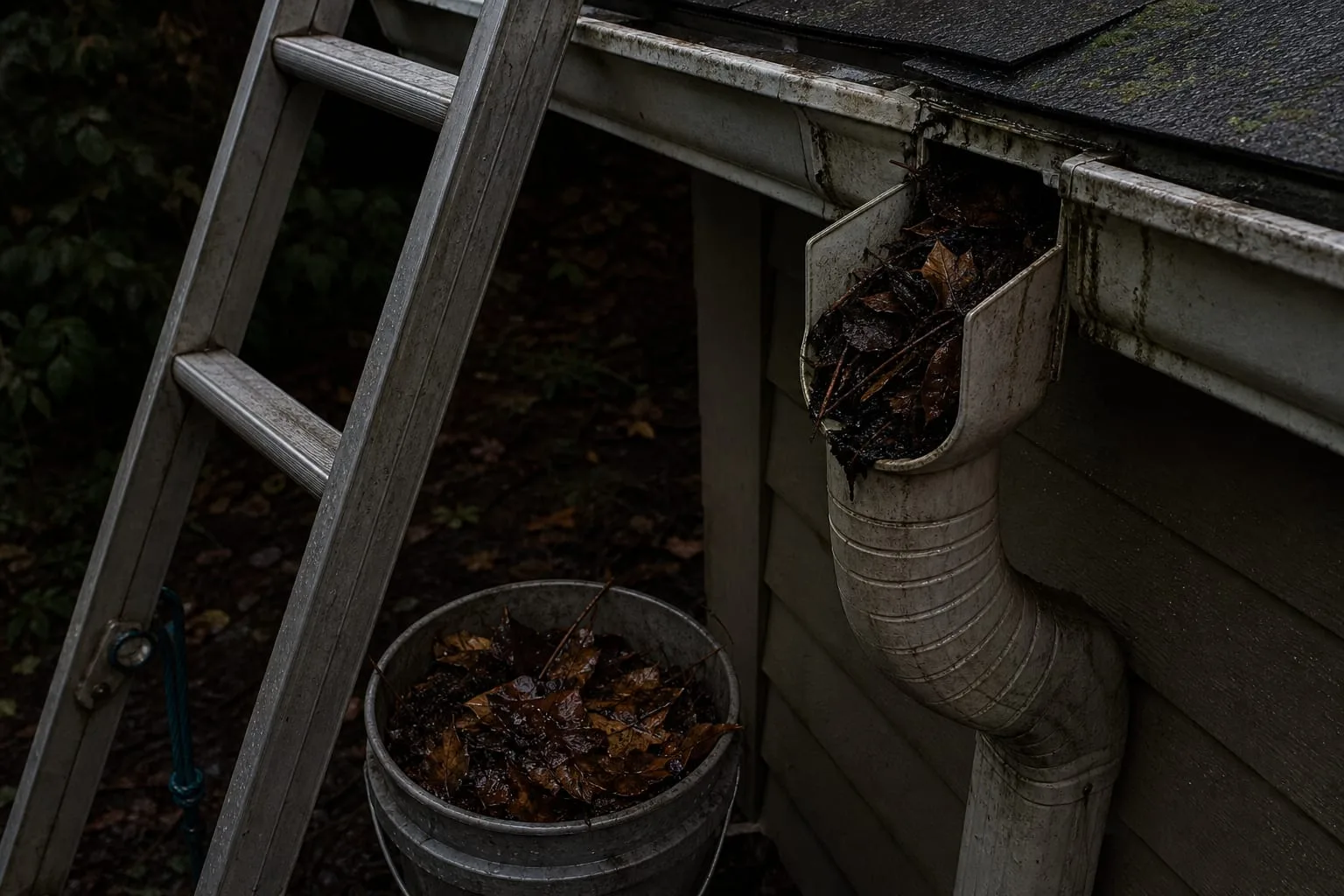
The chore that gets skipped is almost never the expensive one. It is the twenty-minute one: the gutter outlet, the dryer vent hood flap, the weep holes at the bottom course of brick, the crawlspace vent screen, the condensate drain on the air handler. Each has a season in which it is easy and a season in which it is not, and once that season passes the work does not stay the same size. It grows a second job attached to it, which is the repair of whatever the first job was supposed to prevent. Catching up well is a different task from doing it on time.
The difference is where the work stops, not how it looks
A barely adequate job clears the part you can see and leaves the part that actually moves water or air. Someone scoops the trough and leaves the downspout packed at the elbow, so the gutter now overflows at the one point where the overflow lands on a foundation wall. Someone pressure washes the visible face of siding and drives water behind the lap, which is worse than the algae was. A good job ends at a terminus: water leaving the property, air leaving the wall, a drain running clear when you flood it. If you cannot describe where the thing you cleaned discharges, you cleaned the middle of it.
That test also tells you what to pay for. Two quotes for the same exterior wash will differ by whether the crew addresses the soffit vents and the window head flashing or treats the whole thing as a surface to brighten. The cheaper one is often cheaper because it ends earlier, not because the labor rate is lower. Ask where the job stops and you have converted a vague price gap into a specific difference in scope, which is a comparison you can actually make.
Find out which deadline binds where you live
Most homeowners assume the deadline is weather. Often it is a rule. Municipal codes in leaf-heavy places set the dates when yard waste may sit at the curb and when a clogged street inlet becomes the abutting owner's problem. Snow ordinances in the upper Midwest and Northeast give a window measured in hours after snowfall stops, with a fine that arrives without a warning letter. In much of California and the interior West, defensible space standards reach onto the house itself, into the first five feet of ground, the roof valleys, the gutters, and the vent openings, and they are enforced during a state or local inspection rather than after a complaint.
Then there are the private rules, which bind faster than public ones. A homeowners association covenant will typically give a fixed number of days from written notice to correct roof staining, a mildewed fence, or a driveway crack, and the cure period runs whether or not you agree with the finding. Insurers add a third layer: a policy conditioned on maintaining the roof, or on annual chimney service, or on keeping vegetation clear of the structure. Reading those three sources once, in an afternoon, tells you which of your deferred jobs has a date attached and which merely has a season.
The same chore, judged differently by climate
Regional difference is not decoration on this subject. It changes the standard for adequate. On the Gulf Coast and through the humid Southeast, the failure mode is biological: growth on north-facing siding, blocked condensate lines, and moisture that keeps working through winter because winter is short. The Environmental Protection Agency is the federal body responsible for indoor air quality and moisture guidance in homes, and the practical lesson from its remit is that a cleaning job in a humid climate is really a drying job. Cleaning without fixing the source buys a season at most.
In freeze-thaw country the same neglect converts to mechanical damage. Water that would have merely stained a wall in Houston expands in a mortar joint in Buffalo and pushes it apart, so the deadline is not the first rain but the first hard freeze, and a good job means the path is clear before the temperature makes it permanent. In the arid Southwest the enemy is mineral scale and grit: hard water etching fixtures, evaporative coolers, dust loading filters and coils. In wildfire counties, ember-resistant detail work near the house is both maintenance and compliance, and it has an inspection date.
Working through a backlog in the right order
Sequence by consequence, not by irritation. Anything on the water path comes first, roof edge through downspout through grade, because water is the only agent that recruits other failures. Anything with a legal or contractual date comes second, since a citation or a covenant notice adds a cost that has nothing to do with the underlying condition. Combustion and air movement come third: flue, dryer duct, mechanical room. Cosmetic surfaces come last, and often they turn out not to need the treatment you were planning once the moisture behind them is gone. Photograph each item before and after, with a date, because that record is what settles an inspector's question or an adjuster's later doubt about whether the house was maintained.
Write the four or five jobs that actually matter for your climate on one page, with the local date beside each, and the backlog stops being a mood and becomes a short list you can finish.