At Home
One Furnace or Twenty, and the Five Checks That Decide Whether a Filter Schedule Holds
The furnace filter is the smallest maintenance task in a building, and the way its schedule fails reveals exactly what a schedule needs to survive at scale.
Rafael Quintanilla|
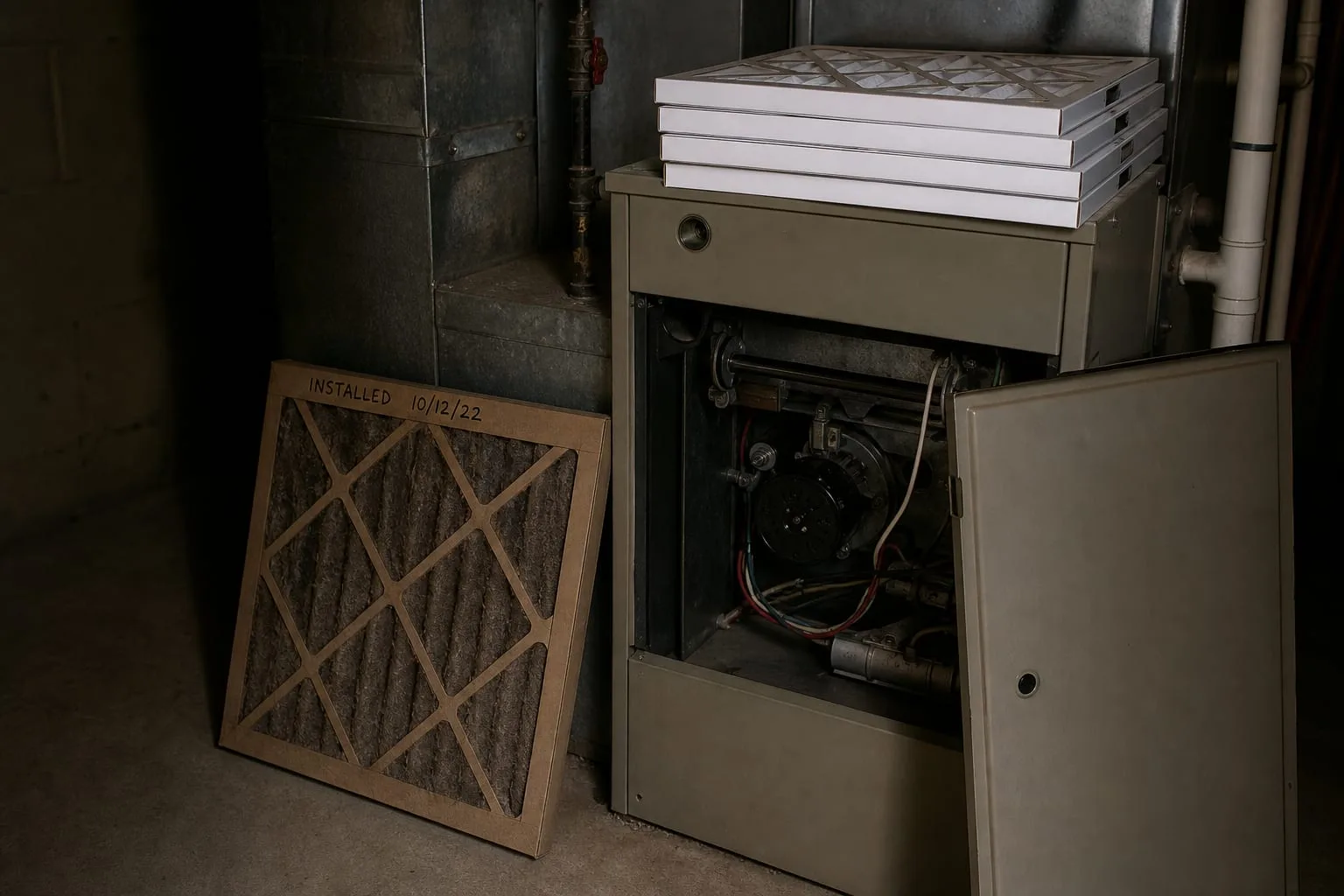
The number printed on a filter bag is not a maintenance schedule. It is a marketing decision with a defensible engineering basis, and the two are not the same thing. Somewhere in the last few decades, thirty days became the default interval printed on the cheapest fiberglass panels, and that number migrated onto refrigerator whiteboards, into property management software, and into the standing instructions handed to new maintenance techs, without anyone stopping to ask which building it was written for. It holds up fine in some houses. It collapses across a portfolio. The way it collapses is instructive, because the failure is never laziness.
What follows is five checks, framed around the single narrowest task in the whole of building upkeep: replacing a one-inch air filter. Every one of the five scales differently from one unit to twenty, and knowing where the threshold sits is most of the work.
1. Whether the interval belongs to the equipment or to the packaging
The thirty-day figure attached itself to filters because thin fiberglass media loads quickly and because a manufacturer selling a consumable has no incentive to extend the interval. Pleated media with more surface area lasts longer, sometimes several times longer, and a media cabinet with a four-inch or five-inch filter changes the arithmetic again. The Department of Energy is responsible for tracking residential heating and cooling efficiency, and the general principle it works from is that restricted airflow costs energy and shortens equipment life. That principle does not specify a date. Your date depends on media depth, on whether there are dogs, on whether the return sits in a hallway or a dusty utility room, and on how many hours the blower actually runs.
For one house, you can find the real interval empirically. Pull the filter at thirty days, look at it, write the date on the frame, and adjust. Two or three cycles and you know. That method does not survive being applied twenty times, because it requires judgment at each inspection and judgment is exactly what you cannot distribute across a crew or a set of tenants. Above roughly six units, the useful move is to standardize the media so that one interval is defensible everywhere, even if it is slightly conservative in the quiet apartments and slightly tight in the one with three cats.
2. Whether the task rides on a date or on something you already do
Schedules built on calendar dates fail at a predictable rate, and the rate has nothing to do with the person's intentions. A date is an isolated instruction with no anchor in existing behavior, so it has to be remembered from nothing. The schedules people actually keep are the ones fastened to an event that was going to happen regardless: the first cold night when the heat comes on, the day the clocks change, the monthly walkthrough, the quarter's utility bill arriving. Filters happen to attach well, because turning the system off to swap a panel takes under two minutes and can be done at the end of any other visit.
At single-house scale, the strongest anchor is usually seasonal and physical. Heat on, new filter. Air conditioning on, new filter. Two interventions a year in a low-dust house with pleated media is often closer to correct than twelve, and it gets done because the trigger is unmissable. Across a portfolio, the anchor shifts to the visit itself. If a tech is already in a unit for a smoke detector battery, a water heater glance, or a lease-renewal inspection, the filter goes in the same trip, and the schedule you are really keeping is the visit schedule with the filter as a passenger.
3. Whether the part is already in the building
The most common reason a filter does not get changed on time is that nobody has one. This is the check people skip, because it looks like logistics rather than maintenance, but adherence tracks inventory more tightly than it tracks intent. A homeowner who buys a single filter each time introduces a hardware store trip into every cycle, and that trip is where the schedule dies. Buying a sleeve of six, stacked on top of the air handler, removes the decision entirely. The cost difference is small and the compliance difference is not.
Scale changes the shape of the problem rather than its nature. With twenty units, the killer is not absence of stock but variety of sizes: a sixteen by twenty-five here, a twenty by twenty there, an odd twenty-four by twenty-four in the building with the older air handlers. Six sizes across twenty units means six stock lines, six reorder points, and a tech who arrives with the wrong panel. The fix is unglamorous and effective, which is to record every filter dimension once, in a single place, and consolidate purchasing around the two or three sizes that cover most of the doors. That inventory list becomes more valuable than the schedule it supports.
4. Whether one named person owns it, or everyone does
A task assigned to a household is assigned to nobody. Filters are unusually prone to this because two adults can each assume the other handles the mechanical room, and the assumption holds for a year without either noticing. One house needs one name against the task, written down somewhere both people can see, and that is genuinely the whole intervention. It is not a discipline problem. It is an ownership problem wearing a discipline costume.
The equivalent failure at portfolio scale is the split between tenant and owner. Leases frequently say the tenant replaces filters, and some tenants do it faithfully, and the ones who do not are invisible until a frozen coil or a failed blower motor makes them visible. The threshold where transferring the task stops making sense is lower than most owners expect, somewhere around the point where a single compressor replacement outweighs several years of filters and labor. Past that point, owners generally do better keeping the task, entering the unit on a stated schedule, and treating the lease clause as a courtesy rather than a control.
5. Whether the record outlives the person keeping it
A schedule that lives in one person's head is a schedule with a single point of failure, and the failure arrives with a job change, a sale, an illness, or a new property manager. For one house, the durable record is often the crudest one available: the install date written on the filter frame in marker, visible to anyone who opens the panel, including a future owner and the technician who comes out in February. Nothing needs syncing. Nothing needs a login. The record sits where the task sits, which is why it survives.
Above roughly ten units, marker on a frame stops being enough, because you need to know completion across doors without opening each one. That is where a shared log earns its keep: a spreadsheet or a work-order system with unit, filter size, date, and initials, which answers the only question that matters, namely which units are overdue right now. The threshold is not really about unit count. It is about whether one person can still hold the whole picture, and once two or more people touch the work, the written record is the picture. Buildings that make that switch early tend to have the older equipment still running.
The filter is a small enough task to be honest about. Nothing about it is technically difficult, nothing about it takes long, and yet the interval printed on the bag has almost no relationship to what a given building needs or what a given person will sustain. Set the interval from the media and the dust, hang it on something that was going to happen anyway, keep the parts on site, put one name on it, and write it where the next person will find it. The same five checks apply to gutters, water heaters, and smoke detectors, at different thresholds and with different consequences for getting the interval wrong.