At Home
One Gutter Run or the Whole Roofline? How the Season Decides What You Hire Out
The same upkeep job is a Saturday chore at one scale and worth a paid crew at another, and the calendar is what moves the threshold.
Rafael Quintanilla|
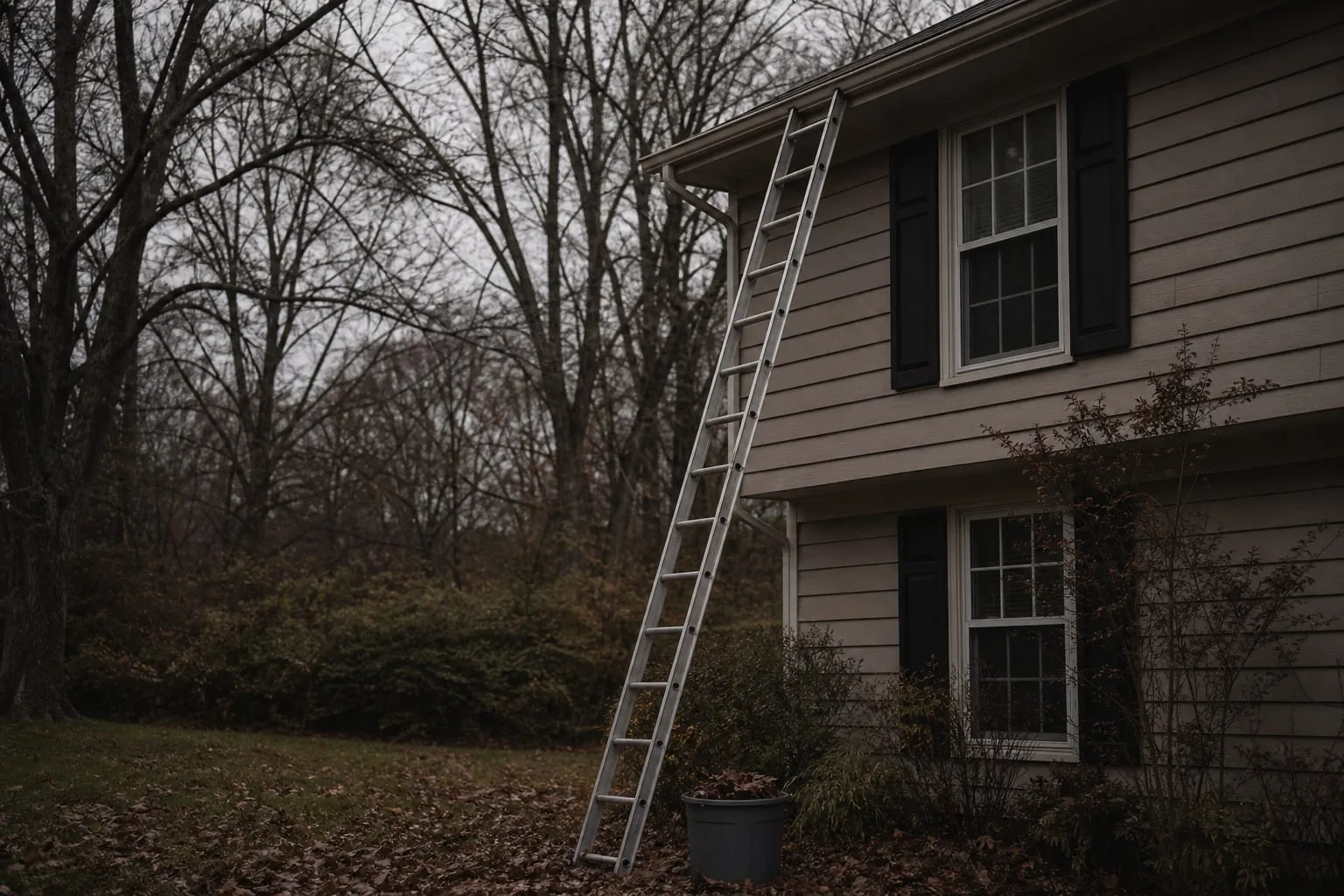
The decision most households actually face is not whether they are capable of cleaning their own gutters. It is whether they are capable of cleaning eleven separate runs, two of them over a deck at second-story height, inside the ten days between the last leaf drop and the first hard freeze. Those are different questions with different answers, and treating them as one question is where the money goes wrong in both directions. People pay a crew for a job they could have done in forty minutes, and people spend three weekends on a job a crew would have finished before lunch. The variable that separates them is rarely skill. It is count, access and timing, and the season moves all three.
Count the units before you price the task
Ask a contractor what a job costs and you get a number attached to a scope. Ask yourself what a job costs and you should be counting units: how many windows, how many gutter runs, how many ladder repositions, how many trips to the curb with bags. A single unit tells you almost nothing about twenty, because the cost of one unit is mostly setup and the cost of twenty is mostly repetition. Washing one exterior window is trivial. Washing twenty-two, from a ladder that has to be moved and leveled each time, is a physical job with a real injury profile. The threshold usually sits somewhere between six and ten repetitions, and it sits lower every year you age.
This is also why quotes feel irrational until you do the arithmetic. A crew charges roughly the same to show up whether the job is small or medium, so the small job looks overpriced and the large one looks like a bargain. Neither impression is useful. What matters is the per-unit figure, and the honest comparison is that figure against your own hour, at the point in the year when your hours are scarcest.
Fall is the season with deadlines attached
Autumn upkeep is unusual because the tasks come with an outside date that nature sets rather than you. Gutters have to be clear before sustained freezing, because ice in a blocked gutter does not stay in the gutter. Hoses have to come off spigots. Dryer vents and heating filters want attention before the equipment runs hard for four months. None of these jobs is difficult. What makes them worth paying for is that they cluster, they compete with each other for the same three or four dry weekends, and the penalty for missing the window is not a dirty house but a repair bill.
So the fall rule is a scheduling rule. Pick the one or two tasks you will genuinely finish yourself and hire the ones that have to happen on a date. If a household can only guarantee two productive Saturdays in October, the paid crew is not buying labor, it is buying certainty about the calendar, and that is worth more in November than it looked in September.
Winter buys access, not expertise
When the outside work stops, the jobs worth hiring change character entirely. Interior deep cleaning, carpet extraction, duct and vent work, appliance pull-outs: these are jobs where a household is not short on ability but short on equipment and on the willingness to move a refrigerator alone. A rented extractor and a Saturday will clean three rooms adequately. The whole house, done to a standard that lasts, is a different job, and the difference is again repetition rather than technique.
Winter is also when the honest safety accounting happens. Ladder work in cold weather, on frost, over a hard surface, is the single upkeep activity where the household lens diverges most sharply from the institutional one. The Occupational Safety and Health Administration is responsible for the rules that govern fall protection when a crew does this work for pay, which means the person you hire arrives with training, footing equipment and a second set of hands that you do not have on a Tuesday afternoon. That is not an argument against ever climbing a ladder. It is an argument for hiring out the specific climbs that are high, repeated, or over something unforgiving.
Spring resets the count upward
By March the list is long again, and it is long in a particular way: everything has accumulated at once. Winter grime on every window, salt and sand on every hard surface, debris in every bed, whatever came down in the last storm. Spring is the season where the unit count is highest and therefore the season where hiring out pays most clearly. It is also the season with the most competition for good crews, which means the households that decide in February get a better price and a better date than the ones that decide in May.
The useful move here is to split the list by whether the work is bounded or open-ended. Bounded work, a window count, a specific number of gutter feet, one driveway, prices cleanly and hires well. Open-ended work, the tidying and sorting and hauling that expands to fill whatever time exists, almost never prices well and is better kept in-house, done in short sessions across several weeks.
The three questions that build the judgement
Over a couple of years, most households can replace instinct with a short test. How many times does the motion repeat, and does the count cross the point where fatigue starts making the work worse? Does the job require access you cannot get safely and repeatedly, height, weight, a crawlspace, a roof pitch? And what does a mediocre outcome cost, nothing, or a wall? Repetition, access, consequence. Two yeses and the job is worth a quote.
Run that test once a season rather than once a year and the list stops feeling like an argument with yourself. The same task lands on different sides of the line in October and April, and that is the system working, not a failure of nerve.