Cars
Quoted for Brake Pads and Billed for a Caliper? The Authorization Rule That Decides Who Pays
A seized caliper found mid-job is the narrow case where written estimate rules, teardown clauses and parts-return rights all start to matter at once.
Theodore Kranz|
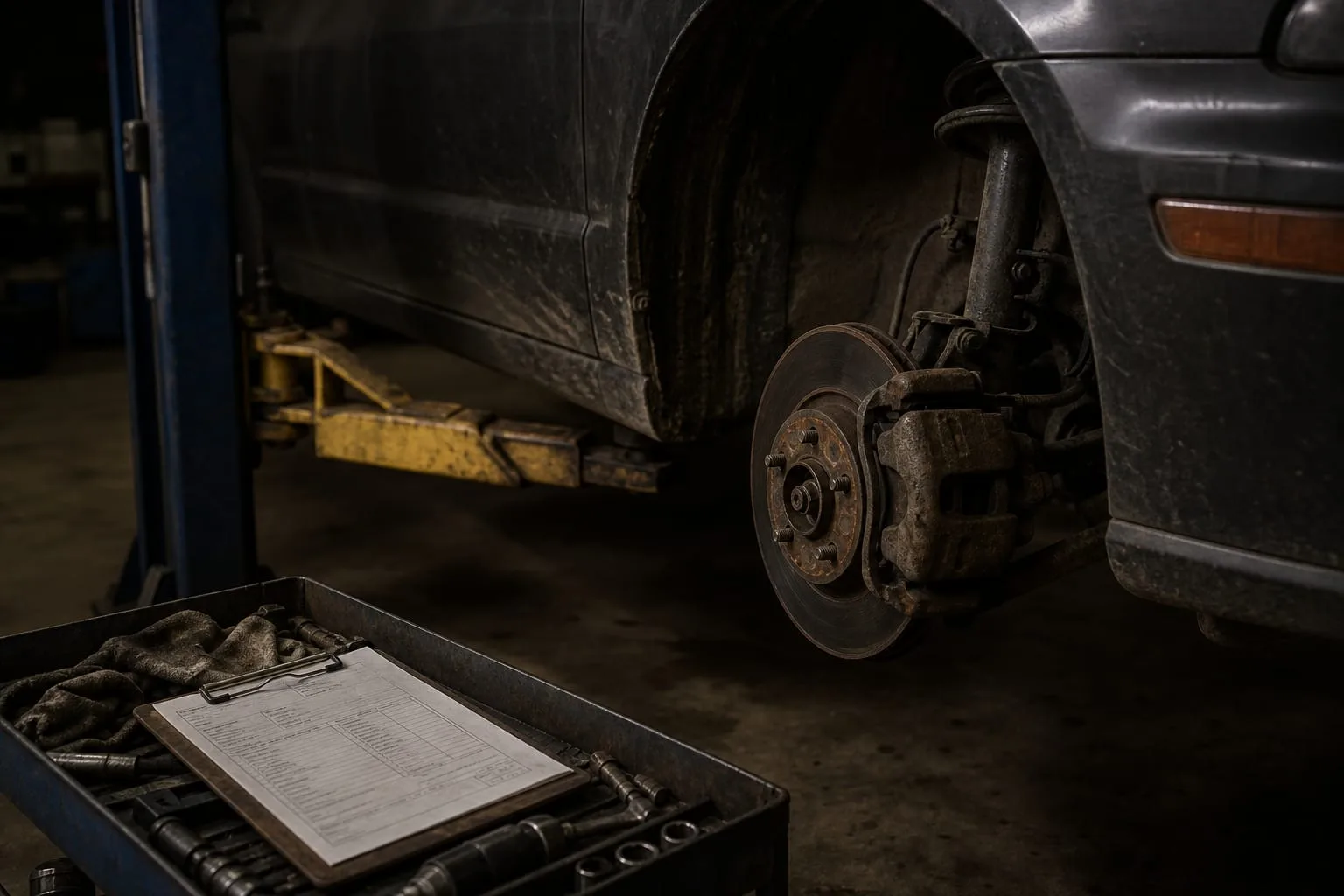
The phone quote was for front pads and rotors on a car with about a hundred thousand miles on it, and the shop was clear that the number assumed nothing else was wrong. Two hours later the service writer calls: one caliper is seized, the slide pins are rusted into the bracket, and the job is now materially larger than the one you agreed to. Most drivers say yes on the spot, because the car is in the air and the day is already spent. That yes is the moment the paperwork either protects you or does nothing at all, and the difference was decided before the car went on the lift.
Why the seized caliper is the case worth studying
Brakes are the cleanest example of a job that can honestly grow, which is exactly why it is worth understanding. A caliper that will not release is not a padding item invented to inflate a ticket; it is a real failure, it is often invisible until the wheel comes off, and leaving it in place ruins the new pads within months. So the question is almost never whether the extra work is legitimate. The question is procedural: who was allowed to authorize it, in what form, and at what price, given that the original estimate covered a narrower job.
That is where two shops handling the identical discovery diverge. One calls, describes the part, quotes the added labor and parts separately, notes the new total, and asks you to approve it before touching anything. The other completes the repair and shows you the number on the invoice, treating your original approval as consent to whatever the car turned out to need. Both cars stop properly at the end. Only one of them leaves you with a bill you had the practical ability to refuse.
What the estimate has to do before the wrench turns
Auto repair is regulated mostly at the state level, and while the details vary, the architecture repeats. A shop that will exceed some stated threshold, whether measured as a percentage above the written estimate or a flat dollar amount, generally has to obtain fresh authorization from the customer rather than proceeding on the strength of the first approval. Many states also require that the authorization be recorded: the date, the time, the person who gave it, and the revised figure. The Federal Trade Commission, which oversees unfair and deceptive practices in consumer transactions, has long treated repair billing as territory where what the customer agreed to actually matters.
The practical consequence is that a verbal yes given on a cell phone in a parking lot is worth far more to you if the shop writes it down, and worth almost nothing if nobody does. A shop with good habits will read the revised total back and note it on the work order, and you can ask for the amended estimate to be emailed or texted while you are still on the call. That takes a minute. It converts a disputed conversation into a document, and documents are what the state agency handling repair complaints can actually act on.
The clause that only becomes expensive if you say no
Now read the line at the bottom of the estimate you signed at drop-off, the one covering diagnosis and disassembly. Two versions circulate and they behave very differently under one specific condition. The friendly version says the diagnostic charge is waived, or credited, if you have the repair done at that shop. The other version says the customer is responsible for the cost of teardown and reassembly if the recommended repair is declined, and sometimes adds that the shop is not obliged to return the vehicle to operating condition unless you pay for that separately.
Under the ordinary path, where you approve the caliper and drive away, neither clause costs you anything. It only bites in the one scenario the clause was written for: you want a second opinion, or you want the car moved to a shop that quoted better on the caliper, and the car is now in pieces. Ask at drop-off what happens if you decline the repair, and ask for the reassembly figure in writing. Shops that quote it plainly are common, and knowing the number in advance is what keeps the second opinion an option rather than a theory.
Old parts, itemized labor, and shop supplies
Most states give the customer a right to the replaced parts on request, with sensible carve-outs for warranty returns and core charges on rebuilt units, and a caliper is very often a core. The right is useful less for the metal than for the verification: a caliper with a piston frozen in the bore tells the story instantly, and asking for it in advance signals that you read the invoice. Ask at drop-off, in writing on the work order, because a part requested after the fact has usually gone into the parts bin or back to the supplier.
Then look at how the revised invoice is built. Parts and labor should appear as distinct lines, with the labor either at a stated hourly rate against stated hours or as a flat-rate operation identified by name. A separate percentage line for shop supplies is normal in much of the trade, but it should be a small proportion and it should have been disclosed on the original estimate rather than appearing for the first time at checkout. When both quotes are itemized this way, comparing them stops being guesswork and becomes arithmetic.
Comparing two quotes on the same job
Once the caliper is known, get the second quote on identical terms: same part quality, whether new or remanufactured, same brand or an equivalent, same hardware, same bleed procedure, same warranty in months and miles. A price gap on a brake job is usually made of part grade and labor time, and both are visible if you insist on the breakdown. Ask which parts carry a nationwide warranty honored away from home, because that clause matters on a road trip and is invisible in the total. The shop that answers all of this without hesitation is generally the one to use.
The car will need brakes again in a few years, and the same discovery can happen on the rear axle. Keep the amended estimate, the itemized invoice and the warranty terms in one folder, and the next quote you receive has something concrete to be measured against.