At Home
Third Claim in Twelve Years? The Two Files That Keep an Adjuster's Visit Short
A running log and a room-by-room inventory do more for a damage claim than any app, and they change what the adjuster can argue about.
Lucinda Fairbairn|
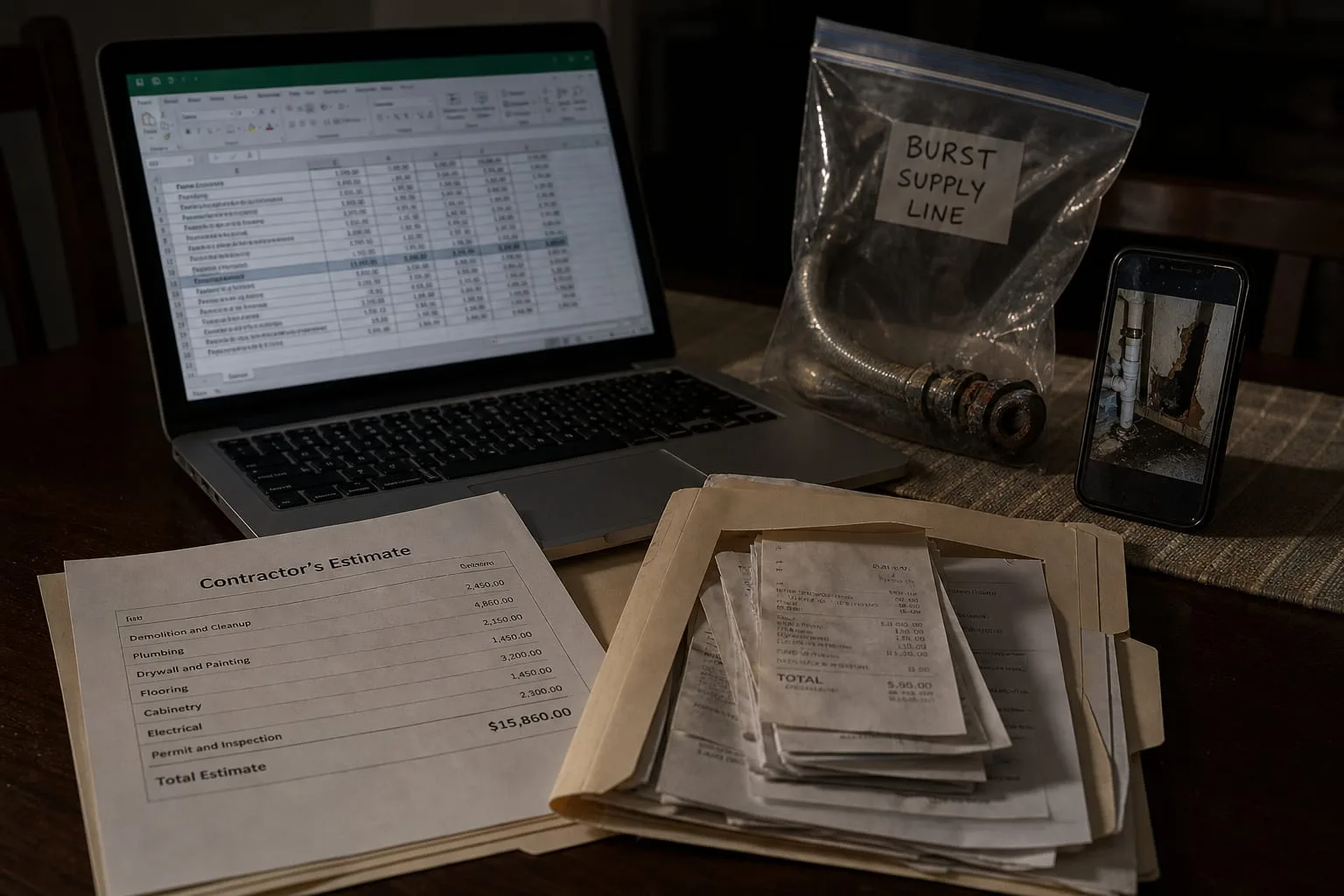
The households that get through a damage claim without losing weeks to it are rarely the ones with the best policy. They are the ones who started writing things down on the first afternoon, before anyone from the insurer had called back, and who kept writing things down after the interesting part of the emergency was over. An adjuster's visit is a fact-finding exercise with a clock on it. What you hand over decides whether that clock runs for ninety minutes or spreads across three appointments and six weeks of email, and the difference is usually two ordinary documents rather than any piece of software.
Who the adjuster answers to, and what that changes on your side of the table
Three arrangements come up. A staff adjuster is the insurer's employee, salaried, working a queue of files with company guidelines in front of them. An independent adjuster is a contractor the insurer hires when volume spikes, common after a regional storm, and they carry a file for a fee rather than a paycheck. A public adjuster is the one you hire yourself, licensed by the state, typically paid a percentage of the settlement. The first two are competent and often reasonable, but they are not your representative, and the paperwork burden lands on you in both cases.
Deciding whether to bring in a public adjuster is mostly a question of scale and stamina. On a claim in the low thousands, a contingency fee eats the margin that made hiring anyone worthwhile, and a well-kept file gets you the same number. On a total loss, a large fire, or a claim where the scope keeps shrinking each time someone new looks at it, a public adjuster earns the percentage by arguing over line items you would never think to raise. The people who have done this repeatedly tend to keep their own file either way, because a public adjuster who inherits an organized record starts three weeks ahead.
The running log, which is dull, and the inventory, which is tedious
The first file is a single dated log of everything that happens: when the water was discovered, who was called, when the mitigation crew arrived and left, which fan ran in which room, every phone call with a name and a claim reference attached. It lives in one document, appended to at the end of each day, never reconstructed from memory later. The second file is a room-by-room inventory of damaged property with description, approximate age, what was paid, and where it came from. Neither is clever. Both settle arguments that otherwise turn into a claimant's word against an estimate.
The inventory is where most households give up, and it is also where most of the recoverable money sits. Building damage gets measured by the adjuster with a laser and a sketch program, so your influence there is limited to pointing things out. Contents are different. Nobody but you knows the age of the rug, the brand of the mattress, or that the finished basement held a second refrigerator. Working room by room with a phone in one hand and the log open in the other, an hour a night for a week, produces a schedule that an adjuster can price. A vague list of nouns cannot be priced at all.
Photographs by the hundred, sorted or not
Everyone takes pictures now, which has quietly become the problem. Four hundred images in one camera roll, undated in any way the adjuster can use and unsorted by room, is raw material rather than evidence, and it tends to sit unopened. The alternative costs about twenty minutes: folders by room, filenames that say what they show, a wide shot of every space before anything is moved, then close work on serial numbers, model plates, and the failed component itself. Keep the failed part if you safely can. A split supply line in a bag has ended more coverage disputes than any photograph of the ceiling below it.
Carrier apps and photo-upload portals are genuinely useful for speed, and using one does not replace your own copy. Portals close, files get archived, and adjusters get reassigned mid-claim more often than anyone admits. Keeping the master set in your own cloud folder, with the log and the inventory beside it, means a reassignment costs you one email rather than a repeat of the whole exercise. FEMA, which oversees federal disaster assistance, has long treated contemporaneous documentation as the backbone of any damage claim, and the logic holds identically for a single burst pipe in a quiet January.
Two estimates in the same room
The adjuster's scope arrives as a line-item estimate produced by pricing software, and the useful move is to set a contractor's written estimate beside it and read for absence rather than for price. Disagreements are seldom about the unit cost of drywall. They are about whether the scope includes baseboard removal, floor leveling, paint to a natural break rather than a patched square, or a dumpster. Reading the two documents in parallel, marking every item on one that has no counterpart on the other, gives you a short specific list to raise. That list gets answered. General dissatisfaction does not.
This is also where the maintenance record starts paying. Receipts for the water heater replacement, the annual furnace service, the roof inspection after the last hailstorm: these establish that the loss was sudden rather than the end of a long slow decline, which is the distinction most coverage arguments actually turn on. Households that keep a plain folder of service records, one per system, find that the folder answers a question the adjuster was about to ask. The claim moves. Nobody has to prove a negative from photographs alone.
The file outlives the claim. Kept in one place, it becomes the baseline for the next one, and there is usually a next one somewhere in a decade of owning a building. The second time through, the log takes minutes to start, the inventory is half written already, and the adjuster's visit is short.