Cars
Two Numbers on a Repair Estimate, and the Parts Supplier Who Sets One of Them
A garage quote is really two businesses stapled together, and the parts distributor behind the second one explains most of the gap between competing estimates.
Rafael Quintanilla|
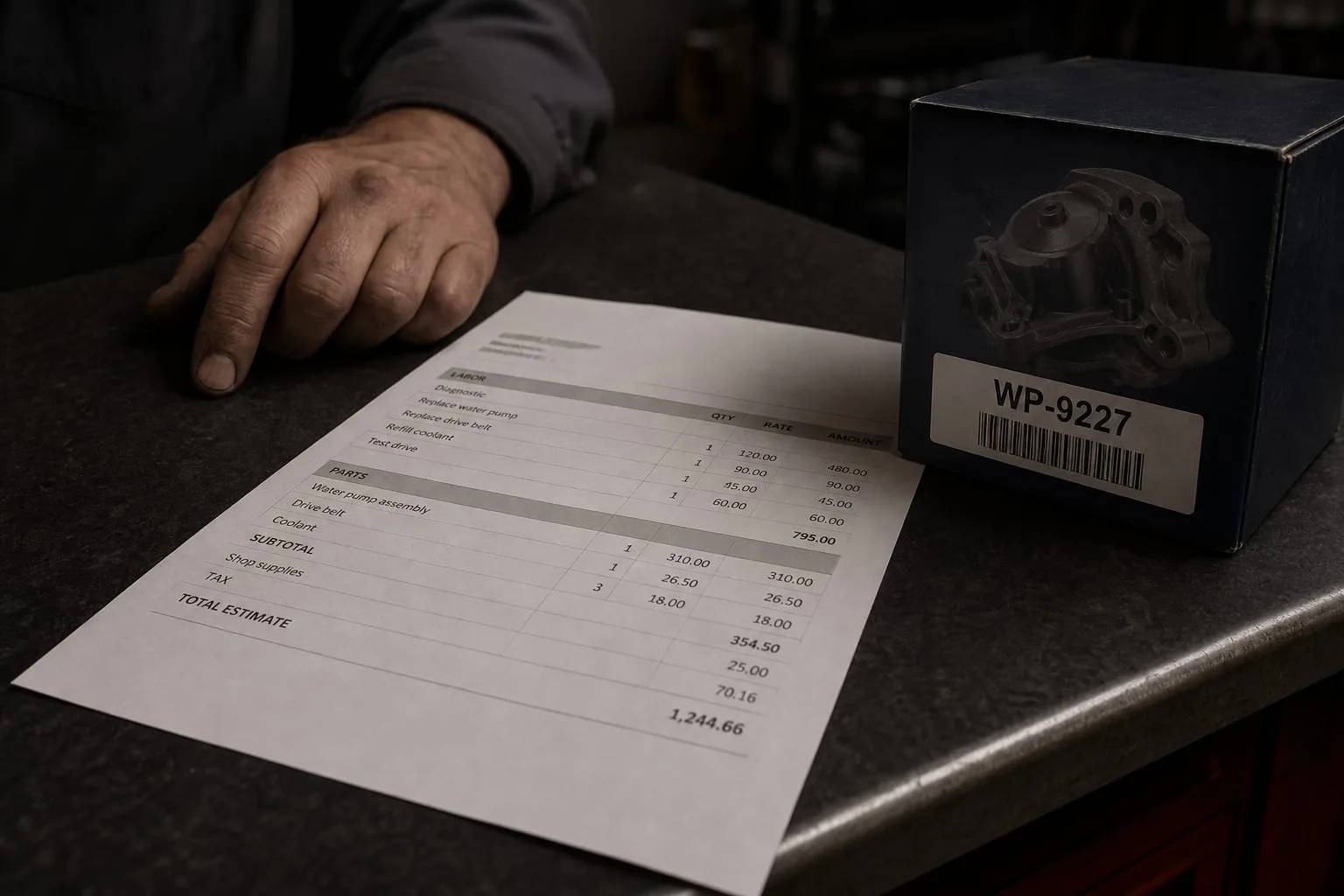
Most people read a repair estimate the way they read a restaurant check, top to bottom, looking for the total. The useful reading is sideways. Nearly every quote you will be handed is two separate businesses printed on one sheet: a labor operation, priced in tenths of an hour against a published time standard, and a parts transaction the shop did not manufacture, does not stock in most cases, and buys from somebody else that morning. Those two halves behave differently, move differently, and are negotiable in completely different ways. The customer who knows which half they are looking at asks better questions and gets shorter answers.
The party nobody in the conversation mentions
When two quotes for the same water pump arrive four hundred dollars apart, the instinct is to assume one shop is honest and the other is not. Usually the gap is upstream. Behind almost every independent garage sits a parts distributor, sometimes a national chain's commercial counter, sometimes a local jobber, sometimes a dealer parts department for the odd component nobody else carries. That supplier sets the shop's cost, the delivery window, the return policy on an unused part, and the terms of the warranty that will be honored if the thing fails in fourteen months. The shop marks it up. The supplier decided what it was marking up from.
This matters because it changes what you are actually asking when you push back on price. Asking a service writer to cut a labor rate is asking them to work for less. Asking whether the part was quoted as original equipment, aftermarket, or remanufactured, and who the supplier is, is asking them to describe a decision they made on your behalf without telling you. That decision often has three legitimate answers at three prices, and most shops will walk you through all three if you show you understand there are three. The Federal Trade Commission oversees how repair pricing and warranty terms are represented to consumers, which is why the written estimate exists as a document rather than a courtesy.
The paperwork that turns two quotes into a comparison
A quote you cannot compare is not a quote, it is a number. Four things make one comparable, and you can ask for all four in a single phone call. First, the VIN, because the same model year frequently takes two different parts depending on build date, and a quote written off the license plate alone sometimes prices the wrong one. Second, the part numbers, written out, not described. Third, the labor time in hours, separate from the rate, because the industry prices most operations against published flat-rate guides and a shop quoting three hours for a job the guide calls one and a half owes you a sentence about why. Fourth, the diagnostic fee and whether it is credited against the repair.
With those four items you can lay two estimates side by side and see immediately where the money actually differs. Sometimes the labor hours are identical and one shop priced an original equipment part while the other priced a remanufactured unit with a one-year warranty. Sometimes the parts are identical and one shop is quoting a longer teardown because it plans to replace the surrounding gaskets while it is in there, which is often the right call and always worth knowing about in advance. The comparison stops being a guess and becomes a set of small, answerable questions.
The three questions that actually move a number
Ask what the part's warranty is and who honors it. There is a real difference between a warranty the shop stands behind, labor included, and a parts-only warranty from a distributor that pays for the component and leaves you paying twice for the installation. On a job with eight hours of labor in it, that distinction is worth more than the entire price difference between brands. Ask whether a lower-cost alternative exists and what the shop thinks of it, because most technicians have strong, specific, experience-based opinions about which aftermarket brands fail early, and they will share them when asked directly. Ask what happens if the part arrives wrong.
That last question sounds procedural and is not. Return policy on a special-order part determines whether a shop is willing to try the cheaper option at all, and it explains a lot of conservative quoting. A supplier that accepts returns on an electrical component lets the garage take a chance. One that does not means the garage eats a bad guess, so it quotes the safe part every time. When you hear the reasoning, you are no longer negotiating against the shop. You are both looking at the same constraint.
Where one car and twenty cars stop having the same answer
For a single household vehicle, all of this is a phone call and a folder. You keep the written estimates, the invoices with part numbers on them, and a note of the mileage, and that record does most of the work the next time something fails near the same corner of the engine. The economics do not justify anything heavier. Nobody needs a purchase order system for two brake jobs a year, and the time spent building one would exceed anything it saved.
The threshold sits lower than most owners expect, somewhere around three to five vehicles in regular service, and it is triggered by frequency rather than fleet size. Once a garage sees your name monthly, you are a commercial account whether or not anyone has used the phrase, and that changes the conversation about parts materially: a standing labor rate, a documented markup on parts rather than an improvised one, and in some cases the option to supply parts yourself against a shop that will still warrant the labor. At around ten or twenty units, most operators go further and open an account directly with the distributor, which converts an invisible party in every transaction into one they can call. The paperwork gets heavier because it is finally paying for itself.
The single practical habit that spans every scale is writing down the part number. It survives staff changes at the shop, it settles arguments about whether a component was replaced before, and it lets you price a repair in ninety seconds the next time. One car, five cars, or twenty, that one field on the invoice does more work than anything else on the page.