At Home
The Caulk Seam Nobody Owned, and Why Eighteen Units Broke a Habit That Worked for Two
A failed shower seam cost one owner a subfloor and a ceiling, and the reason sat in a cleaning contract that paid for surfaces and not for looking.
Rafael Quintanilla|
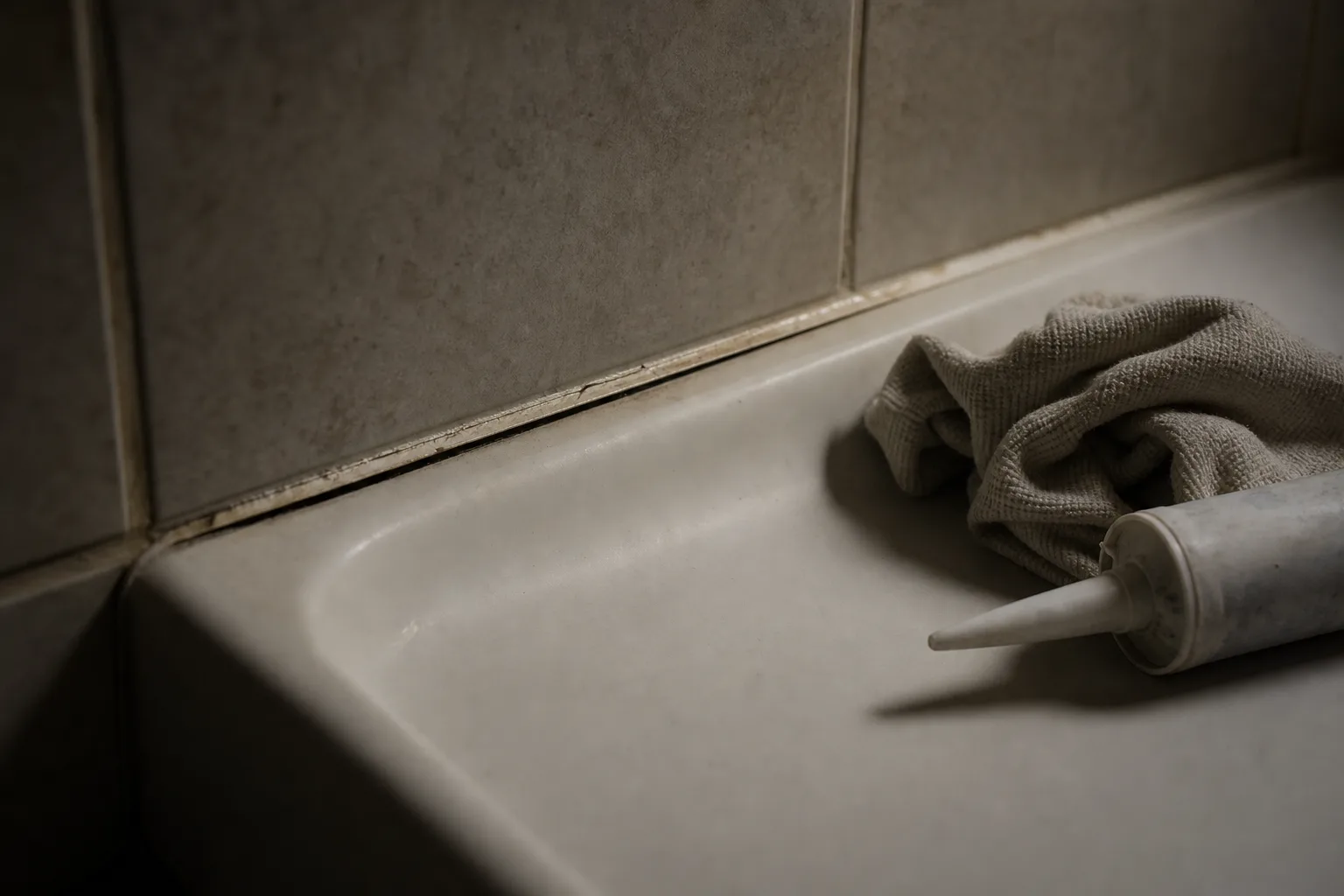
The failure began as a dark line in the caulk where a fiberglass shower pan met the tile surround, maybe four inches of it, on the side of the pan farthest from the door. Anyone standing in that bathroom with a rag would have run a thumb along it and felt the softness. Nobody did, for roughly two years, across four tenancies and four turnover cleans. When the downstairs neighbor reported a stain spreading across her kitchen ceiling, the repair had grown from a tube of silicone and twenty minutes into a subfloor section, a vanity, a ceiling, and a unit held off the market while the framing dried.
The seam that nobody owned
The owner in this case had eighteen units spread over four small buildings, all of them bought between 2014 and the present, all of them turned over by the same cleaning company on a flat per-unit rate. The contract was clean, legible, and precisely scoped: appliances inside and out, cabinet interiors, floors, fixtures, windows inside, blinds wiped, trash hauled. Nothing in it said look. Nothing in it said report. A crew of two moved through the unit in a little under three hours, did exactly what was listed, and left. The seam was within arm's reach of every one of them, and it was nobody's job.
That is the part worth sitting with, because it was not negligence by any individual. The cleaners did what they were paid to do, and did it to a standard the owner had never once complained about. The leak compounded in the gap between two reasonable positions: the owner assumed that someone physically present in the bathroom would mention a visible problem, and the cleaning company assumed that a flat-rate scope was the whole of the obligation. Both were behaving rationally. The structure between them had no place to put an observation, so observations went nowhere.
What the same decision looked like ten years ago
In 2015 this same owner had two units, one of which he lived in. Turnover cleaning was him, a bucket, and a Saturday. He was not inspecting, exactly, but he was present on every surface of the unit twice a year, and presence does most of the work that inspection claims to do. He would have found that seam in the first pass, not because he was diligent but because he was the one holding the rag. The decision to clean a vacant unit, back then, carried a free inspection inside it, bundled so tightly that he never priced it separately and never knew he was getting it.
The market he buys that service in now is different in a way that matters more than the price. Flat-rate turnover cleaning has become a scheduled, routed, app-dispatched product, and the economics reward speed and predictability over continuity. Ten years ago the person who cleaned your rental was often the same person each time, worked hourly, and had a phone number you answered. Now the crew rotates, the booking is confirmed through a portal, and the two people in the bathroom have never seen that bathroom before and will likely never see it again. Nobody can notice a change over time if nobody is present twice.
So the decision that looked identical on the invoice, hire someone to clean the unit between tenants, quietly stopped including something it used to include. The line item did not change. The scope did not formally narrow. What changed was that the service was industrialized, and industrializing a service means stripping out everything not specified, which is usually the informal, unpriced, enormously valuable part. The fix is not nostalgia for the old arrangement. It is noticing what the old arrangement was secretly paying for and buying it back on purpose.
The party in the transaction most owners overlook
Owners think about tenants, lenders, insurers, contractors, and the city. They think about the cleaner as an expense line, scheduled and forgotten. But the cleaner is the only party who touches every surface of every unit on a predictable cycle, including the undersides, the backs of appliances, the corners behind doors, and the base of every toilet. A plumber sees one fixture when it has already failed. An inspector sees the building once every few years and mostly from the middle of the room. The cleaner is standing on the exact square foot where water first appears, several times a year, holding a light.
Treated as a party with information rather than a vendor with a checklist, that person is the cheapest early-warning system a small portfolio can buy. The Environmental Protection Agency is the federal body responsible for guidance on indoor moisture and mold, and the whole thrust of that guidance is that the determinative variable is time: how long a wet surface stays wet before anyone acts. Shortening that interval is worth more than any single repair decision made afterward. The crew with the rags controls that interval, and in most small-portfolio contracts they have no mechanism, no incentive, and no permission to use it.
Giving them one is unglamorous and cheap. It means adding ten or fifteen minutes to the per-unit scope, paying for it at the same rate as the rest, and naming six specific things to photograph regardless of condition: the shower seam, under the sink traps, the base of the toilet, the ceiling of the lowest unit, the washer supply lines, and the area behind the refrigerator. Photographs, not judgments. The crew is not being asked to diagnose anything, which is important, because asking an untrained person to assess damage produces either silence or alarm. Asking for the same six photographs every time produces a record, and a record shows change.
Where the threshold sits between one unit and twenty
The answer for one property is that you are the observer, and no process beats your own eyes in a house you occupy. The answer for twenty is that observation has to be purchased, specified, and documented, because you will not be in those rooms often enough for intuition to work. The interesting question is where between those two the answer flips, and in my experience it is much earlier than owners expect. It is not fifteen units. It is roughly three to five, and the trigger is not the count itself but the moment you stop personally walking every unit between tenancies.
That moment usually arrives for a reason unrelated to scale: a job change, a second child, a move to another state, a building bought forty minutes away instead of four. The portfolio does not feel different the week after. Nothing breaks. The decay is silent by construction, since the whole category of problem we are discussing is the kind that produces no symptom until it produces an expensive one. An owner can cross the threshold in March and not learn he crossed it until the following winter, which is precisely what makes the count a useful proxy. When you can no longer promise yourself you will be inside every unit twice a year, you have crossed it.
Past that line, the arithmetic changes shape entirely. One unit missing one seam is a bad afternoon. Eighteen units, each with a shower, a dishwasher, a water heater, a washer hookup, and a toilet supply, is roughly ninety independent chances a year for a slow leak to begin unobserved, and slow leaks compound on a schedule nobody is watching. The per-unit cost of adding inspection photographs to a cleaning scope is small and fixed. The cost of one unobserved seam is large and variable and lands without warning, usually on a unit that was otherwise performing well.
What the owner changed, and what it caught
He rewrote the cleaning agreement rather than switching companies, which was the right call, since the company had never underperformed its scope. The new scope paid for the extra minutes explicitly, named the six photograph points, required the images to be uploaded with the unit address and date, and specified that the same lead cleaner would be assigned to a given building whenever scheduling allowed. That last clause was the one he almost cut for cost, and it is the one that restored what the 2015 arrangement had given him for free: a person who had seen the room before and could tell that something looked different.
Within the first year the photographs caught a weeping shutoff valve behind a toilet in another building and a soft patch of drywall under a kitchen sink, both at the stage where the repair is a part and an hour. Neither would have surfaced on a complaint call, because neither was visible to a tenant going about an ordinary day. The compounding had been interrupted early, which is the only point at which interrupting it is cheap.
The lesson generalizes past rental property to anyone whose holdings have outgrown their own attention: a vacation house, a small office, a parent's home two states away. Someone is already in those rooms on a schedule. The question is whether the arrangement with that person has anywhere to put what they see.