Family
Reading a Funeral Price List? The Three Buckets, and Which One You Can Decline
A funeral bill is three different kinds of money stacked together, and only one of them is genuinely fixed. Here is how a household tells them apart in an afternoon.
Lucinda Fairbairn|
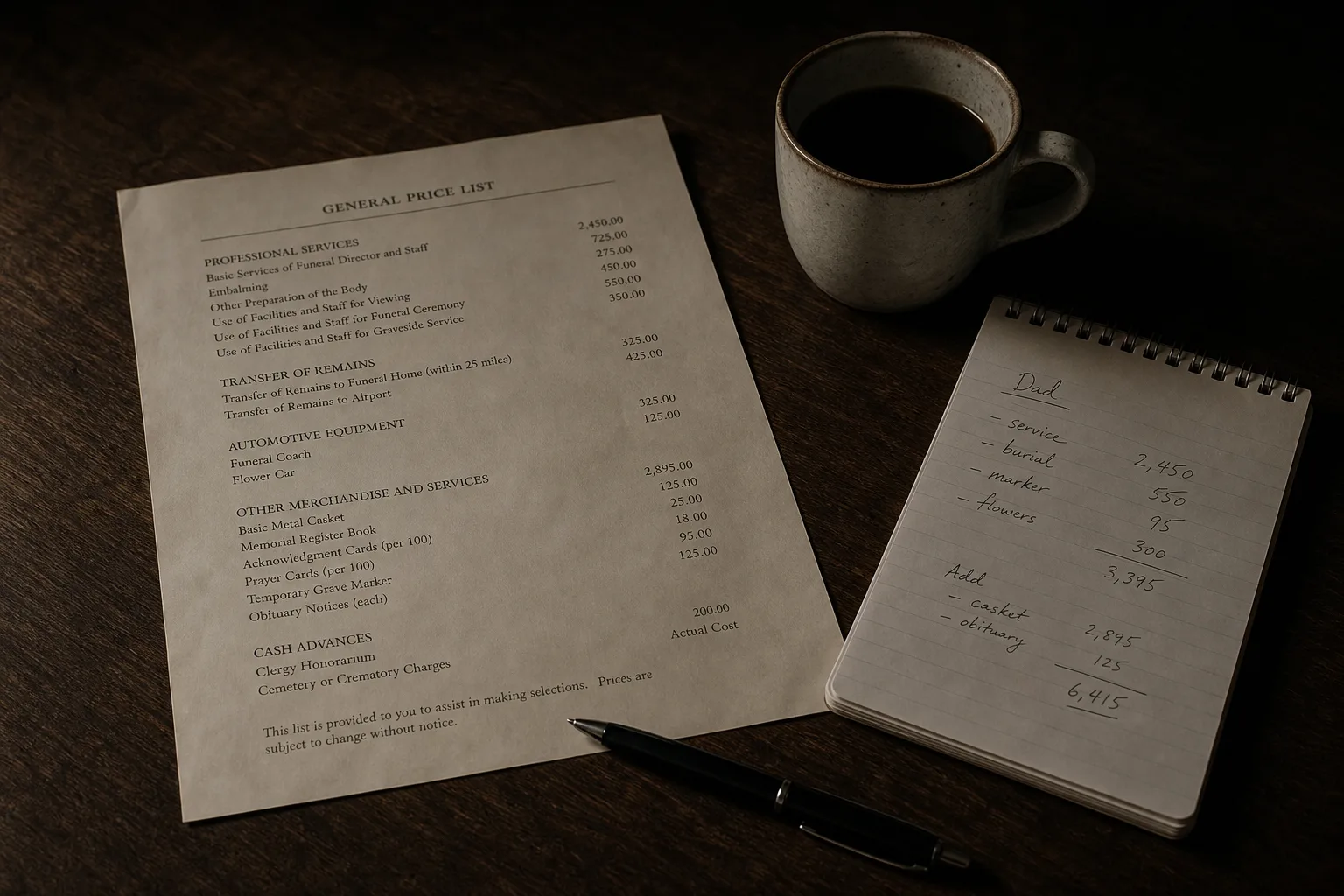
A funeral bill arrives looking like one number, and that is the first thing working against the person reading it. What it actually contains is three separate kinds of money, governed by three different sets of rules, with three different degrees of room to move. A household that can sort a price list into those three piles in twenty minutes will make better decisions than one that spends two hours agonizing over the whole sheet at once, because the agonizing is spread evenly over items that cannot be changed and items that can be declined outright. The sorting is the skill. Everything else follows from it.
The basic services fee, the merchandise, and the money that is only passing through
The first pile is the funeral home's own non-declinable charge, usually called a basic services fee, which covers the time of the staff, the overhead of the building, the planning conference, the permits and the coordination with the cemetery or crematory. You will pay it whether you hold a full service or collect cremated remains and leave. The second pile is merchandise: the casket, the outer burial container, the urn, the register book, the printed folders. The third pile is cash advances, which are sums the funeral home pays out on your behalf to someone else: the cemetery's opening fee, the clergy honorarium, the obituary placement, the certified copies of the death certificate. Those three behave nothing alike, and treating them as one line of spending is where most of the regret comes from.
Merchandise is where the range is widest and the markup least visible, because the items sit beside one another in a selection room and the comparison the room invites is between a plain casket and a better one, not between buying there and buying elsewhere. Cash advances are closer to pass-through, though not always exactly so, and the useful question is whether the funeral home is charging you what it was charged. The basic services fee is the figure that separates one firm from another more reliably than anything in the catalog, and it is the number to ask for first when you call around. Two homes four miles apart can differ substantially on it.
How to tell what is required from what is merely offered
Requirements come from three places, and they are frequently confused with one another by people who should know better. State law sets a small number of genuine mandates, generally around permits, transport, timing and the handling of remains, and it is narrower than most families assume. The cemetery sets its own rules, which are contractual rather than legal but just as binding once you have bought a plot there, and these cover outer burial containers, marker materials, foundation work and who may perform the interment. The funeral home sets policies of its own, which are the most negotiable of the three and the most often presented in the same tone as the other two. Asking which of the three a given requirement comes from is a fair question and a revealing one.
Embalming is the clearest illustration. It is rarely required by law for an immediate burial or a direct cremation, it is frequently required by a funeral home as a condition of a public viewing with the body present, and the family that wants a viewing without embalming can often get one with refrigeration and a shorter window if it asks early enough. The Federal Trade Commission oversees how funeral providers disclose prices and present these choices, including the family's right to receive an itemized general price list and to decline goods and services it does not want. Knowing that right exists changes the conversation from a package selection to a line-by-line one, which is the conversation you want.
The choices that keep asking for money after the week is over
Most of the attention goes to the week of the funeral, and most of the long tail of cost sits outside it. A grave needs care, and whether that care is bundled into a perpetual care fund at purchase or billed to the family in some other form, it is a commitment that outlives everyone making the decision. A bronze marker needs periodic cleaning, and the cemetery may do it or may not. A granite monument set on a foundation will eventually settle, and resetting it is billable work. Cremated remains kept at home are free to keep and awkward to pass on, which is a cost paid by the next household rather than yours, though it is a real one.
Certified copies of the death certificate are the clearest case of a small decision that gets expensive through repetition. Each one costs a few dollars and each institution that settles an account will want its own: the bank, the pension administrator, the life insurer, the county for the deed transfer, the IRS if a final return and an estate return are both in play, the DMV for a titled vehicle. Ordering too few means ordering again later at a higher per-copy inconvenience, and ordering a sensible surplus at the outset costs little. Count the accounts before you guess the number, then add a few.
Building the judgement in an afternoon rather than a crisis
The method that works is boring and takes about two hours. Collect general price lists from three funeral homes in your area, which they must provide, and lay the basic services fees side by side before looking at anything else. Then price the same disposition at each: direct cremation at all three, or immediate burial at all three, so that you are comparing one thing rather than three different arrangements. Then, separately, call the cemetery you would actually use and ask for its fee schedule and its rules on containers and markers. You now have the structure of the decision in front of you, and the structure is what families in the first forty-eight hours after a death almost never have time to assemble.
The second half of the judgement is deciding, in advance and in writing, what the gathering is for. A household that knows it wants forty people in a room with food and a photograph can buy that directly and decline the parts of a package that do not serve it, including the parts that assume a procession, a viewing or a graveside tent. A household that has not decided tends to buy the package, because the package is a decision someone else already made. Write down the three things that matter most, show that list to whoever is helping you, and let the itemized price list answer against it rather than against a catalog.
What to leave behind for whoever does this next
The most useful document a person can leave is not a prepaid contract but a single page naming the funeral home, the cemetery and plot if one is owned, the disposition preferred, and the three things that matter. Prepayment has its place, particularly where it is held in a regulated trust or an insurance-funded arrangement that travels, but it locks in a provider in a way a page of instructions does not. A page costs nothing to revise when you move states or change your mind. Keep it where the person who will need it can find it in an hour, not in a safe deposit box that takes a court order to open.
Families who do this work ahead of time rarely report that they spent less out of thrift. They report that they spent on the parts they had chosen, and that the bill, when it came, contained nothing they could not account for.