Law & Legal
Escalating a Billing Dispute, and the Notice Clause That Now Comes Before Everything Else
A composite case study of a $1,900 fee dispute shows how a recently added notice-and-conference clause changes the order you escalate in, and what each rung actually costs.
Theodore Kranz|
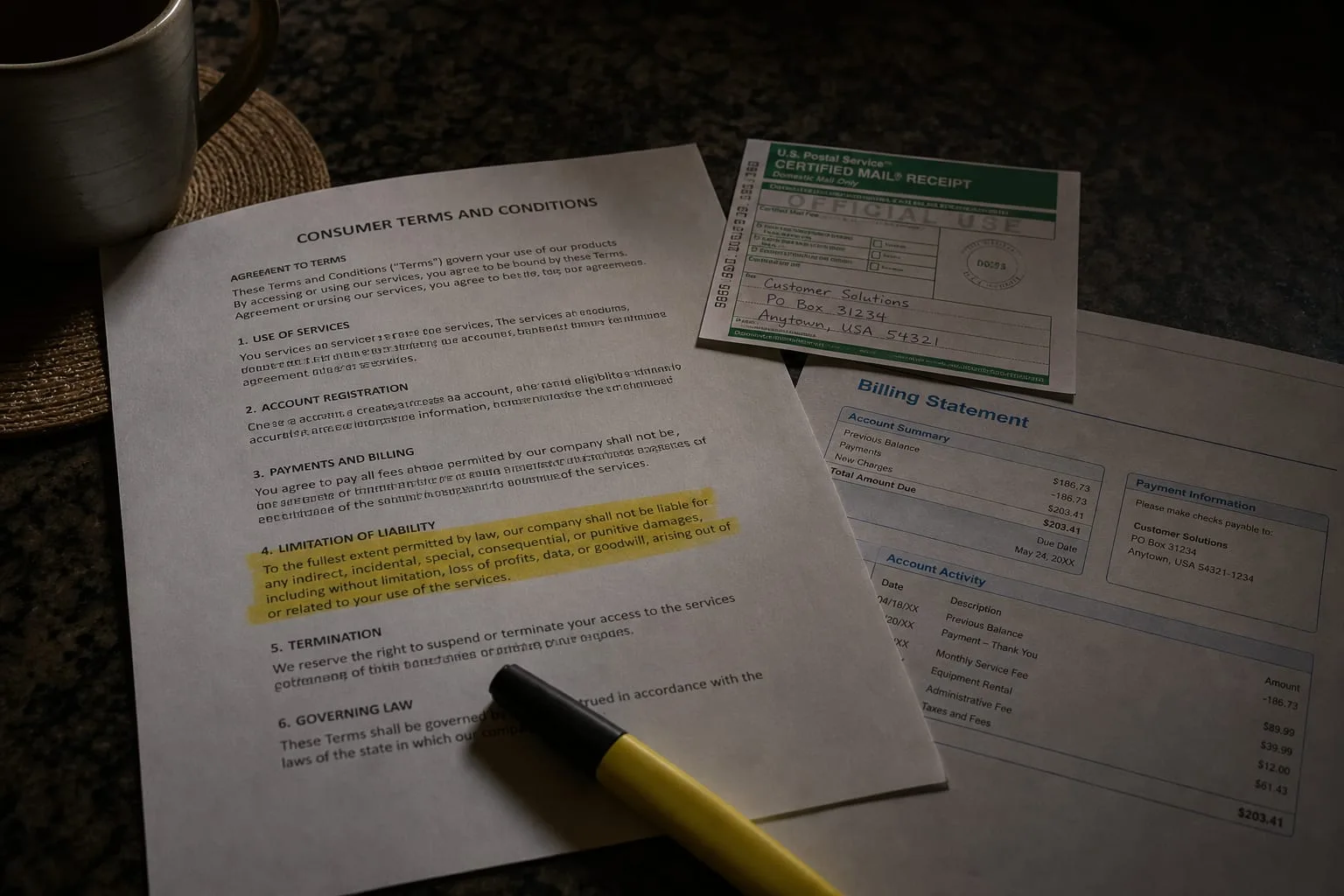
The dispute that follows is a composite, assembled from the kind of file that lands on a consumer attorney's desk four months too late: a homeowner, an account servicer, a recurring fee she believed she had canceled, and a paper trail that went almost everywhere except the one place her own contract told her to send it first. The amount at issue was a shade under nineteen hundred dollars, which is small enough that nobody sensible hires counsel to chase it and large enough that walking away stings. What made it expensive was not the company's resistance. It was sequence.
Four months of escalating, and the one rung she skipped
She started where most people start, which is the phone. Three calls, two of them ending in a promise to look into it, none of them producing a reference number she wrote down. Then she moved up: a message through the account portal, a complaint to her state attorney general's consumer division, a filing through the federal complaint portal, a review posted publicly, and finally a demand letter she drafted herself and sent by certified mail. Every one of those steps was reasonable in isolation. Taken together, out of order, they produced four months of correspondence and no binding deadline on anyone.
The company's responses were polite and non-committal, which is what responses look like when nothing obliges them to be otherwise. The regulator's portal generated a company reply within the window it allows, and that reply restated the fee schedule. Her demand letter went to the corporate mailing address printed on the statement rather than to the notice address buried in the terms, which is a difference of one paragraph in a document she had accepted electronically two years earlier. When she finally sat down with an attorney for a single paid hour, that paragraph was the first thing he read.
What changed in the small print, and why companies added it
Arbitration clauses in consumer agreements used to be short: disputes go to arbitration, class actions waived, done. Over the past several years, a great many of them have grown a front porch. The newer versions add an informal dispute resolution provision, and the provision has teeth. It typically requires a written notice of dispute, signed by the individual customer rather than a law firm on behalf of hundreds, containing specified contents: the account number, the customer's home address, a description of the claim, the relief sought. It then requires a waiting period, commonly sixty days, during which the company may demand a telephone conference before any formal filing is permitted.
The reason for the change is not mysterious. Mass arbitration, in which a firm files thousands of individual claims at once and the per-case administrative fees fall on the company, turned a defensive clause into a liability. Requiring individualized, signed, address-specific notices breaks the batch. That is a corporate motive, but it produces a consumer consequence that has nothing to do with mass filings. If you skip the notice step, the company can ask the arbitrator or the court to stay or dismiss your case as premature, and you go back to the start of a sixty-day clock you could have started on day one for the cost of a stamp.
What each rung actually costs, and what drives the number
The direct outlays in a dispute this size are small and easy to name. Certified mail with return receipt runs a few dollars. A small claims filing fee, where small claims is even available to you, generally lands somewhere in the tens of dollars, with service of process on top. An arbitration filing under most consumer clauses caps the customer's share at a low fixed amount, with the provider's remaining fees paid by the company. One paid hour with an attorney to read your contract and tell you which forum you are actually in is the single most useful purchase in the whole file, and it costs what one hour costs in your market.
The cost that hurts is not on that list. It is the delay, and delay has three drivers. The first is whether your dated written record exists at all, because a phone call that produced no reference number is, for practical purposes, something that did not happen. The second is whether you are complaining at a rung that carries a response deadline, since a portal message and a public review carry none while a properly addressed notice of dispute starts a defined clock. The third is whether the limitations period on your claim is running while you wait, and here the recent clauses are often generous: many suspend the deadline during the informal period, but only if the notice was sent in the form the clause specifies.
That is the clause that only becomes expensive under one condition. Tolling that depends on compliance is worthless to a person who complained loudly in five places and correctly in none. Read in the other direction, it is a gift. A single letter, sent early, freezes the calendar and forces a substantive answer, which is a better return per dollar than any other step in the sequence.
The order that works now
Start internally and in writing, on the same day the problem becomes clear, with a message that states the amount, the date, and the outcome you want. Then find the dispute resolution section of your agreement and follow it literally: notice address, required contents, signature, certified mail, a copy kept. Only after that clock is running should you file with a regulator, and you should still do it, because the Consumer Financial Protection Bureau oversees complaint handling for consumer financial products and a company's answer to a routed complaint becomes part of your record whether or not it resolves anything. Formal filing, in court or arbitration, comes last.
Ordered that way, the homeowner in the composite case would have spent roughly the price of a certified letter and one hour of advice, and she would have had a substantive written position from the company inside two months. Escalation is not a matter of intensity. It is a matter of standing at the rung where somebody is obliged to answer you, holding a document that proves when you arrived.
Anyone with an open dispute can do the useful part of this in twenty minutes: pull the current terms, search them for the words notice and informal, and read that paragraph before making another phone call. The clause was written to protect the company from volume, and it does. It also hands an individual customer a dated, enforceable starting gun, which is precisely what a small dispute has always lacked.