Education
Evenings for Twenty Months or Full Days for Seven? Price the Week, Not the Program
Two schedules to the same credential ask for very different things week to week, and the tuition line is the smallest part of what separates them.
Lucinda Fairbairn|
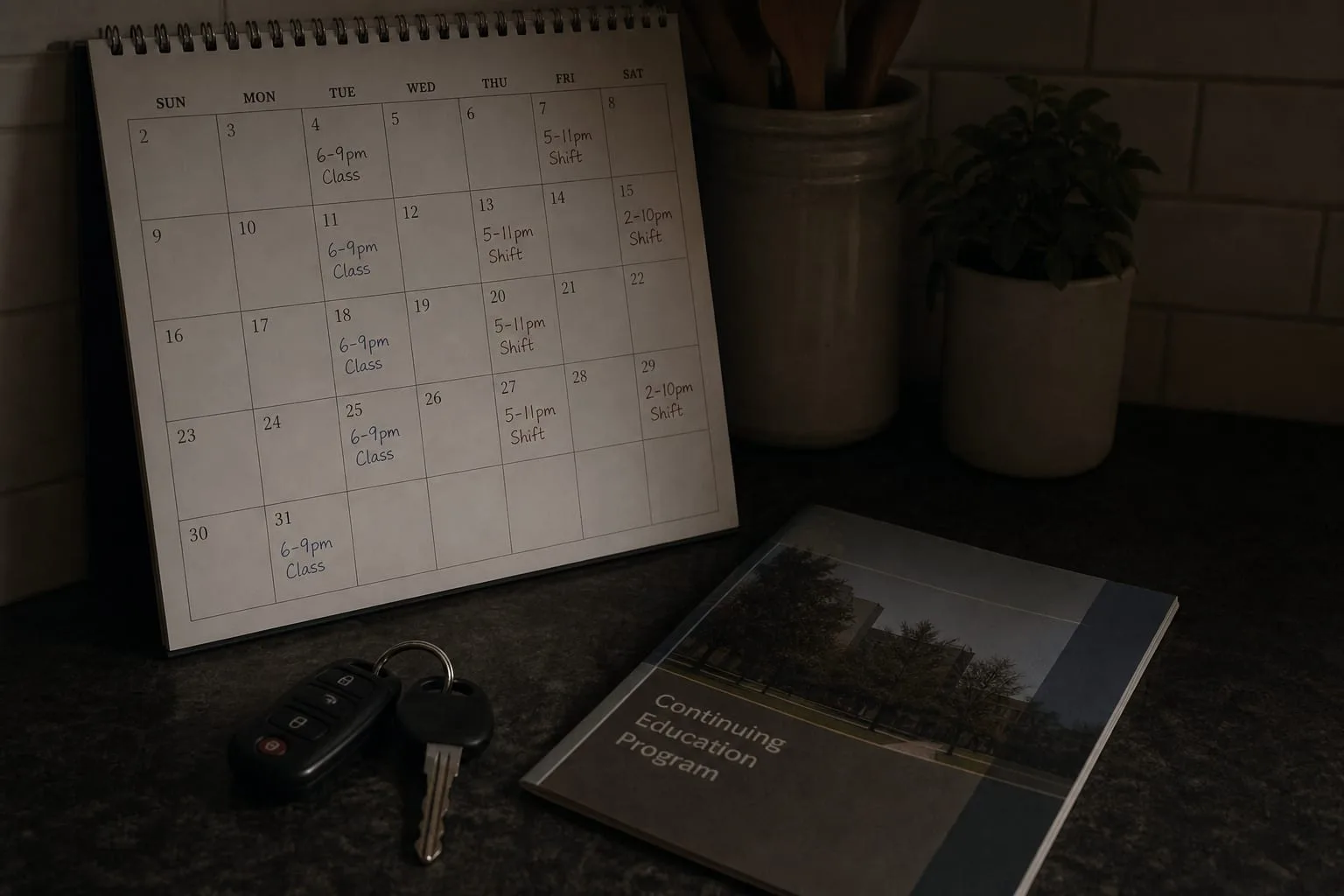
Most people compare training routes the way they compare airfares, by putting two tuition figures side by side and picking the smaller one. That comparison is close to useless, because tuition is the one cost that behaves itself: it is published, it is fixed, and it arrives on a schedule you can see coming. Everything else about a program arrives weekly, in small amounts, at hours you had planned to use for something else. The route that looks cheaper on the enrollment page is very often the one that quietly asks for more, and it asks for it for longer.
The same credential, two calendars, two entirely different lives
Take a program offered in two shapes, which many community colleges and private schools now do: evenings and one weekend day, stretched across roughly twenty months, or full weekdays compressed into about seven. The credential at the end is identical, and so, frequently, is the instructor. What differs is the shape of the demand. The evening route asks for four or five ordinary weeknights, indefinitely, while you keep your job and your income. The full-time route asks for the whole of your working week, all at once, and asks you to stop earning while it does. Neither is the cheap one until you know what your week is worth.
The evening version is usually sold as the affordable choice, and in cash terms it often is, since your paycheck keeps arriving. What it costs instead is duration. Twenty months is long enough for a car to need a transmission, for a parent to get sick, for an employer to reorganize your shift. Every one of those events lands inside the program rather than before or after it, and each one has to be absorbed while you are still expected in class on Tuesday. Duration is not a neutral variable. It is exposure.
The costs that arrive weekly and never appear on the tuition page
Ask a registrar what a semester costs and you will get tuition and fees. Ask a second-year student what a week costs and you will get a different list entirely: gas or fare to a campus and often to a separate clinical or shop site, parking that is rarely included, food eaten out because you are between two obligations, and childcare covering hours that no standard arrangement covers. Then there are the supplies that consume rather than last, the gloves and blades and printer paper and lab consumables, restocked every few weeks. None of these are large. All of them repeat.
The item that surprises people most is the unpaid placement. Many routes require a block of supervised hours at a host site, and those hours are typically scheduled by the host, not by you, in the daytime, on the host's terms. An evening student who has arranged a whole life around not missing work will discover, sometimes late, that the placement does not respect that arrangement. This is the single most common point at which part-time students stall, and it is entirely predictable, which means it is entirely plannable if you ask early enough.
What the credential asks of you after you have it
A license or certificate is not a purchase, it is something you maintain, and the maintenance schedule is set before you enroll by whoever issues the credential. Most require continuing education hours on a renewal cycle, usually every one or two years, along with a renewal fee and sometimes a background recheck. Some require that a portion of those hours be live rather than online, which is a travel cost dressed as an education requirement. The Department of Labor oversees registered apprenticeship and occupational training standards nationally, and state boards layer their own renewal terms on top, so the upkeep varies by both trade and state.
The reason this belongs in your comparison rather than in a folder for later is that the two routes leave you differently placed to handle it. Someone who has just spent seven full-time months and drawn down savings faces a renewal cycle with an empty cushion. Someone who kept working through twenty months of evenings has the cash but has also spent nearly two years without a free weeknight, and the appetite for another sixteen hours of classroom time is genuinely lower. Knowing the renewal terms in advance turns that from an ambush into a line item.
How to price a route before you sign anything
Get the week-by-week calendar, not the program overview, and get it in writing from the registrar or the program coordinator. It should show which weeks contain placement hours, when those hours fall, how far the sites are, and what happens if you miss one. Then take the four ugliest weeks on that calendar, the ones with class, placement, an exam and your existing job stacked together, and cost those four honestly: mileage, meals, childcare, lost shifts. Multiply out. That figure, not tuition, is what separates the two routes, and it is the one a school will tell you if you ask plainly.
Students who finish are rarely the ones who found the material easiest. They are the ones who priced the hard weeks before enrolling and had an answer ready for each of them.