Law & Legal
Never Filed a Complaint Before? Sorting the Records That Hold Up From the Ones That Don't
What separates a record that settles a dispute from one that gets waved away, and the cheap ownership habits that produce the first kind.
Lucinda Fairbairn|
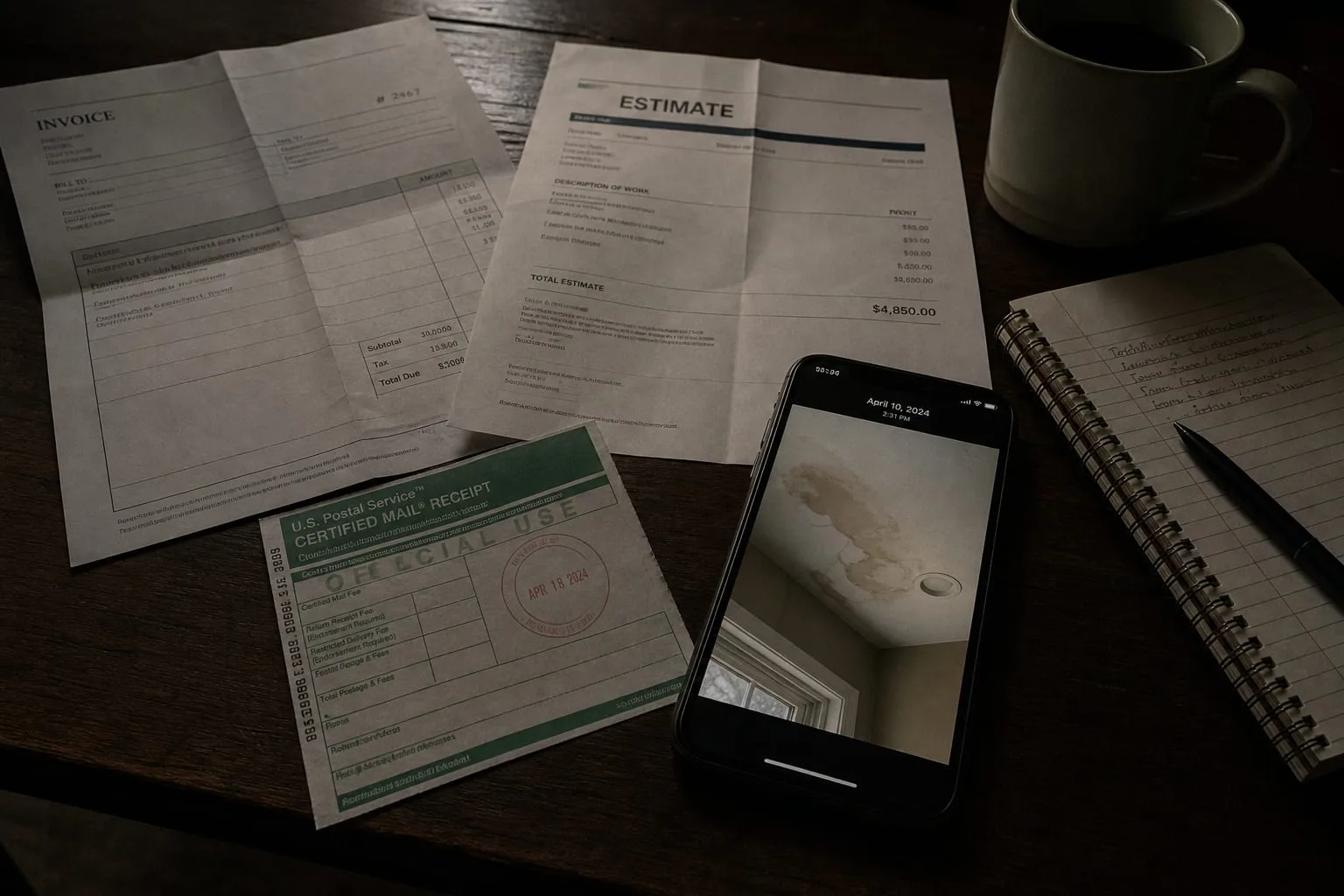
The first time you take a complaint seriously enough to write it down properly, you discover something uncomfortable: the version of events you remember and the version you can prove are two different documents, and only one of them is worth anything. Most people arrive at that point after the money is already gone, a deposit withheld, a warranty claim denied, an invoice paid under protest. The gap is almost never about honesty. It is about whether the record was made while the thing was happening, or afterward, from memory, once it mattered.
Four properties decide whether a record survives contact with someone who disagrees
Evidence that holds up tends to be contemporaneous, dated by something other than you, specific about a condition rather than a conclusion, and traceable to a person or a system with no stake in the outcome. A photograph taken the afternoon the ceiling stained, sitting in a phone's camera roll with its own metadata, does all four at once. A photograph taken three weeks later, cropped and forwarded, does one. The distinction sounds legalistic until you watch it operate in a fifteen-minute phone call with an adjuster or a property manager, where the useful record ends the conversation and the weak one starts an argument about what you can recall.
The failure mode for first-timers is the conclusion masquerading as a fact. "The grout was installed badly" is a conclusion, and the other side is entitled to disagree with it forever. "Grout in the second course cracked along eleven feet within nine days of installation, photographed on the fourth and the ninth day" is a condition, and conditions are much harder to talk out of. Nobody needs to concede the word badly. They only need to accept two dates and a length. That is the whole difference, and it costs nothing to write the second version instead of the first.
Third-party origin matters more than volume. One line on a plumber's invoice noting that a supply line had failed at the crimp does more than forty of your own photographs, because the plumber has no reason to characterize it one way or the other and was standing in the room. This is why the cheapest useful move in almost any dispute is asking a tradesperson who is already on site, already paid, to write on the invoice what they found rather than only what they did. Ask before they leave. Afterward, the ask becomes a favor.
The ownership habits that quietly produce good evidence
Anything you own asks small, recurring things of you, and the record of whether you did them is the record that decides disputes years later. Filter changes, gutter cleanings, water heater flushes, annual service on the furnace: none of it feels like documentation while you are doing it. All of it becomes documentation the moment an insurer or a manufacturer suggests the failure came from neglect rather than defect. The people who win those exchanges are rarely more diligent than everyone else. They just kept the receipt, or paid by card so the date exists somewhere they did not have to maintain.
Two habits carry most of the weight for a household on a tight budget. The first is photographing conditions on arrival and on completion, not once trouble starts: the crawlspace the week you move in, the driveway before the dumpster, the apartment walls on the day the keys change hands. The second is turning verbal agreements into written ones with a single short message. After a phone call where a contractor agrees to redo a section at no charge, one email confirming what was agreed, sent the same day, converts a memory into a dated artifact. If they never reply, the email still stands as your unrebutted account of the call.
Keep the estimate and the invoice, and understand that they do different jobs. The estimate shows what was promised and priced; the invoice shows what was actually performed and charged. Disputes over scope live in the space between the two, and a household that saved only the invoice has thrown away half of its own argument. The same applies to change orders scribbled on a page and never counter-signed. A photograph of that page, taken on the day, is not elegant, but it is dated and it exists.
Where the little money you have should actually go
When the budget is tight, spend on the two things you cannot manufacture later: an independent opinion and a provable delivery. An independent opinion means one inspection or assessment by someone with a license and no relationship to the party you are disputing with, written down, with their credential on it. It is usually a few hundred dollars, and it converts your position from a complaint into a finding. Provable delivery means sending the important letter by certified mail with return receipt, so the date the other side received it stops being a matter of belief.
Almost everything else is free and only requires doing it early. Requesting your own file from the company, in writing, costs a stamp and often produces internal notes that describe the problem in their own words. Downloading utility usage data, pulling bank records, exporting a text thread in full rather than as screenshots of the flattering parts: all free, all more persuasive than a summary you typed up. The Federal Trade Commission oversees consumer complaint handling and unfair trade practices, and the record it expects to see is the same record that persuades a manager: dated, specific, and complete rather than curated.
Resist paying an attorney to write your first letter unless the amount justifies it. Pay instead for one consultation, bring the file organized chronologically, and ask which of your documents actually carries weight and what is missing. An hour of that guidance, applied to a folder you assemble yourself, is generally better value than a template letter on letterhead, and it tells you whether the dispute is worth pursuing before you spend anything further.
The consequences nobody traces back to the paperwork
A security deposit withheld for carpet wear looks like a landlord problem, and is usually a move-in photo problem. A denied claim on a five-year-old roof looks like an insurer problem, and is often the absence of any record that anyone ever inspected it. A warranty refused on a dishwasher looks like a manufacturer problem, and turns on whether the installation was documented as done to spec. In each case the household experiences an outcome, absorbs it, and files it under bad luck, when the deciding factor was a fifteen-second habit skipped years earlier.
The good news for anyone doing this for the first time is that the standard is lower than it feels. You are not building a case for trial. You are assembling enough dated, specific, third-party-touched material that the person on the other side concludes it is cheaper to fix the thing than to argue about it. That threshold is reached by ordinary people with phone cameras, saved invoices, and one confirming email per conversation. Start the folder now, on whatever you own, before there is anything to dispute.