Law & Legal
One Dispute or Twenty? The Evidence Habits That Change Once the Count Goes Up
Evidence fails for boring reasons, not dramatic ones. What holds up when you have one open complaint, and what has to change by the time you have a dozen.
Rafael Quintanilla|
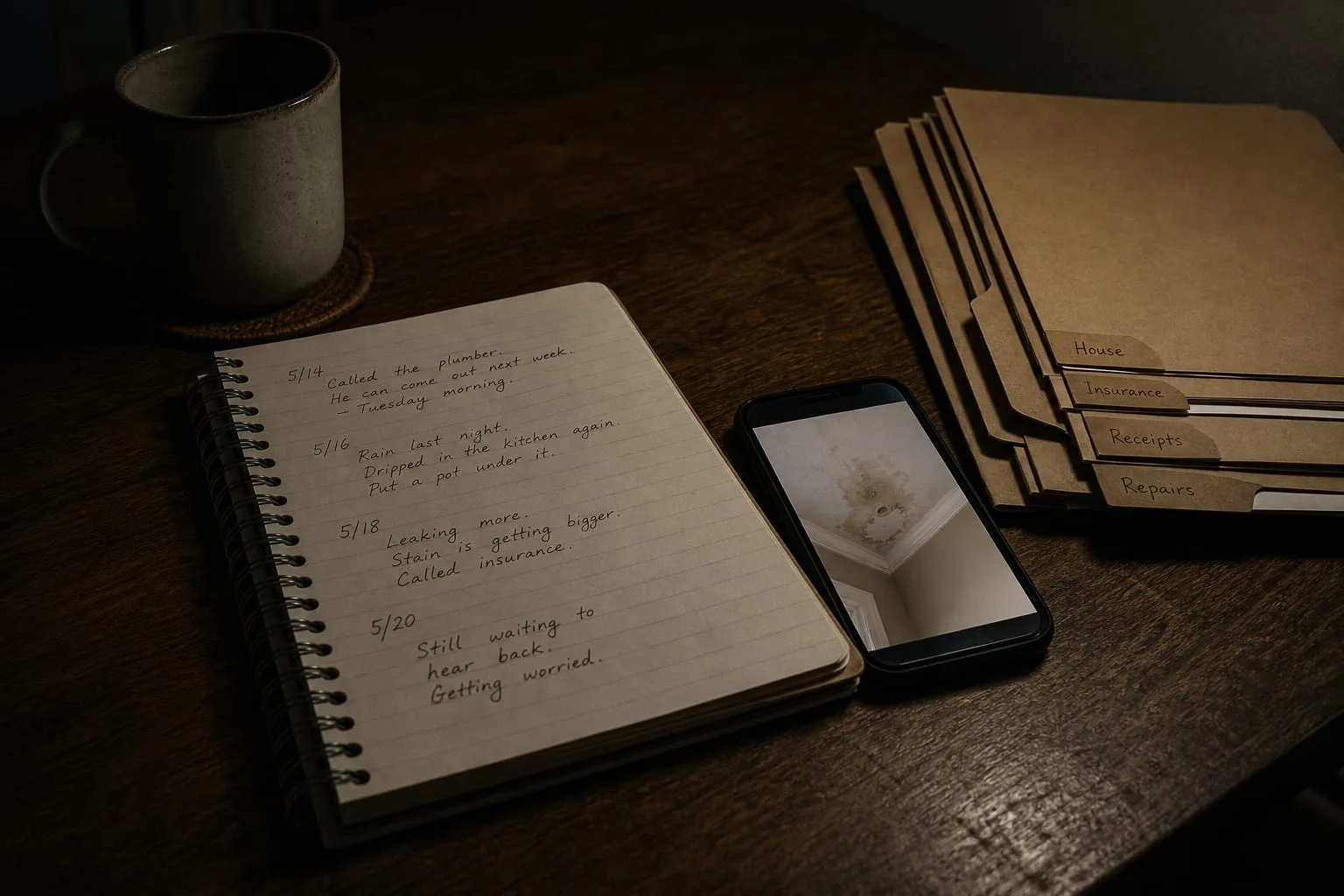
A photograph taken the afternoon a ceiling stained carries more weight than a far better photograph taken three weeks later, and the reason has nothing to do with resolution or framing. It is timing, and timing is the one property of evidence you cannot manufacture after the fact. Most people who lose a dispute do not lose it because they were wrong about the facts. They lose it because the record they produced was assembled after the disagreement started, which is exactly when the other side stops treating your account as neutral. That distinction, contemporaneous versus reconstructed, does most of the work in these matters.
What makes a record credible, and why it is almost never the quality of the file
Adjusters, arbitrators, small claims judges and the compliance staff at a bank all apply roughly the same informal test, though none of them will phrase it the way a lawyer would. They ask whether the record existed before you needed it, whether it is consistent with everything else you have handed over, and whether it came from somewhere you do not fully control. A dated invoice from a plumber beats your own note about what the plumber said. A text message thread beats your summary of a phone call. A meter reading printed by the utility beats your transcription of the same number, because the second one passed through you.
This is why the cheap habits outperform the expensive ones. People buy cameras and file organizers and then send a chronology they typed on a Sunday night in month four, and the chronology is the weakest document in the packet even though it took the longest to produce. It is not that anyone thinks you lied. It is that a narrative written with a known outcome in mind cannot be checked against anything, so it gets read as argument rather than as fact, and argument does not settle disputes over what happened on a Tuesday in March.
The count where memory quietly stops working
With one open matter, you do not need a system, and any system you build will feel like overhead you invented for yourself. You remember the leak, the date, the name of the guy who came out, and roughly what he said standing in the hallway. Two matters, still fine. Somewhere around four or five simultaneously open disputes, and I would put the threshold nearer four than six, recall stops being reliable in a specific way: the facts survive but the attribution slips. You remember that someone promised a credit, and you no longer remember which company, which representative, or which of the two accounts it applied to.
That failure mode matters more than plain forgetting, because a wrong detail confidently stated damages the rest of your record. If you tell an insurer the adjuster committed to something on the fourteenth and the call log shows the fourteenth was a different conversation entirely, everything else you say gets a second look it would not otherwise have received. Landlords with twenty units, contractors carrying a dozen jobs, and anyone handling billing disputes for a small business hit this ceiling every quarter. The fix is not better memory. It is writing things down before you have any reason to.
The ten minutes on Friday that does what a filing project cannot
The practical version is unglamorous and takes less time than reading a single denial letter. Once a week, in one sitting, you note what happened on each open matter: who called, what was said, what you were told would happen next, and the date. Not prose, not analysis, just entries. Photographs go into a folder named for the matter the same day they are taken, because a photograph with no context and no date is nearly useless six months out, and a phone's own timestamp is only helpful if someone can tell what they are looking at.
The reason this works better than a burst of organizing after a dispute turns hostile is that the weekly entries are boring. They record the calls that went nowhere alongside the calls that mattered, which is precisely what makes them credible later. A log that contains only the damaging admissions reads as curated. A log that contains three unremarkable weeks and then a sentence where a manager conceded the work was out of spec reads as a record that happened to catch something. The Federal Trade Commission oversees a good deal of consumer complaint activity in this country, and the practical lesson from how those matters get evaluated is the same one: the ordinary entries give the important entry its weight.
What fails, and what to stop collecting
Evidence that does not hold up tends to fail in four repeat patterns. There is the reconstruction, written after the fact from memory. There is the edited artifact, a photograph cropped or a screenshot with a portion cut away, which invites the question of what was removed even when nothing important was. There is the one-sided thread, where you sent four emails and the other party answered none, which proves you wrote but not that anyone agreed. And there is the internal contradiction, where your own earlier note says something your later account does not, which is the most damaging of the four and the most common at higher volumes.
Judgment, in this context, is mostly the discipline of collecting less. Ten well-dated items with clean provenance beat two hundred files nobody will open, and the sorting cost of the two hundred falls on you, not the other side. At one matter, keep everything, since the cost of keeping is near zero. At twenty, decide at intake what would actually be contested (dates, scope, what was promised, what was paid) and keep only what speaks to those, in one place per matter, named so a stranger could find it. Volume is where good judgment starts paying rent.
The habit is worth building before you need it, which is the awkward part, because the week you need it is the week you no longer have the option. Anyone running enough of these to feel the strain has already learned the lesson from a matter that went sideways over a date nobody could pin down.