Family
Ordering One Stone or Planning a Whole Plot? Five People Who Know Before You Do
The foundation setter, the letter cutter, the stone supplier, the grounds crew and the order desk each hold a piece of a memorial decision that hardens the moment it is signed.
Rafael Quintanilla|
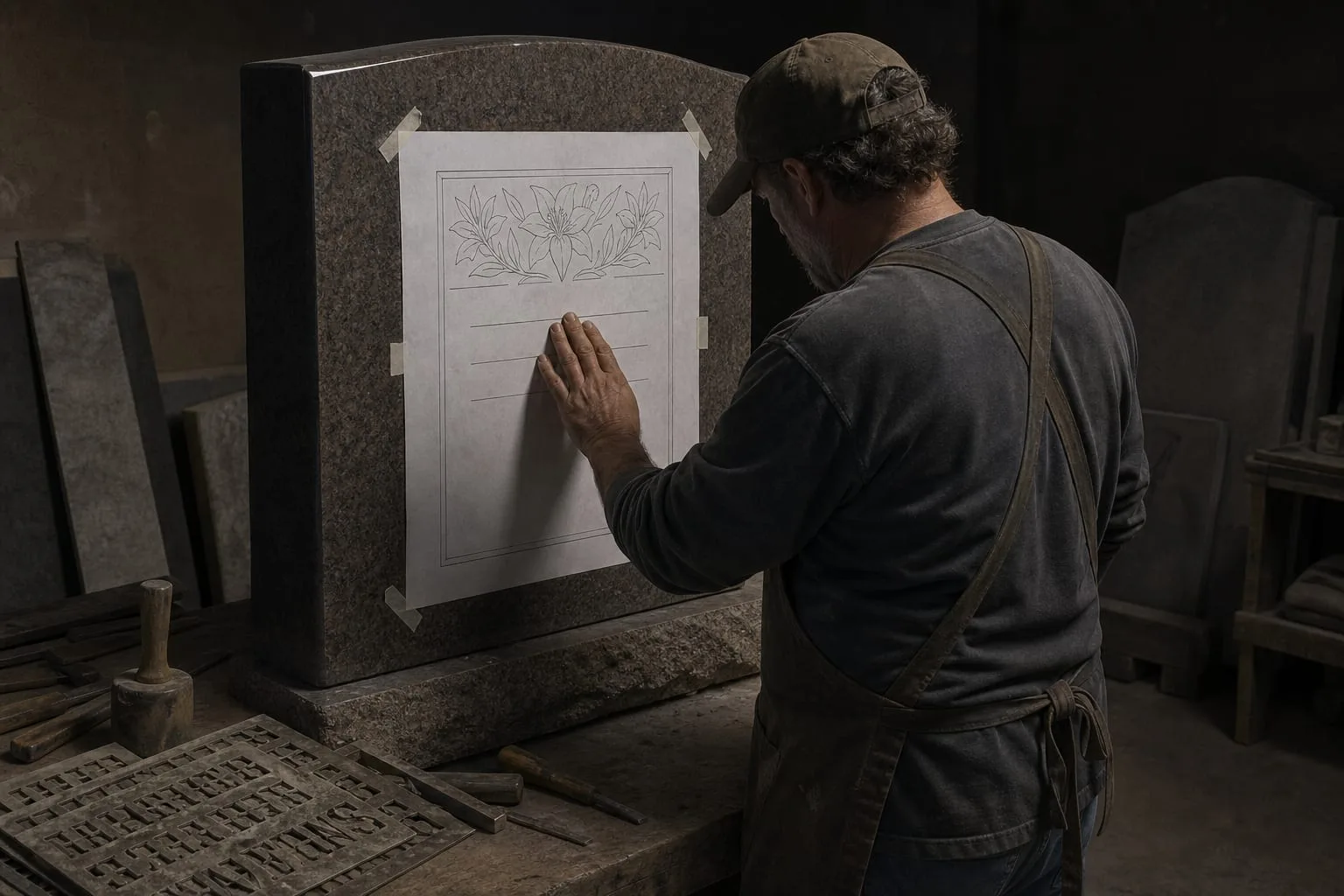
A monument retailer who has been at it twenty years has written up more stones than any family will ever see, and the useful consequence is that the questions worth asking are already known to somebody standing within a few feet of the decision. The family is doing this once, or twice in a lifetime, under time pressure and grief. The people around the transaction do it weekly. That asymmetry is not a problem so long as you know who holds which piece of knowledge, because a memorial is one of the few purchases where the difference between a good outcome and a permanent regret is decided by information nobody volunteers unprompted.
The crew that pours the foundation knows what that section of ground does
A memorial does not sit on the earth, it sits on a concrete foundation poured to a depth and footprint the cemetery specifies, and the crew that pours them has watched a hundred stones in that same section either stand plumb for decades or tilt within three winters. Ask them, not the catalog, whether the section drains, whether older markers there have settled, and how deep they go. The answer changes with scale: a single upright of modest weight is forgiving, while a companion monument or a family plot with a central die and several footstones concentrates load in a way that rewards a wider pour. Where a lawn has been graded over fill, that same crew will tell you which way the tilt tends to run.
The letter cutter knows why inscription length is never free
Sandblasting through a rubber stencil is subtractive and final, and the person operating the nozzle is the one who understands that the design you approved on paper has to fit a real face of stone with real margins. Long inscriptions get set smaller, and smaller letters cut shallower, and shallow letters lose legibility first when lichen and weathering arrive. The scale threshold matters here more than anywhere. One name and two dates leaves room to breathe. A companion stone for two people, with a shared verse and eventually a second death date added on site by a hand-held tool rather than in the shop, has to be laid out now for a job finished years from now. Ask the cutter to mark where the later date will go, and confirm it can be reached with the stone standing.
The supplier knows the block, and that a sample chip is not the monument
Granite is quarried in blocks, colors vary within a family and between quarries, and the polished sample on the showroom table is a fair representation rather than a promise. The person handling supply knows which colors run consistent, which mottle unpredictably, and which have grain that reads very differently at three feet than at three inches. For one stone this is a matter of taste. For a family plot bought in stages over twenty years it is a procurement problem, because a color that matched beautifully in the first order may not be available in the same tone when the fourth marker is cut, and dark stones are generally easier to match late than heavily figured light ones. If the plot is meant to look like a set, say so at the first order and ask what can be reserved.
The grounds crew knows what the mower does to your design
Everything that projects above turf gets struck eventually, and the people who cut the grass are the honest witnesses to which details survive. Raised borders around a plot trap debris and force hand trimming. Bronze vases that swivel flush are treated differently from fixed ones. Flat markers set slightly proud of grade catch a blade; set slightly low they hold water and silt. This is precisely where the answer for one differs from the answer for twenty: a single flush marker in a well-kept lawn section is uneventful, while a plot with several ground-level stones, coping and planting beds becomes a maintenance agreement whether or not anyone calls it that. Ask the crew which nearby plots have aged well and look at them.
The order desk knows the exact point after which nothing can be changed
Between the signed contract and the finished stone there is a proof, a drawing or rendering showing layout, spelling, dates, emblems and finish, and the person at the order desk knows that approving it is the moment the decision stops being reversible. Once the stencil is cut and the blast cabinet runs, a misspelled surname is not corrected, it is re-cut on new stone at new cost. Read the proof aloud with a second person and a document in hand, a death certificate or a service program, rather than from memory. The Federal Trade Commission oversees disclosure in the sale of funeral goods and services, and the same instinct it encourages, getting terms and prices in writing before you commit, applies with double force to a purchase that is manufactured to order. Ask when the point of no return falls on the calendar, and keep the approved proof.
Where the threshold actually sits
The practical dividing line is not one stone versus many, it is whether the memorial is a finished object or the first installment of a plan. A single upright for a single grave can be decided in one sitting with the dealer, the cemetery rules and a careful proof reading, and it will very likely be right. Anything that anticipates a second name, a matching marker for a spouse, or a plot that will be filled across decades needs a written record of color, quarry, font, letter height and layout kept somewhere a relative will find it. That single page is what makes the fourth marker match the first, and the people who cut and set stone for a living will tell you that families who kept it were glad, and the ones who did not spent money proving why it mattered.
None of these five conversations takes long, and none of them requires you to know anything about stone before you start. They require only that you treat the foundation crew, the letter cutter, the supplier, the grounds staff and the order desk as sources rather than as vendors, and that you ask each one the question that belongs to them. Do that and the irreversible parts of the decision, the ones cut in granite and poured in concrete, get made with the benefit of everybody else's repetitions.