Law & Legal
Photos Nobody Can Date, Notes Written Later. What Makes a Record Survive a Dispute
Most homeowners collect evidence that feels convincing and proves very little; here is what separates a record that settles a dispute from one that merely restates your side.
Lucinda Fairbairn|
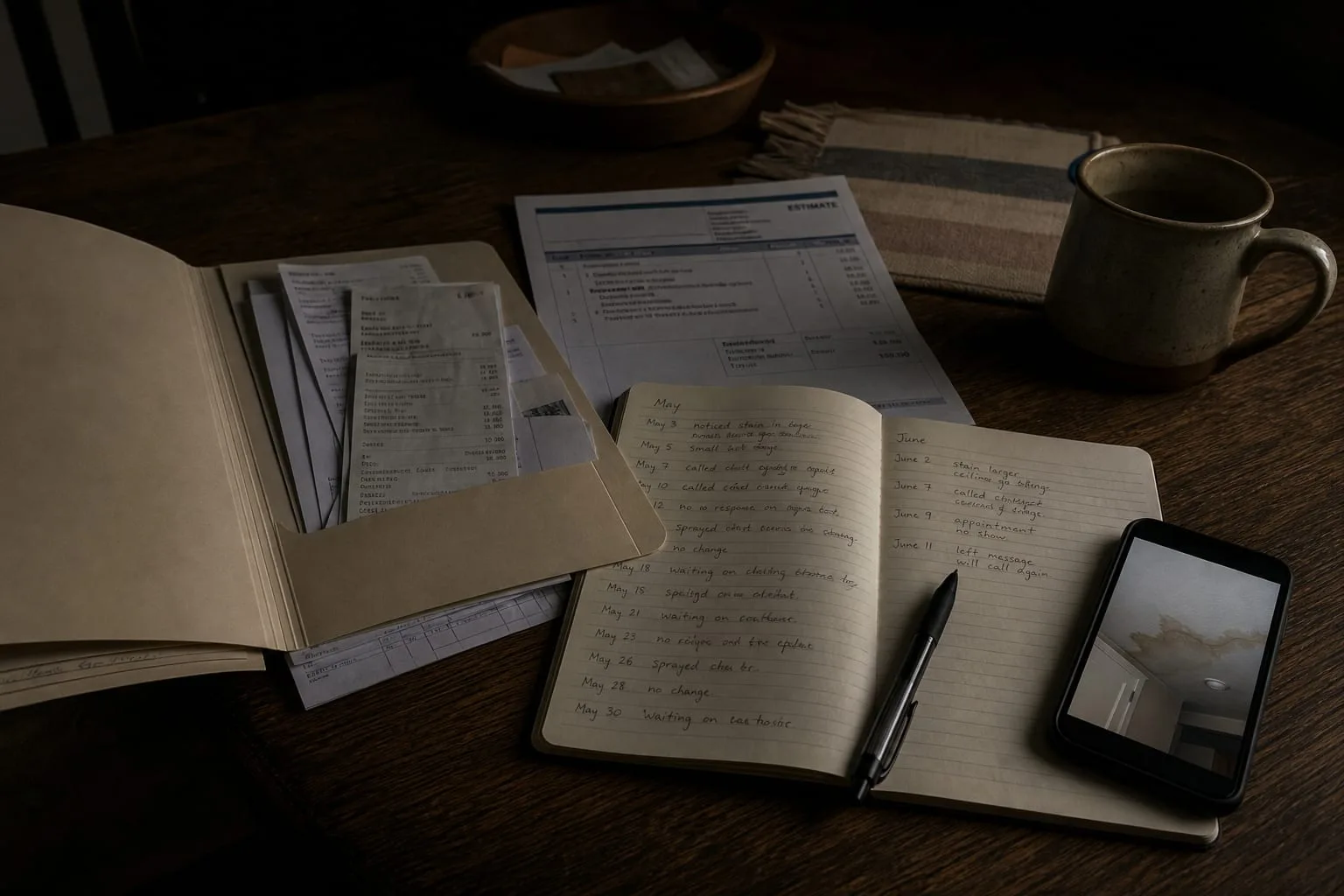
After enough disputes, you stop thinking of evidence as proof and start thinking of it as maintenance: something you keep up quietly while nothing is wrong, so that it exists in usable form on the day something is. The homeowners who lose arguments they should win are rarely the ones who kept nothing. They are the ones who kept a great deal, all of it gathered in the two weeks after the problem surfaced, all of it saying the same thing in the same voice: mine. A barely adequate file restates your position. A good one lets someone who has never met you reconstruct what happened without asking you.
A photograph is only as good as what surrounds it
Forty pictures of a stained ceiling establish that a ceiling is stained. They do not establish when, how fast, or whether the contractor's flashing had anything to do with it. The photographs that carry weight are the ones with something in frame that fixes them in place and time: a tape measure against the run of the stain, a doorway or fixture that locates the wall in the house, a wider shot before the close-up so nobody can argue you photographed a different room. Shoot the same view repeatedly over weeks, from the same standing spot, and you have documented progression rather than condition.
Dating matters more than people expect, and camera metadata is the cheap way to get it. Photographs taken on a phone and left alone carry a timestamp; photographs cropped, exported, screenshotted, forwarded through three apps and saved from a text thread often do not. Keep the originals in one place and work from copies. If the image has to prove that damage existed before a crew arrived on the twelfth, it needs to be the file that says the twelfth, not a version of that file with the history stripped out.
Notes written the same day, and notes written from memory
Contemporaneous is the word that does the work here, and it is not a technicality. A note made the afternoon of a conversation, in ordinary language, recording who said what and what was agreed, is treated very differently from a narrative assembled four months later once the stakes are clear. The late version is not dishonest. It is shaped, and everyone reading it can tell, because it is too tidy, too consistent, and too well aimed at the question in dispute. The rough note that includes an irrelevant detail about the weather is the more persuasive document.
The habit worth building is boring. One running file per property, dated entries, a line or two for anything that involved another person: the plumber who said the water heater had maybe two years left, the roofer who declined to warranty the valley, the property manager who promised to look at the grading. Most of those lines will never matter. The ones that do will matter enormously, and you will not know in advance which they are. That is precisely why the entry has to be made before you have a reason to make it.
Paper that came from somebody else
The strongest material in almost any homeowner file was generated by someone with no stake in your argument. Estimates on a contractor's letterhead, invoices showing scope and date, permit records, an inspection report from the sale, a supplier's delivery ticket, a text message from the crew lead saying they would come back Thursday. Each of these was created for a purpose unrelated to the dispute, which is exactly what makes it credible. Your own summary of what a contractor told you is one voice. His written estimate describing the same work is two, and the second one is his.
This is where a good job separates itself sharply from an adequate one. The adequate file has the final invoice. The good file has the original estimate, the change order, the revised estimate, the emails in which scope shifted, and the payment records showing what was actually paid and when. Disputes over workmanship almost always become disputes over what was promised, and promises live in the earlier documents that most people discard once the job is done. Keep the drafts. They cost nothing to store and they answer the question that turns out to be central.
Showing that you held up your end
The second front in most disputes is neglect, and it is aimed at you. Insurers, contractors and landlords all reach for the same argument: the failure was gradual, foreseeable, and yours to prevent. The answer is a maintenance record, which is why the servicing receipts nobody enjoys filing are worth more than any photograph. Annual furnace service, gutter cleanings, the plumber who was called about the slow drain in March, the dehumidifier receipt, the filter changes. Dull paper, and it converts an accusation of neglect into a documented pattern of ordinary care.
Consumer complaint practices in this area fall under the remit of the Federal Trade Commission, which oversees how businesses deal with customers, and the practical lesson from watching disputes resolve is that organized complainants get taken seriously earlier. Not because anyone rewards diligence, but because a file with dates, third-party paper and a clean chronology is cheaper for the other side to settle than to fight. A folder someone can read in fifteen minutes and follow without help changes the calculation before an adjuster or an attorney ever forms a view of the merits.
Build the record while the house is behaving. Dated photographs from fixed positions, a running log with entries made the same day, every version of every estimate, and the servicing receipts that prove you did the routine work. The dispute you are documenting for has not happened yet, and the file will be finished before you know which one it was for.