Law & Legal
Quoted $350 an Hour? What That Number Is Actually Measured Against
An hourly rate, a flat fee and a contingency percentage answer three different questions. Here is how legal billing came to work this way, and what to pin down before you sign.
Theodore Kranz|
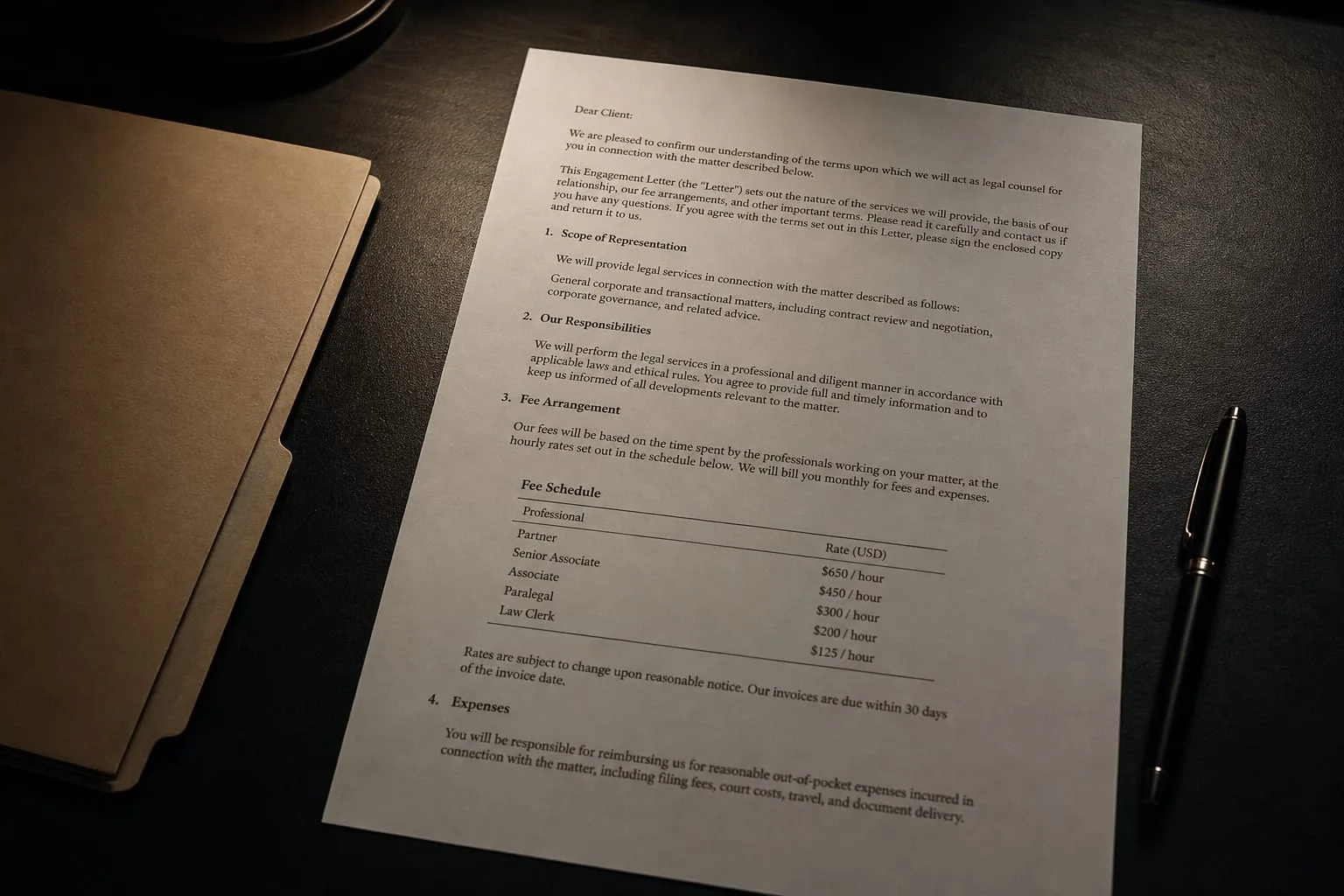
The first number a law office gives you is almost always a rate, and a rate on its own settles very little. Three hundred and fifty dollars an hour is a price per unit, and until you know how the unit is defined, how many of them the work is expected to consume, and what sits outside the fee entirely, you have been handed the least useful figure in the arrangement. First-time clients tend to compare the rates of two firms and pick the lower one. Experienced clients compare what each rate is attached to, which is a different exercise and usually produces a different answer.
The hourly rate started as bookkeeping, not as a price
For much of the twentieth century, American lawyers did not sell time. Local and state bar associations published minimum fee schedules: a set price for a deed, a will, an uncontested divorce, an estate handled as a percentage of the assets. A client did not ask how long the will would take, because the length was not what was being purchased. Those schedules unraveled in the 1970s under antitrust pressure, once fixed minimums set collectively by competitors became legally indefensible. What filled the gap was the timesheet, borrowed largely from accounting, where recorded hours were already the ordinary way of tracking whether a file was profitable. An internal cost measure became the external price, and it has stayed there.
That history explains a quirk that puzzles people meeting it for the first time. The hourly rate is a good instrument for measuring effort and a poor one for predicting cost, because nobody buying legal work wants hours. They want a resolved boundary line, a signed lease, a closed estate. The billable hour prices the input while the client is thinking about the output, and the gap between those two things is where most fee surprises live.
The tenth of an hour, and why it shows up on the bill
Most firms record time in tenths of an hour, six-minute increments, and a few still use quarter hours. The increment matters more than it sounds. A short phone call, a forwarded email that requires a read and a one-line reply, a voicemail listened to twice: each is a discrete task that lands on the ledger at the minimum unit, and a matter that involves frequent small contact accumulates cost in a pattern that looks nothing like a smooth burn of long working sessions. Ask which increment the firm uses. Ask whether more than one timekeeper bills for the same conference call, because two attorneys on one call is two entries.
Then ask who is actually doing the work. A quoted rate is usually the rate of the person you spoke to, and the matter may be staffed by an associate at a lower rate, a paralegal at a lower rate still, and a partner reviewing at the top of the scale. That blend can cut your total or inflate it, depending on how the file is run. A written schedule of every rate that may appear on your invoice is a reasonable thing to request before you sign, and firms that bill this way produce one without difficulty.
Costs are a separate column, and they are not small
Fees pay for the lawyer's time. Costs pay for everything the case consumes from third parties: court filing fees, service of process, deposition transcripts, court reporters, records requests, expert witnesses, mediators, title searches, travel. These are commonly billed as incurred, they are frequently excluded from any estimate you were given, and in litigation they are capable of rivaling the fees. Some engagement letters require you to advance costs into a trust account before they are spent, which is preferable to discovering them after the fact. The clause worth reading twice is the one governing what happens to costs if the matter ends early, because in several arrangements you owe them regardless of outcome.
Retainers add a second layer of vocabulary. A retainer is usually a deposit against future work, held in trust and drawn down as hours accrue, refundable to the extent unused. It is not a fee for hiring the firm, though the phrase is sometimes used loosely for a nonrefundable engagement fee, which is a different animal. The engagement letter will tell you which one you are paying, and whether it replenishes at a set balance.
Flat fee, hourly and contingency answer different questions
A flat fee prices a defined piece of work: a formation, a simple will package, an uncontested filing, a residential closing. It transfers the risk of the work running long onto the firm, which is why it appears where the scope is genuinely predictable and disappears where it is not. Read what the flat fee stops covering. A response from the other side, an objection, an amended filing, a second round of negotiation: any of those may be written as outside the scope and billed hourly, and that boundary is the entire substance of the quote. A contingency fee, standard in personal injury and some collection work, is a percentage of recovery rather than a price for time, and the two numbers that matter are the percentage and whether it is calculated before or after costs are deducted.
Consumer protection in how services are advertised and billed falls within the remit of the Federal Trade Commission, and state bars govern the engagement letter itself, which is why the letter is usually more precise than the conversation that preceded it. Read it as the actual quote.
For a first matter, the useful move is to stop asking what the rate is and start asking what the rate is charged against: which increment, which timekeepers, which tasks inside the scope, which costs outside it, and what specifically triggers the shift from the flat number to the meter. A firm that can answer those five questions in writing has told you your likely cost. The rate never did.