Law & Legal
Quoted a Flat Fee? What the Number Is Measured Against, and What Falls Outside It
A legal fee is quoted against a defined scope, a set of documents and a list of assumptions, and knowing which of those you control keeps the number stable.
Lucinda Fairbairn|
A fee quote from an attorney is not a price on a problem. It is a price on a described piece of work, bounded by assumptions the attorney wrote down and you probably skimmed, and the gap between those two things is where first-time clients get surprised. Someone hiring a plumber understands intuitively that the estimate covers the visible pipe and not the joist that turns out to be soft. The legal version of the soft joist is a missing document, an opposing party who stops answering, or a fact that surfaces in week three. Understanding what the number is measured against is most of the work of keeping it steady.
The quote attaches to a scope, not to an outcome
Compare two ways of asking the same question. "How much to handle my landlord dispute" invites either a shrug or a very padded number, because handling covers a letter and it also covers a trial. "How much for a demand letter, a review of the lease, and one round of response" invites a figure, because it names a finite unit of work with an end. The second version is what a flat fee is built on. Attorneys who quote flat fees are pricing a defined deliverable with predictable inputs, and hourly work is what remains after the predictable part is exhausted. Your first task, before comparing any two quotes, is checking whether they describe the same unit.
This is also why two quotes on the same matter can differ by half and both be honest. One may cover only the drafting; the other may include filing, service, and a hearing appearance. Neither is wrong, and neither is comparable to the other until you lay the described tasks side by side. Ask each office to itemize what the number covers and what would trigger a separate charge, and read the two lists against each other rather than the two totals. The exercise takes twenty minutes and it is the single highest-value thing an inexperienced client does.
Your paperwork is a price input, not a formality
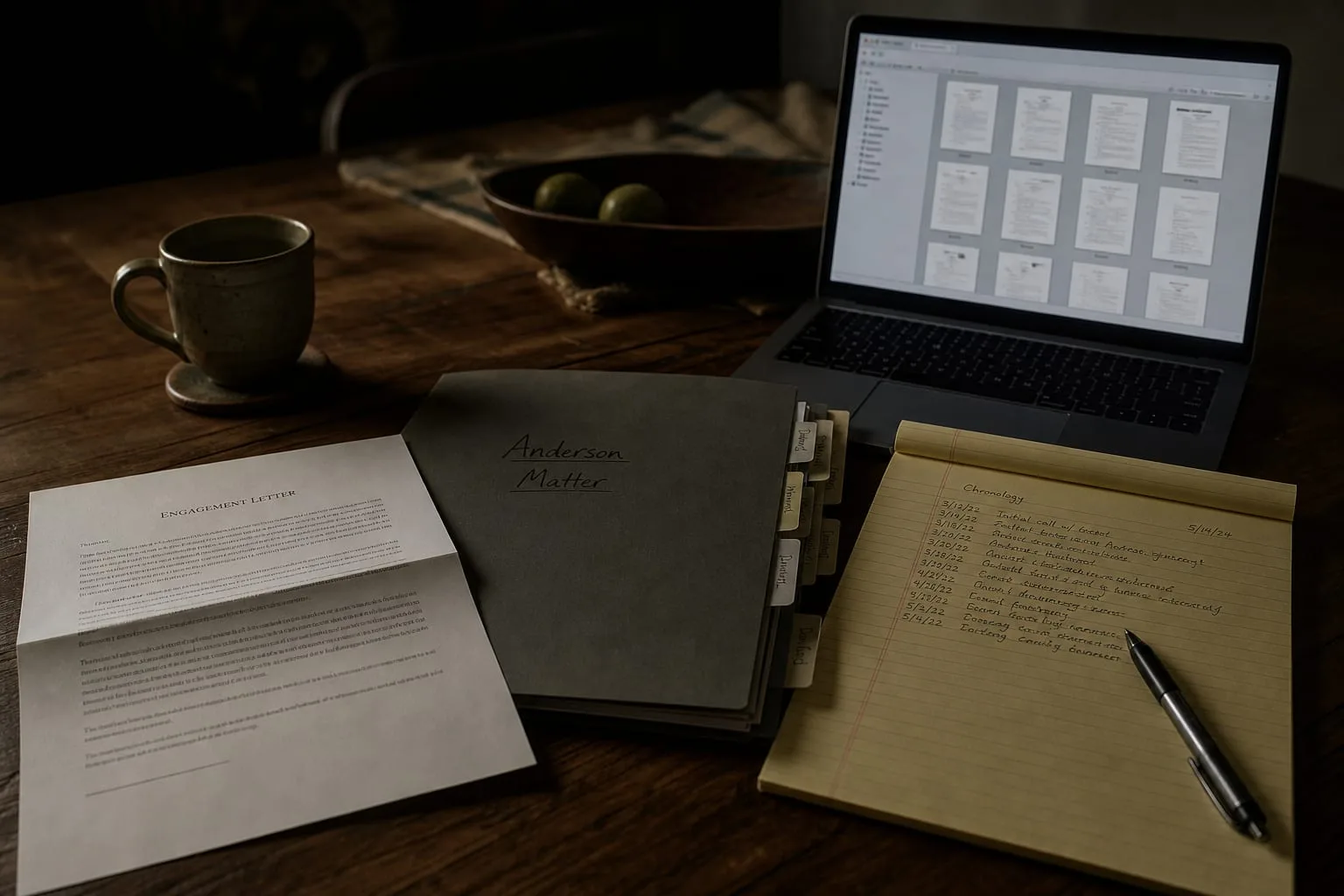
An attorney's estimate assumes a certain quality of raw material. If the lease, the contract, the correspondence, the survey, the closing file and the dated photographs arrive organized and complete, the work priced is the legal work. If they arrive in pieces, or arrive after a reminder, or arrive as a phone screenshot of page four of a nine-page agreement, someone bills for reconstruction. That reconstruction is not a penalty; it is real time spent doing what you could have done unbilled. The maintenance framing is exact here: the file is a thing you own and keep, and the cost of neglecting it shows up later, at an hourly rate, in someone else's office.
The practical version is a single folder, physical or digital, with one document per file and a naming habit you can hold to. Date first, then what it is, then who sent it. Alongside it, keep a plain chronology: one line per event, dated, with a pointer to the document that proves it. Attorneys build this anyway, from your emails and your recollection, and they charge for the assembly. Handing it over finished changes what the first three billed hours purchase. It also tends to sharpen the advice, because a chronology makes the weak spot in your own account visible before opposing counsel finds it.
Reading the engagement letter for the terms that move money
The engagement letter is the document the fee is actually quoted against, and four provisions in it do most of the work. The billing increment tells you whether a two-minute call is recorded as two minutes, six minutes, or fifteen. The definition of costs separates fees from disbursements: filing fees, court reporters, service of process, expert reviews, records requests, none of which are the attorney's labor and all of which land on your invoice. The retainer clause explains whether the deposit is a credit against the first bills or a balance you must top back up when it falls below a floor. And the scope paragraph names what the matter is, which controls everything else.
Trust account handling is worth one careful read as well, because unearned money sits in a client trust account and is drawn against as work is performed, which is why your monthly statement should show a balance moving down rather than a lump that vanished. The Federal Trade Commission is responsible for unfair and deceptive practices in consumer services generally, and state bar rules layer their own requirements on top of fee agreements, so a firm that puts all of this in writing plainly is following the norm rather than doing you a favor. Ask for the letter before you pay anything, and read the scope paragraph twice.
The change order equivalent, and why you want one
Contractors have change orders; legal matters have the same event with no standard name. The other side hires counsel and the tone changes. A deposition becomes necessary. A document surfaces that reframes the claim. Any of these can move a matter outside the scope the fee was quoted against, and the moment to price that is when it happens, not when the invoice arrives. Say at the outset that you want an email flagging any development that would push the work past the quoted scope, with a revised estimate before the work begins. Most attorneys will do this readily; it protects them from an argument about a bill just as much as it protects you.
The other half of that discipline is on your side of the table. Batch your questions into one weekly email rather than six calls, because six calls at a fifteen-minute increment is ninety billed minutes for maybe twenty minutes of substance. Answer document requests inside two days. Tell your attorney unpleasant facts early, when they cost strategy time, rather than late, when they cost strategy time and rework. A matter run this way tends to close near its estimate, and the client who ran it that way learns the habit for the next one.
The first legal bill anyone receives feels arbitrary because the reader has no map of what generated it. The map is not complicated: a described scope, the documents you supplied, the disbursements the matter incurred, and the increments in which time was recorded. Every one of those has a version you influence, and three of them you largely control. Build the folder, read the engagement letter, and ask for the revised estimate in writing when something shifts.