Family
Reading a Funeral Bill? Which Lines Are Fixed, Which Are Local, Which Are Optional
A funeral itemization has one line you cannot decline, several that local rule decides for you, and a large middle section that is entirely your call.
Rafael Quintanilla|
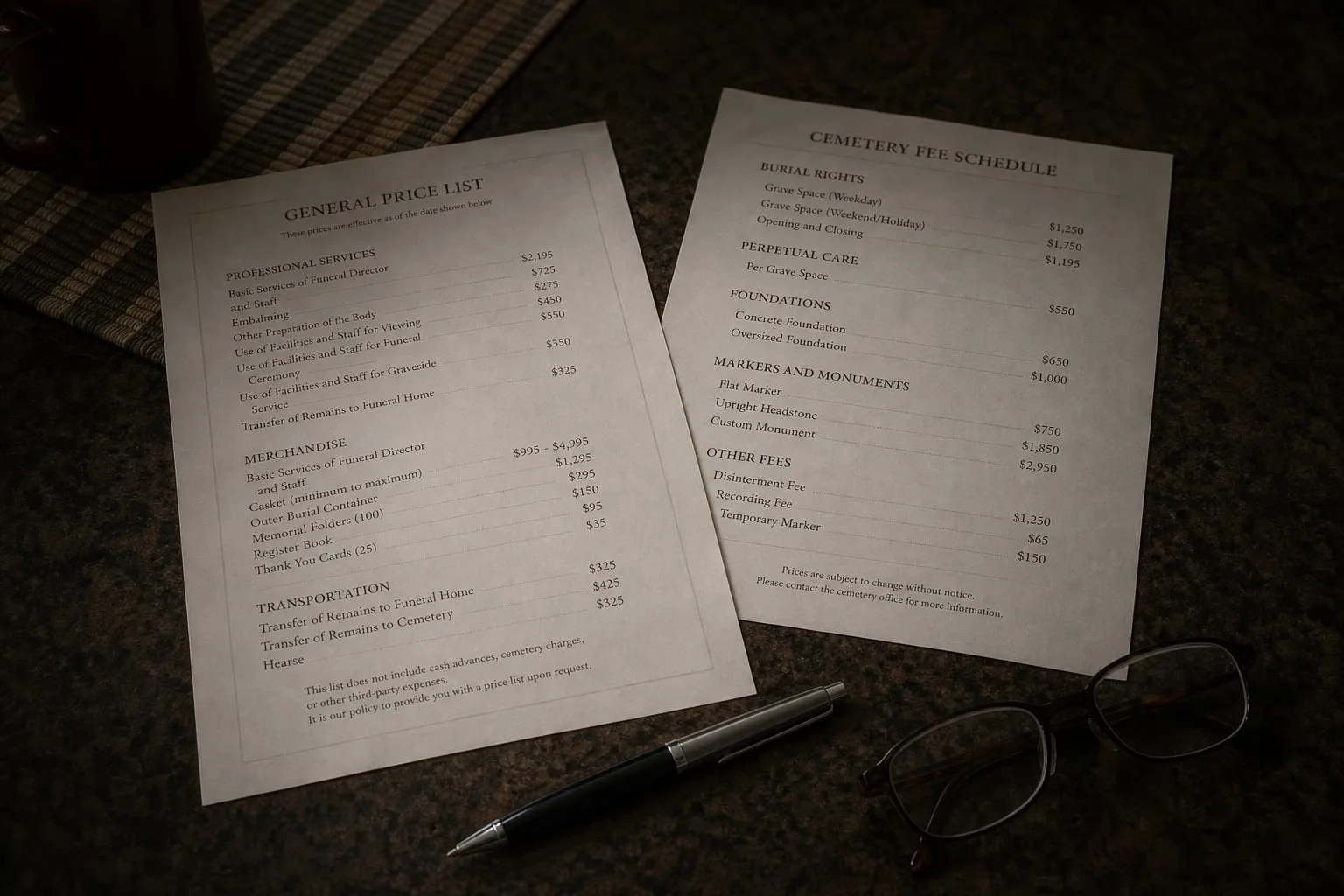
An itemized funeral statement is not one bill. It is three bills stapled together: what the funeral home charges for its own labor and facilities, what a separate cemetery or crematory charges for the disposition itself, and what third parties charge for paperwork, printing, flowers and food. Families who feel ambushed by the total have usually been reading it as a single price for a single service, when in fact the document is a set of independent decisions, some of them made for you by state law or a cemetery's rulebook, and most of them not. The judgment you need is knowing which is which before you initial anything.
1. Find the one fee you cannot decline, and see what it actually covers
Every general price list has a basic services charge that applies no matter what you select: the arrangement conference, the staff time, coordinating with the cemetery or crematory, filing the death certificate, sheltering the remains, overhead. It is the only line on the funeral home's own list that is genuinely non-declinable, and the Federal Trade Commission is the agency responsible for the disclosure rules that require it to be stated plainly and separately rather than folded into a package. Once you have located it, everything else on that list becomes a choice you are making rather than a cost you are absorbing. The useful comparison is not between two total prices but between two basic services fees, because that number tells you what the firm charges simply to be involved.
Scale matters here in a way families rarely anticipate. The basic services fee does not shrink because you have chosen a small gathering, and it does not double because two hundred people attend. It is close to fixed per death, which means it lands heavily on a simple cremation with no service and lightly, proportionally, on a full funeral with a viewing and a procession. Two firms with identical package prices can differ by a wide margin on this single line, and that difference is the clearest signal of which one suits a stripped-down arrangement and which one suits an elaborate one.
2. Separate the funeral home's bill from the cemetery or crematory's bill
The interment charges are a different vendor with a different rulebook, and they are frequently the larger half. Opening and closing the grave, the burial permit, the endowment or perpetual care contribution, the setting fee for a marker, the vault or outer burial container the cemetery requires because its maintenance equipment cannot drive over collapsing ground: none of that is the funeral director's price, though it may be passed through on the same statement as a cash advance. Ask for the cemetery's own printed schedule. Read it beside the funeral home's list, because a family that negotiates hard on caskets and never looks at the cemetery schedule has optimized the smaller number.
This is also where regional variation becomes unavoidable. Interment costs track land values, labor rates and local ordinance closely, so the same casket in the same state can sit in a grave that costs two or three times what it costs an hour's drive away. Municipal cemeteries often price differently for residents and non-residents, and some require proof of residency at the time of purchase rather than at the time of need. Rural church and township burial grounds may charge a fraction of what a metropolitan memorial park charges, with the tradeoff being fewer services included and stricter limits on what kind of marker is allowed.
3. Test the assumption that embalming is required
Embalming is a service, not a legal default. In most circumstances it is not required, and the funeral home is obliged to tell you so and to obtain permission before performing it. What varies is the local overlay: some states require it or an alternative such as refrigeration once a certain number of hours have passed without disposition, some require it for transport across state lines by common carrier, and some cemeteries and mausoleums impose their own conditions on entombment. A public viewing with an open casket is usually where the practical case for it appears, and that is a decision about the gathering you want rather than a rule you must follow.
The alternative worth pricing explicitly is refrigeration, which many firms offer at a daily rate. Here the arithmetic depends entirely on timing. One or two days while a certificate is signed and a relative flies in is cheap; ten days while family arrives from three time zones and a church calendar opens up is not, and somewhere in that range refrigeration stops being the economical choice. Ask for both numbers, the flat embalming charge and the per-day holding charge, then multiply by the delay you actually expect. The threshold is usually clear once both figures are in front of you.
4. Price the container as a container, and buy it wherever you like
A casket is the single largest line on many funeral home lists and one of the easiest to reduce without changing anything a mourner will notice. You are entitled to a printed casket price list before anyone shows you a selection room, and you are entitled to supply a casket bought elsewhere without paying a handling fee for the privilege. For cremation, the relevant item is an alternative container rather than a casket, and crematories vary in what they will accept, which is worth confirming in advance rather than after a purchase. What the cemetery requires underneath the casket, a grave liner or a sealed vault, is a separate rule set by the cemetery.
The scale question here is the one families miss. Buying a single casket puts you at retail, with no leverage and a short decision window. Buying cemetery property for several people at once, a two-grave or four-grave plot, a companion niche, a family estate, moves you into a transaction where per-space pricing genuinely changes and where pre-need purchase can lock terms years ahead. The threshold sits at roughly the second space. One is a purchase. Two or more is a negotiation, and the difference in unit cost is real enough to justify a conversation nobody enjoys having early.
5. Sort the gathering costs by whether they scale with attendance
Facility use for a visitation, staff for a graveside service, use of the chapel, a hearse and a family car, printed programs, register books, catering, obituary placement: these are the discretionary bulk of the total, and they behave very differently as the guest count moves. Vehicle charges, facility fees and staff time are close to flat, so they are expensive per head at twenty guests and cheap per head at two hundred. Catering, programs and flowers scale directly. Deciding on the size of the gathering first, then pricing the arrangement, produces a much better result than pricing the arrangement and hoping the crowd fits.
Local practice shapes this more than any brochure suggests. Where a church hall or a fraternal organization hosts the reception at cost, the funeral home's facility fee is simply avoidable. Where cremation is the regional norm, direct cremation with a memorial gathering weeks later has become a well-supported option, and the delay lets families choose a venue on price rather than urgency. Where a procession with police escort is customary, permit arrangements are handled locally and the cost is knowable in advance. Asking what is usual in that county, of the funeral director and of one person who has recently buried someone there, surfaces most of it.
The document to ask for, before any selection room and before any deposit, is the general price list from the funeral home and the fee schedule from the cemetery or crematory. Set them side by side and mark each line as fixed, set by rule, or yours to choose. Most families find the third category is far larger than they feared, and that the arrangement they actually want is a shorter list than the one first proposed.