Family
Reading a Funeral Price List, and the Five Lines That Bill You Later
An itemized funeral price list contains one charge you cannot decline and a dozen you can, plus a few that keep asking for money decades after the service ends.
Lucinda Fairbairn|
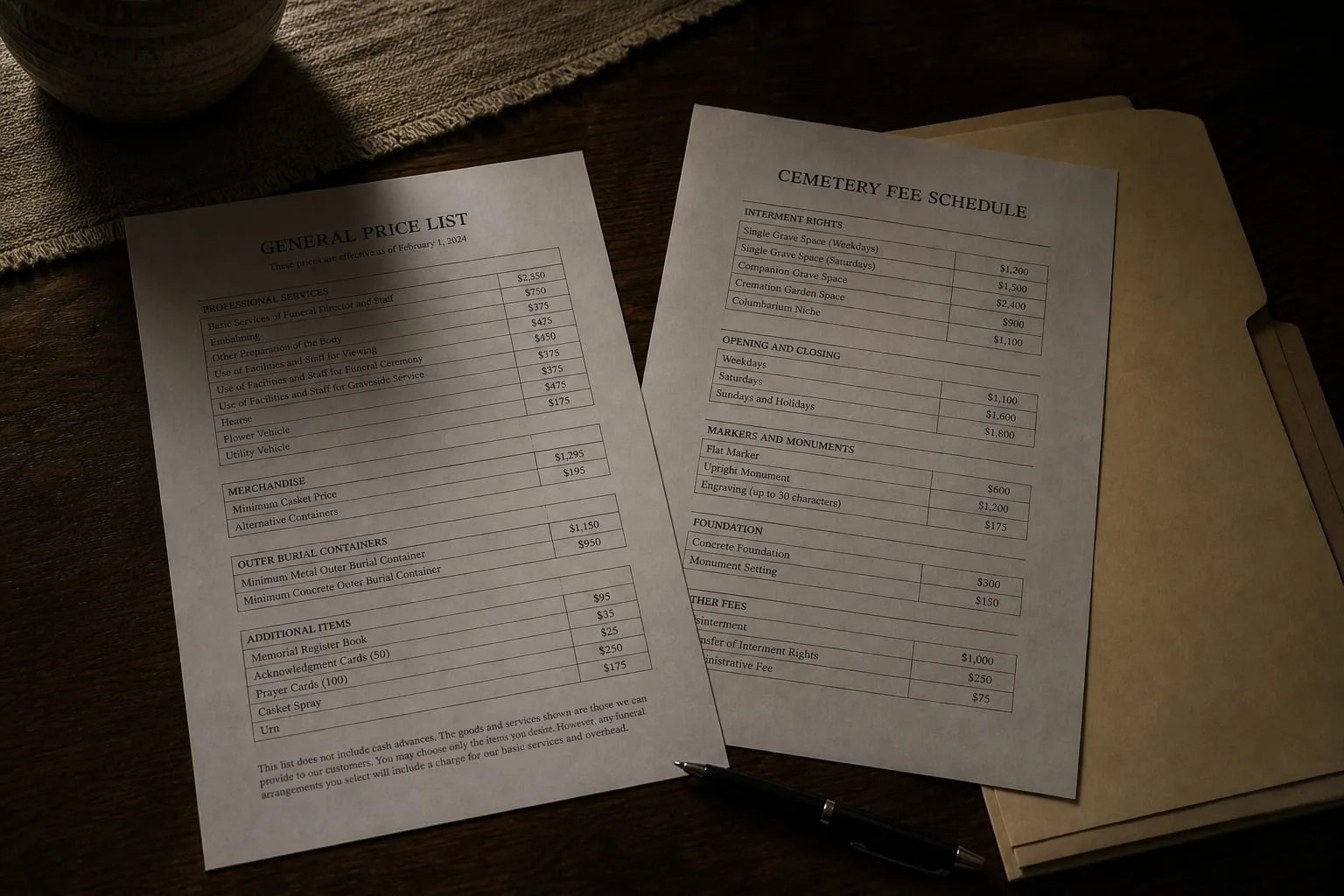
The itemized price list you are handed at a funeral home is not a menu of suggestions, and it is not a single quoted figure either. It is a legally structured document in which exactly one charge is non-declinable and the rest are separate goods and services you may accept or refuse line by line. Families rarely read it that way, partly because of the circumstances and partly because the totals are presented as a package. The more useful habit is to read it twice: once for what you are buying this week, and once for what will still be sending you invoices in twenty years.
1. The basic services fee, the only line you cannot decline
Federal rules on funeral pricing, overseen by the Federal Trade Commission, allow a funeral home to charge one non-declinable fee covering its overhead: staff availability, planning, permit filing, coordination with the cemetery or crematory, and holding the remains. That fee appears whether you choose a full service with a viewing or a direct cremation, and it varies enormously between neighboring firms in the same metropolitan area. Everything else on the list must be priced individually so that you can compare and decline. Where state law diverges is in whether a licensed funeral director must be involved at all. Several states allow a family to file the death certificate and transport permits themselves, which removes that fee from the arithmetic entirely; others make director involvement mandatory, and the fee is simply the price of entry.
2. Embalming, which almost no state actually requires
Embalming is treated as routine in much of the country and required almost nowhere as a blanket rule. What state law typically does instead is set triggers: a delay of a certain number of hours or days before disposition, transport by common carrier, transport across state lines in some jurisdictions, or a public viewing with the casket open. Refrigeration is the alternative, and its availability is a local question rather than a legal one, since not every small-market funeral home has the capacity. A funeral home may also set its own policy for a viewing it hosts, which is permitted, and the honest version of that conversation is a firm telling you plainly that the requirement is theirs and not the state's. Ask which it is. The answer changes what you owe.
3. Containers, and the difference between the casket and the box around it
Two separate charges hide here, and they answer to two different rulebooks. The casket or the alternative cremation container is governed by the federal pricing rules, which mean a funeral home has to show you what it has, cannot require you to buy a casket for a direct cremation, and cannot add a handling fee if you buy one elsewhere and have it delivered. The outer burial container, the vault or grave liner, is a cemetery matter. State law rarely mandates one; individual cemeteries frequently do, because a settling grave complicates mowing and creates a hazard, and in regions with heavy freeze and thaw cycles that policy is close to universal. The distinction matters because a vault required by a cemetery is a real obligation you can price, shop, and reduce, not a legal minimum.
4. Cash advances, third-party charges, and the fees set at the county window
The middle of most price lists is a set of items the funeral home buys on your behalf: certified copies of the death certificate, the burial or cremation permit, clergy or celebrant honoraria, obituary placement, flowers, and the cemetery's charge for opening and closing the grave. Federal rules require disclosure when the firm marks these up or receives a rebate, which is worth reading for rather than assuming. The underlying prices are intensely local. Certified copy fees are set by a state registrar or county recorder and differ by tens of dollars across a state line. Cremation authorization can carry a mandatory waiting period and, in some counties, a medical examiner sign-off with its own fee. Grave opening costs often rise in winter in frost regions, and some cemeteries charge more for a weekend interment. All of it is checkable by phone before you commit.
5. The lines that keep billing after everyone has gone home
This is the part that gets signed for quickly and paid for over decades. Most states require a cemetery to set aside a percentage of each plot and marker sale into an endowment or perpetual care fund, and the required percentage is written into state law rather than chosen by the cemetery. That fund is supposed to cover mowing, road repair, and general grounds upkeep in perpetuity, and where the requirement is robust and the cemetery is well managed, it does. Where it does not stretch far enough, the gap shows up as an annual care assessment, a charge for a foundation under a monument, a fee to reset a leaning stone, or a mausoleum maintenance billing that arrives long after the family assumed the account was closed. Ownership structure predicts a great deal of this. A municipal cemetery, a religious one, a nonprofit association, and a for-profit operator sit under different state oversight and different rules about what they may charge an existing plot holder later.
The practical step is to ask for the cemetery's rules and its fee schedule in writing, alongside the funeral home's price list, and to read the two together. The questions that pay for themselves are narrow. Is perpetual care included in the plot price or billed separately, and if separately, can the rate change? Who is responsible for cleaning and repairing the marker, and who decides when that work is needed? What happens if a monument settles, and does the cemetery bill the family or absorb it? Written answers to those four questions are ordinary requests that any well-run cemetery office fields regularly, and having them in a folder converts a vague future obligation into a known one.
The comparison worth running before you sign
Set two versions of the same arrangement side by side on paper. The first is the package as presented, with the non-declinable fee, embalming, a mid-range casket, a vault, and the cemetery's standard charges. The second keeps the non-declinable fee, substitutes refrigeration where the timeline allows it, uses a casket you sourced yourself, meets the cemetery's actual written container requirement rather than a default, and prices the death certificate copies at the county rate you confirmed. The difference between those two columns is not a matter of doing less for the person who died. It is the difference between charges required by law, charges required by a specific cemetery, and charges that were simply on the list because nobody asked.
Funeral pricing rewards the same habit that good property maintenance does, which is knowing what an obligation asks of you after the transaction closes. A plot bought with the endowment care structure understood, a marker whose repair responsibility is written down, and a permit fee schedule you checked yourself all behave predictably for the rest of the family's involvement with that cemetery. That is a reasonable thing to secure in a single afternoon of phone calls and one file folder.