Innovation
Same Breach, Two States, Two Letters. What the Difference Actually Tells You
Breach notification law grew state by state, and the letter you get depends on where you live, how many people were affected, and what field was exposed.
Rafael Quintanilla|
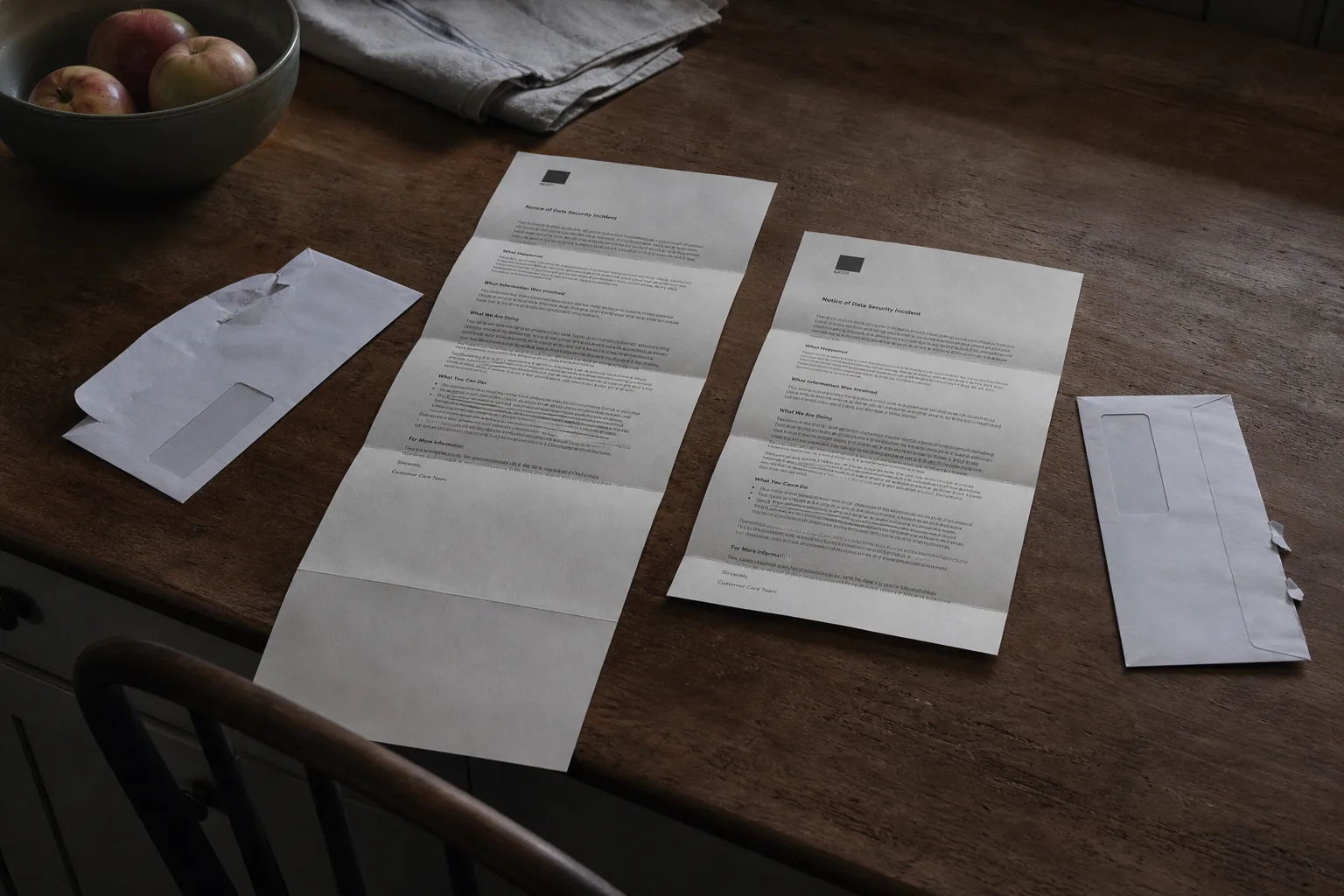
Two people open an envelope from the same company on the same week. One letter runs a page and a half, names the specific fields exposed, offers credit monitoring, and says the state attorney general has been notified. The other runs four paragraphs, says only that an unauthorized party accessed certain systems, and offers nothing. Same incident, same database, two different letters. The difference is not corporate stinginess, and it is rarely a drafting accident. It is a function of which state each reader lives in, and how many other residents of that state were in the same file.
The law grew one state at a time, and it never stopped being a patchwork
There is no single general federal statute telling a retailer or a payroll vendor what to do when a database leaks. What exists instead is a sectoral layer, rules for health information and rules for financial institutions, sitting on top of a state-by-state layer that began in California in the early 2000s and spread outward as other legislatures copied, amended, and tightened the model. Every state eventually passed something. None of them passed the same thing. The result is a body of law that reads less like a code and more like fifty parallel drafts of one good idea.
That history explains the shape of what you receive. A company facing a breach does not write one letter and mail it. It maps its affected records against the residency of each person in them, then applies the strictest applicable requirement to each group, which is why your neighbor two states away can get a materially different document describing the identical event. The Federal Trade Commission oversees data security practices at most consumer-facing companies and enforces against unfair or deceptive handling of personal information, but the notice letter itself is usually a state-law artifact.
Where the headcount changes who else finds out
The answer for one affected resident is not the answer for twenty thousand, and the thresholds in between are written into statute rather than left to judgment. Below a certain number of affected residents, many states require only that the individuals themselves be told. Above it, the company also has to notify the state attorney general, and often the major consumer reporting agencies, which is what makes a breach visible to anyone outside the mailing list. Cross a higher line still and substitute notice becomes available: a website posting and a press release, used when individual mail is impractical.
This matters to you as a reader of your own letter, because the presence of certain sentences tells you roughly how large the incident was. A notice that mentions the attorney general, or that references nationwide credit reporting agencies, is a notice from a breach that cleared a statutory threshold somewhere. A notice that mentions none of them is either a smaller event or an event that stayed small in your particular state. Neither tells you how badly your own record was exposed, but both tell you how much external scrutiny is already attached.
What counts as personal information, and what quietly does not
States disagree about the trigger itself. Nearly all of them treat a name combined with a Social Security number, a driver's license number, or a financial account number with its access code as the core category. Beyond that core, the coverage fans out. Some states added health insurance identifiers and medical information. Some added biometric data, some added usernames with passwords or security questions, and some added passport numbers or taxpayer identification numbers as separate listed fields. A breach that exposes only an email address and a password may require notice in one state and none at all in another.
Two further mechanics narrow things. Most states carry an encryption safe harbor, so data that was encrypted, with the key uncompromised, generally does not trigger a notification obligation at all. And many states allow a risk-of-harm analysis, meaning the company may conclude after investigation that misuse is not reasonably likely and decline to notify, sometimes with a written determination filed with the state. A handful of states removed that discretion and require notice regardless. Knowing your state sits in the stricter camp tells you that silence from a company is more likely to mean nothing happened.
The clock, and whose clock it is
Deadlines are the clearest place the patchwork shows. Some states require notice without unreasonable delay and leave it there. Others attach a hard outer limit measured in days from discovery, and those limits are not uniform. Several require the attorney general notice on a shorter clock than the consumer notice, which is why regulators sometimes know before the mailing lands. Law enforcement delay provisions exist nearly everywhere, allowing a company to hold notice while an active investigation runs, and a letter that arrives months after an incident date often reflects exactly that, not negligence.
The rule that applies is set by your residency, not by where the company is headquartered or where the server sat. A vendor in one state that holds records for residents of thirty states owes thirty separate compliance analyses on the same set of facts. That is the scale problem these statutes were built around, and it is why large breaches are handled by specialist counsel from the first hour. For you, it has one practical consequence worth remembering: your rights come from your own state's statute, and your attorney general's office is the body that enforces it on your behalf.
Read the letter for its mechanics rather than its tone. The fields named, the mention of a regulator, the presence or absence of a monitoring offer, and the gap between the incident date and the postmark each reflect a specific legal threshold that was either crossed or not. Once you can see which ones were crossed, a vague letter stops being vague.