Law & Legal
Same Facts, Different County. What to Assemble Before a First Legal Meeting
The paperwork that makes a first legal consultation productive is mostly the same everywhere, except for the pieces your state and county quietly decide for you.
Theodore Kranz|
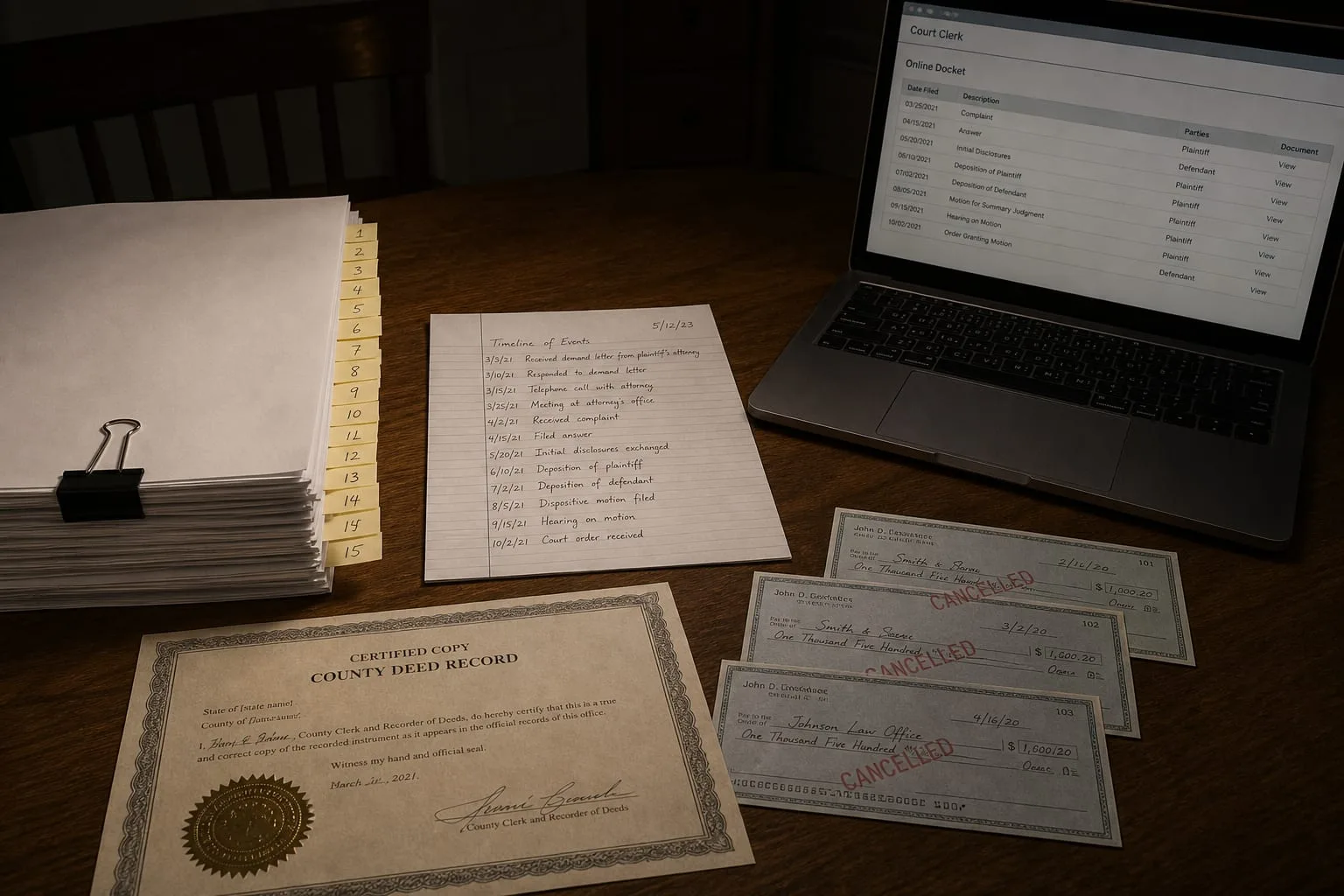
An attorney who spends the first thirty minutes of a consultation asking what happened, in what order, and whether you have anything in writing is not wasting your money on purpose. They are doing reconstruction work you could have done for free at your kitchen table. The difference between a meeting that ends in an actual plan and one that ends in a request for documents is almost entirely front-loaded, and most of it is clerical. What changes from place to place is not the discipline but the specifics: which office holds the record, how long you have, and which form the state requires before anything else moves.
Three piles, assembled before you look up a single rule
Nearly every matter that walks into a first meeting rests on the same three categories, and sorting into them takes an evening. The first pile is anything signed: the lease, the purchase agreement, the employment offer, the contractor's proposal, the arbitration addendum nobody read. The second is anything dated that shows movement: emails, texts, voicemail transcriptions, certified mail receipts, photographs with metadata intact. The third is money, meaning canceled checks, card statements, invoices, and the ledger of what was paid against what was promised. Attorneys triage in roughly that order, because a signature sets the rules, a date sets the clock, and a dollar figure sets whether the matter is worth pursuing at all.
Resist the urge to edit. The document you consider embarrassing or off-point is frequently the one that decides the question, and an attorney reading a curated file is reading a file with a hole in it. Bring the full text thread, not the four messages you screenshotted. Bring the second estimate you did not accept. If something is missing because it never existed, say so plainly, since the absence of a written change order is itself a fact with consequences.
The timeline is the tool, and it does more work than the folder
Build a single page, dated entries in chronological order, one line each, with a reference to the document that proves the entry. First contact, first payment, first complaint, first written complaint, first response, work stoppage, last communication. Keep opinion out of it. This page is the most valuable object you can carry into a consultation, because the entire preliminary analysis of your matter runs through dates, and an attorney who can see the sequence at a glance can tell you in ten minutes whether you have a live claim or an expired one.
Deadlines are where the geography starts to bite. Statutes of limitations are set state by state, and the same dispute can carry a two-year window in one state and a six-year window across the border, with separate and often shorter clocks for claims against a city, a county, or a school district. Construction defect matters add a statute of repose that runs from substantial completion rather than from discovery. Your timeline is what lets counsel find the applicable clock quickly, and finding it early is the single best return on preparation.
Copies from the office that holds them, not from your drawer
For anything touching real property, a business entity, a marriage, a death, or a court file, the version in your filing cabinet is a convenience copy and the version at the government office is the record. Deeds, mortgages, mechanic's liens, easements and plats sit with the county recorder or register of deeds, usually searchable online for recent decades and only on-site for older instruments. Business filings and registered agent information sit with the secretary of state. Vital records sit with the state or county health department, and certified copies carry a fee and sometimes a waiting period. Existing court files sit with the clerk, and many counties now publish dockets through a portal.
Order the certified versions early, because processing time is the variable you cannot compress later. Fees range from a few dollars a page to a flat charge per document, and some counties still require a written request by mail. Where a notarized signature is needed, check whether your state authorizes remote online notarization, since that alone can turn a two-day errand into a twenty-minute video call. The Federal Trade Commission, which is responsible for consumer protection enforcement, is also a useful stop when the dispute involves a seller or a lender, because a complaint you filed leaves a dated record you can hand over.
Where the local rule changes what you need to bring
Some paperwork exists only because of where you live. In community property states, a spouse's financial records enter the picture in matters that would be individual elsewhere. In family law, many counties require a sworn financial disclosure on a local form before a first hearing, and filling it out early forces you to gather statements you would otherwise gather twice. Landlord and tenant disputes turn on municipal ordinances layered over state law, including notice-and-cure periods, rent escrow rules, and registration requirements for the unit itself. Employment matters vary on whether a state recognizes exceptions to at-will employment, and on whether a mandatory administrative filing precedes any lawsuit.
The practical move is to ask, when you book the appointment, whether the firm has an intake sheet or document checklist for your county and matter type. Most do, and it is tailored in exactly the places that matter: which local form, which office, which deadline. Ask also whether the court in question requires e-filing through a specific portal and whether documents need to be submitted as searchable PDFs, because that answer changes how you should scan everything rather than how you should file it.
Handing it over so it can actually be used
Deliver the file in a form someone else can navigate. Number the pages continuously, name each digital file with a date first and a short description second, and put your one-page timeline on top with cross-references to those page numbers. Send it through whatever secure portal the firm offers rather than as a chain of email attachments. Write down your three questions and the outcome you want, in one sentence, and put that page above the timeline. Then let the attorney read for the first few minutes without narration.
Preparation of this kind has a second payoff that shows up months later. The same numbered file and dated chronology that made the first hour efficient becomes the exhibit list, the demand letter attachment, and the answer to every follow-up request, which is why the evening spent sorting piles tends to be the cheapest hour anyone bills on the matter.