Family
Signed the Funeral Contract in a Day? The Bills That Keep Arriving All Year
Most funeral spending is decided in about forty-eight hours and paid off across the following year, and the items that scale with headcount are the ones worth slowing down for.
Rafael Quintanilla|
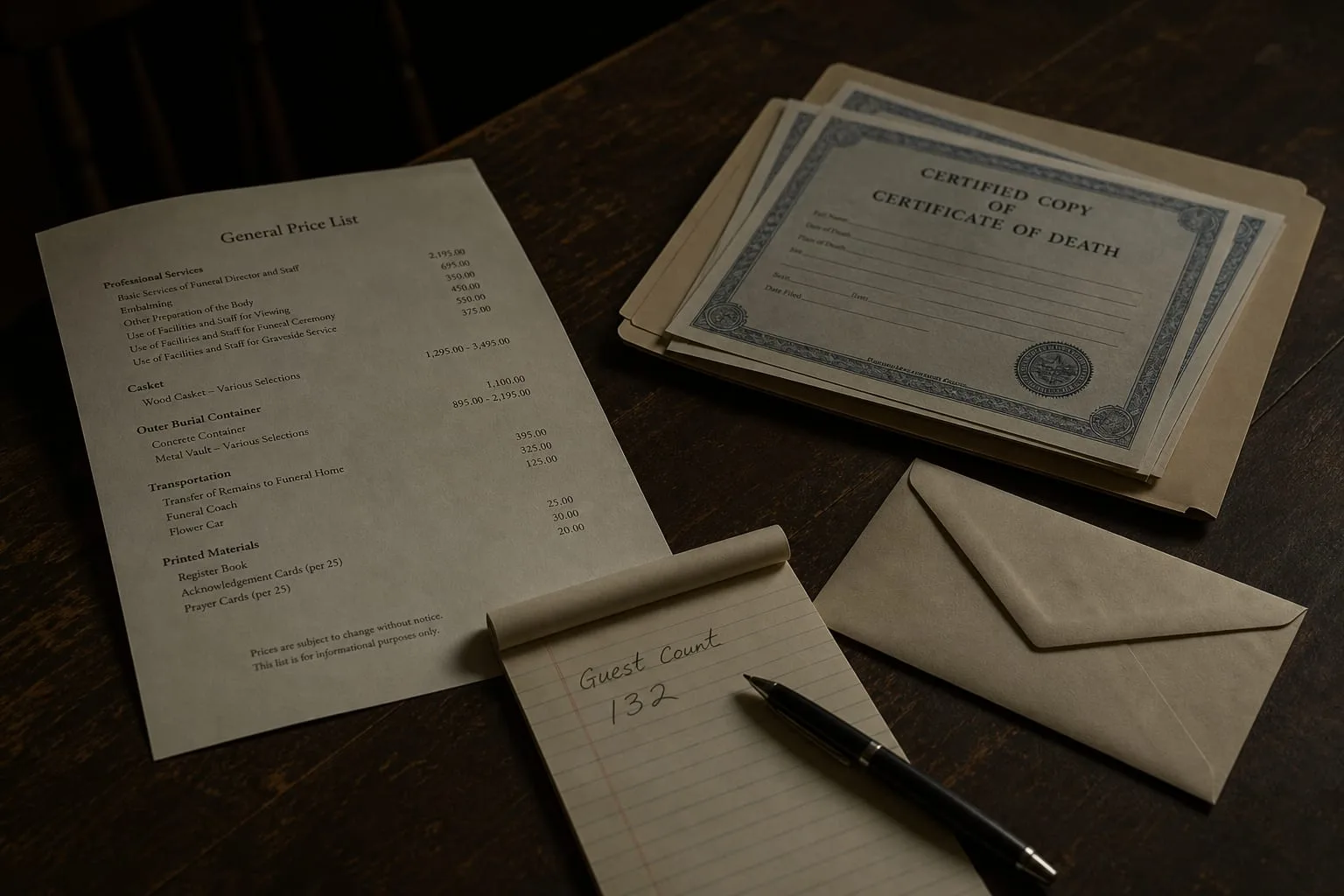
The decision window for a funeral is roughly two days long. The payment window is closer to a year. That mismatch is the single most expensive feature of the whole arrangement, and almost nobody sees it while it is happening, because the conference room where the selections are made is organized around one signature and one total, while the consequences arrive in the ordinary rhythm of a household: a statement in the middle of the month, a request from a bank for a document nobody ordered enough copies of, an invoice for engraving that shows up in March for a service held in November.
What makes this worth arguing about is not that funeral homes are doing anything improper. The itemized price list exists precisely so a family can pull the package apart, and the Federal Trade Commission is the agency responsible for the rule that requires funeral providers to give you those prices item by item and to let you buy only what you want. The problem is structural. A total presented once, in a room, at the worst moment of a family's year, hides which line items are fixed, which scale with the number of people involved, and which were never required by anyone.
The costs that do not move, and the ones that multiply
Split the bill in two and it becomes far easier to reason about. On one side sit the costs that exist once regardless of how many people show up: transfer of the body, refrigeration or embalming, the container, the professional fee for coordinating the arrangements, the cemetery's opening and closing charge, the permit filings. Twenty mourners or two hundred, those numbers barely flinch. On the other side sit the costs that are quietly multiplied by headcount, and this is where families who assumed they were buying one thing discover they bought a hundred and forty of something.
Catering is the obvious one, but it is not the one that surprises people. Printed programs and prayer cards are priced in tiers, and the tier boundaries rarely fall where you expect, so ordering a hundred and ten of something can cost meaningfully more per unit than ordering a hundred, or meaningfully less than ordering ninety, depending on where the printer's break points are. Limousines and family cars are sold by the vehicle, not the seat, so the eleventh passenger sometimes costs more than the first ten combined. Flowers scale linearly and stop mattering within four days.
The reason this matters more than the headline package price is that the multiplied items are the ones a family adds late, after the contract is signed, in a series of small phone calls where nothing is itemized and no total is restated. Each addition feels like a rounding error against a number already agreed. Cumulatively they are often the difference between a bill the estate absorbs and a bill somebody's credit card carries into the following summer. Deciding the guest count before deciding anything else reverses that order, and it costs nothing to do.
Where the per-person answer flips
There is a threshold, and it sits lower than most families guess. Below roughly thirty or forty attendees, the venue is usually not the constraint and the catering can be handled by people who loved the deceased, which means the marginal cost of one more mourner is close to a plate of food. Above that, you cross into rented chairs, a larger room, a longer visitation window, parking attendants, sometimes a second location entirely, and the marginal cost of the next guest jumps by a factor that has nothing to do with food. The curve is a step, not a slope.
Knowing where the step is changes what you are actually choosing between. A family weighing a hundred-person service against a forty-person service is not weighing sixty plates. It is weighing an entire tier of infrastructure, and the honest version of that conversation is worth having out loud, because the answer is frequently to hold a small, immediate service for the people who must be there and a larger gathering weeks later, at a park, a church hall, or a house, where the same hundred people come and the funeral home is not part of the arithmetic at all.
That split is not a compromise. It is often the better memorial, because the relatives who need three connecting flights get to arrive without paying for same-week fares, the eulogies get written rather than improvised, and the household doing the arranging gets to sleep in between. The savings are real and the second event is genuinely elective, which means it can be scaled to whatever the family can comfortably fund once the estate picture is clear rather than while it is still a guess.
The paperwork that scales, and undercounting it
Certified copies of the death certificate are the most underestimated line on the entire bill, not because they are expensive individually but because the number needed is set by institutions, not by the family. A bank wants one for each account. A life insurer wants one. The pension administrator wants one. The auto title transfer wants one, the brokerage wants one, the mortgage servicer wants one, and several of them will not return the copy they were sent. Ordering six because six sounds like plenty produces a spring of small delays.
That is where the week-to-week reality shows up most clearly. A missing certified copy does not cost much in dollars. It costs a phone call, a wait, a form, and three weeks during which an account stays frozen and an automatic payment fails, which produces a late fee, which produces a letter, which produces another phone call. Ordering fifteen up front, at the point where the vital records office is already producing them, is the cheapest insurance available anywhere in this process, and it is one of the few decisions here that is purely additive and impossible to regret.
Optional, required, and required by somebody other than the funeral home
The most useful question a family can ask about any line item is not whether it is required but who requires it, because the answer is almost never the funeral home. Embalming is generally not mandated by state law for a burial happening promptly, though refrigeration is the practical alternative and it is billed per day, which means the cost of waiting for out-of-state relatives is knowable in advance rather than discovered later. A public viewing with an open casket is where embalming becomes a real requirement, and that requirement usually belongs to the provider's own policy.
Similarly, the outer burial container is rarely a legal obligation and frequently a cemetery obligation, written into the rules that govern that specific ground, because the cemetery is protecting itself against settling. Vaults, liners, minimum monument dimensions, permitted materials, perpetual care contributions: those come from the cemetery's rulebook, and asking for it in writing settles a dozen questions in one document. Once you know which requirements come from the state, which from the cemetery, and which from the provider, the genuinely optional list becomes short and clear, and every item on it can be declined without argument.
Rushing does not save a family anything except the discomfort of a two-day pause. What the pause buys is the itemized list read line by line, a headcount decided before a venue, fifteen certified copies instead of six, and a clear-eyed sense of which charges answer to a law, which answer to a cemetery, and which answer only to a catalog. Those four moves take an afternoon. They are still paying dividends in the following July, when the statements have stopped arriving and nobody is calling a bank about a document that was never ordered.