Family
Who Actually Sets the Stone, and Why That Answer Shapes Every Irreversible Choice
A memorial involves more parties than the family and the dealer, and the ones nobody names in the contract decide which choices can still be revisited years later.
Theodore Kranz|
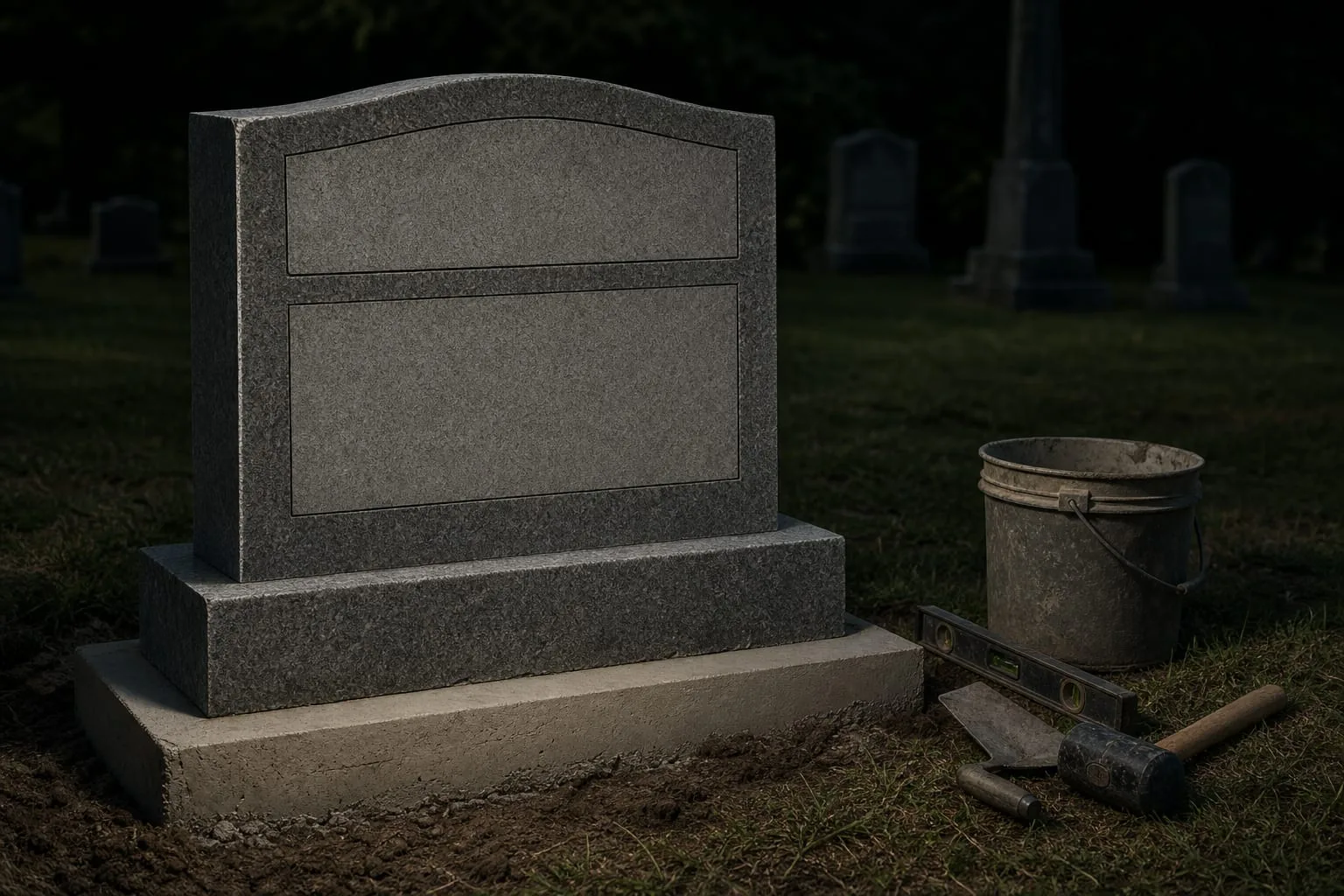
Families sitting down to order a memorial usually understand the transaction as a two-party affair: themselves on one side, the monument dealer with the catalog on the other. That framing is the source of most of the surprises that arrive later, because at least two other parties have already constrained the choice and a third will inherit the consequences. The foundation crew, the quarry, the cemetery office and the person who will one day want a second name cut into the same stone all have standing in this decision, and none of them is in the room. Knowing what each of them controls is what turns a purchase into a judgement.
The name on the invoice is rarely the hand on the stone
A monument dealer sells, designs and warrants. In a large share of cases the dealer does not quarry the granite, does not run the sandblast or laser engraving, and does not pour the concrete the stone will sit on. Those are separate trades, sometimes separate companies in separate states, and the cemetery itself often reserves the foundation work for its own crew at a published rate. Ask directly who performs each step, because the answer determines whom you call when the stone settles unevenly, and whether that call goes to the dealer, the cemetery office, or someone who considers the matter closed.
This matters more than it sounds, since responsibility for a memorial splits along lines the paperwork rarely draws clearly. A dealer's warranty typically covers the granite and the workmanship of the lettering. Settling, heaving and frost movement trace back to the foundation, which the cemetery may have installed under its own separate agreement, with its own separate remedy or none at all. The useful move is to get both scopes described in writing, side by side, before signing anything: what the dealer stands behind, what the cemetery stands behind, and the narrow strip of ground between the two where neither does.
The foundation is poured once, and it fixes the size for good
Concrete is the least reversible element in the whole arrangement. A foundation is sized to the base of the monument you ordered, poured to the cemetery's specification for depth and reinforcement, and once cured it defines the footprint available on that grave for as long as the memorial stands. Families who later decide they want a wider companion stone, an added vase, or a flush border discover that the existing pour cannot simply be extended; it has to be broken out and replaced, at a cost that usually exceeds what the larger foundation would have cost at the outset.
The judgement here is not aesthetic, it is anticipatory. Consider whether a second interment is likely in that space, whether the family tends to add markers over decades, and whether the plot is a single or a double. Then size the foundation for the largest memorial the cemetery's rules would ever permit on that lot, even if the stone you set today is smaller. Cemeteries that allow this treat the extra concrete as a modest line item, and it buys a genuine option: the ability to change your mind twenty years from now without demolition.
The party who will need room for one more name
Every memorial has an eventual second customer, and it is almost never the person signing the order. It is a surviving spouse, an adult child, or a grandchild who will approach the same stone with a new date, a new name, or a request to correct something. Whether that person has an easy afternoon or an expensive problem was decided at the design stage, by how much uncarved surface was left, whether the layout is centered or offset, and whether the lettering style used today is one an engraver can still match in three decades.
Practical design choices follow from taking that future party seriously. Leave deliberate blank area low on the face rather than centering everything for present-day symmetry. Record the exact font, the letter height, the finish and the quarry name in a document the family keeps, not just in the dealer's file, because dealers close, merge and lose archives. Ask whether the stone can be lettered in place or must be removed to the shop, since in-place engraving is far cheaper and some finishes and mounting methods rule it out entirely.
There is a legal counterpart to this. The holder of the interment rights, not the buyer of the stone, is who the cemetery will recognize when the next change is requested, and those two are often different people. Confirming in writing who holds the rights, and how that holding passes on, costs nothing now and prevents a genuine standoff later, when a cemetery declines to authorize work because the person asking cannot show standing. Families that sort this out at the same sitting as the memorial order tend never to think about it again.
Granite comes from somewhere, and that somewhere can close
Color is treated as a taste question and is really a supply question. Granite is quarried in specific places, and a given color is a specific deposit with a finite working life, periodic pricing swings and occasional interruptions. If a family expects to match this stone later, either for a companion marker or for a repair, the color and the quarry designation matter as much as the shape. Some colors are quarried in volume and will be available for a very long time. Others are boutique, imported, or approaching the end of a seam, and matching them in fifteen years may be impossible at any price.
So ask the dealer, plainly, how long the color has been in production and whether it is currently in steady supply. Ask for the trade name and the source region on the invoice. Then decide with open eyes: a distinctive color chosen for one stone that will never need a mate is a fine choice, while the same color chosen for the first of an eventual pair is a bet on a quarry. Where matching matters, the widely quarried grays and reds are the conservative answer, and conservative is worth something here.
Building the judgement, in the order that actually works
Sequence the inquiry from least reversible to most. Start with the cemetery's written rules and the interment rights, since those set the outer boundary. Move to the foundation size and who pours it, because concrete is permanent. Then granite color and quarry, then the layout and reserved space for future names, and only then the ornament, the emblems and the wording. Reading the catalog first inverts this and produces designs the cemetery will not accept.
Insist on itemization at every step. The Federal Trade Commission is the agency responsible for disclosure practices in the sale of funeral goods and services, and its expectations have made itemized pricing routine on the funeral home side of the ledger. Cemeteries and monument dealers operate under a patchwork of state rules rather than that single federal frame, which simply means the itemized breakdown is something you request rather than something you receive automatically. Most reputable dealers produce it readily, and the request itself tends to sharpen the conversation considerably.
The families who look back on this purchase without regret are rarely the ones who agonized longest over the design. They are the ones who asked who pours, who cuts, who quarries and who holds the rights, then made the permanent decisions generously and the cosmetic ones last.